

Gel and gel bead ice packs can both work well, but they solve different product-design problems. A smooth gel pack is usually selected when a buyer wants a continuous fill, a flatter surface, and controllable fill distribution. A gel bead pack is often considered when visible texture, tactile movement, or close conformity around a shaped product is part of the brief. Neither format is automatically colder, safer, more flexible, or longer-lasting.
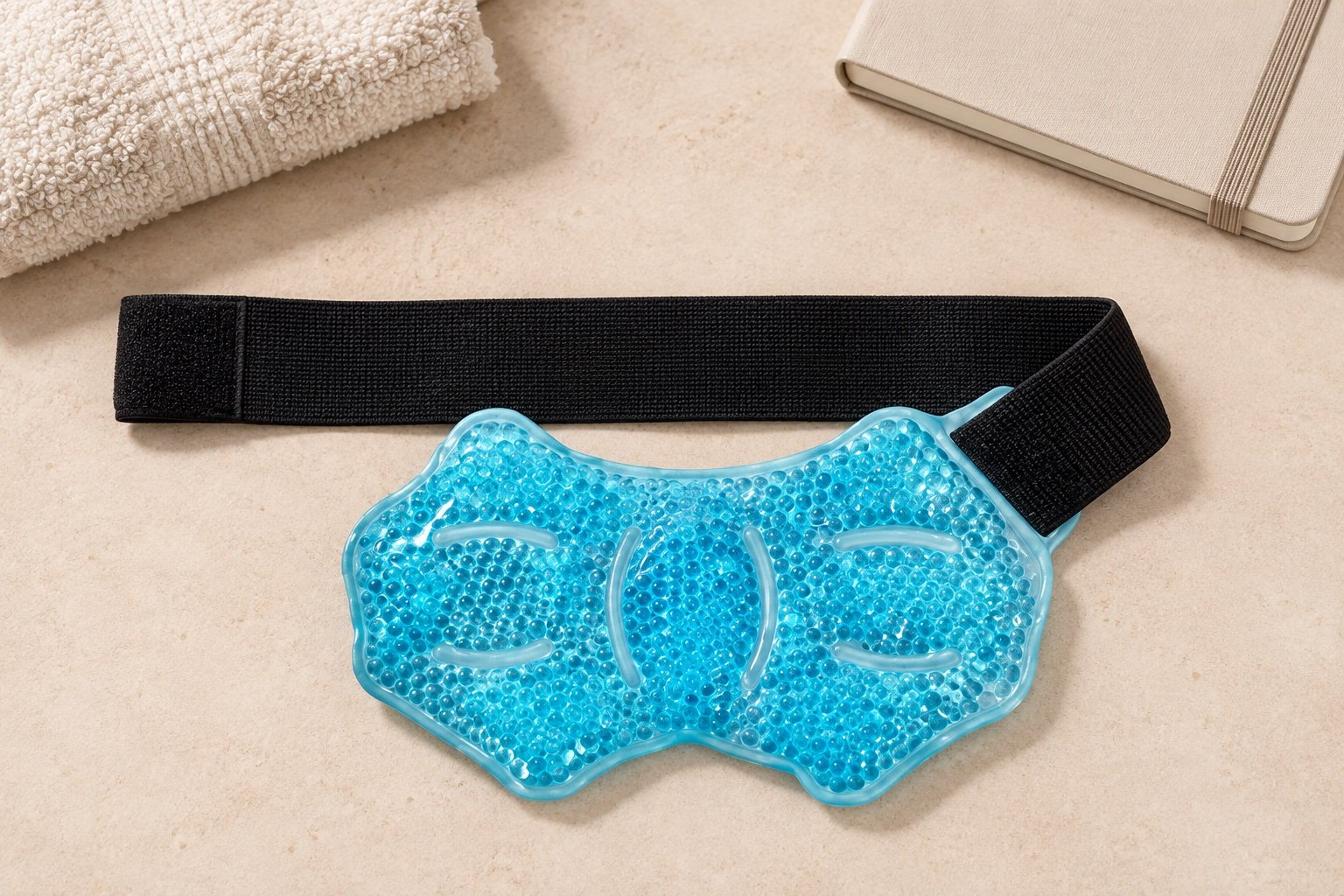
Start a catalog shortlist with the rectangular gel pack and round gel-bead pack. Their different shapes and sizes are not a matched performance comparison; use the trial criteria below.
For B2B buyers, the useful comparison is not “which filling is best?” It is “which finished construction meets our approved use case under a repeatable test?” Formulation, fill mass, shell film, chamber pattern, conditioning method, surface layers, and product geometry can change the result more than the words gel or gel beads on a quote.
On this page
Gel vs. gel bead ice packs: the short answer
| Buyer question | Smooth gel pack | Gel bead pack | What still needs validation |
|---|---|---|---|
| How does the fill move? | Moves as a continuous viscous mass | Moves as many discrete beads, often with liquid around them | Fill ratio, viscosity, bead size, temperature, and chamber layout |
| How does it feel? | Usually presents a smoother, more uniform surface | Creates a textured, mobile feel that can be visible through clear film | Actual surface layers, backing, pressure, and conditioned sample |
| Which is more flexible? | Depends on the formula and conditioning temperature | Depends on bead formulation, surrounding liquid, and construction | Bend and conformity checks at the intended use temperature |
| Which stays cold longer? | The filling name alone cannot answer this | Compare equivalent mass, starting temperature, ambient conditions, load, and end point | |
| Which is easier to customize? | Both can support custom shapes and branding when the materials and process are compatible | Artwork, seams, corners, fill port, dimensions, packaging, and approved sample | |
This comparison intentionally avoids universal performance numbers. Cryozin’s guide to ice-pack cooling duration explains why starting temperature, total thermal mass, construction, test load, and environment must be controlled before two samples can be compared fairly.
What is a smooth gel ice pack?
A smooth gel ice pack contains a continuous thickened fill inside a sealed flexible pouch. The precise ingredients and filling system inside an ice pack vary by formula, so a generic product name does not establish freezing behavior, viscosity, safety, or heating suitability. The finished pack may be transparent, colored, printed, wrapped in fabric, or divided into chambers.
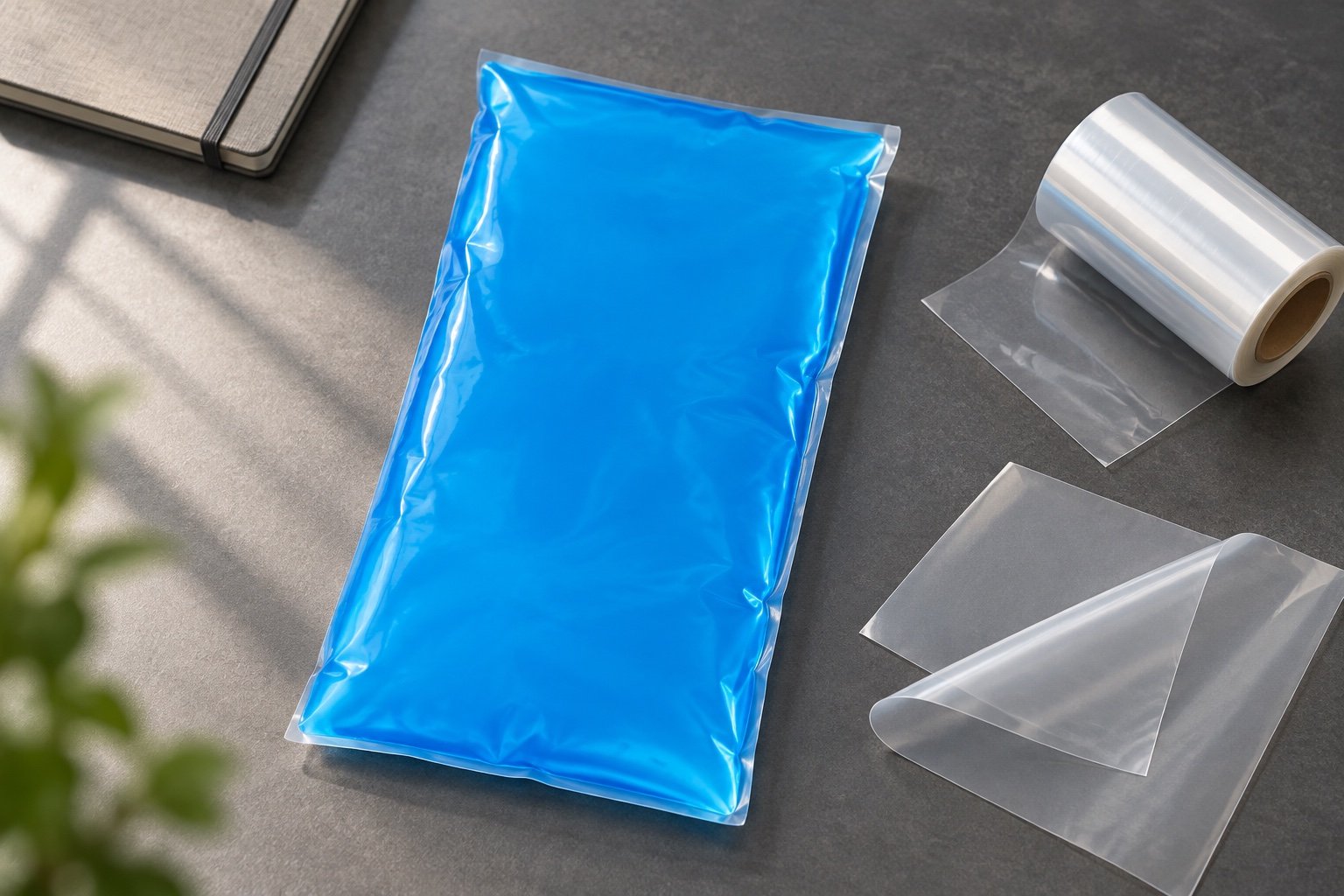
Smooth gel can suit a flat rectangular pack, a larger wrap insert, or a product where the buyer wants a relatively even visual surface. It can also migrate within a large pouch. If consistent coverage matters, the designer may need a controlled fill ratio, a chamber pattern, or a textile system that holds the pack in position.
Do not infer low-temperature flexibility from appearance. A formula that feels fluid at room temperature may become much firmer after conditioning. Buyers should review the variables described in Cryozin’s article on flexible gel ice packs after freezing and test the finished sample at the intended set point.
What is a gel bead ice pack?
A gel bead pack contains many rounded or shaped gel units inside a pouch, commonly with some mobile liquid phase. Bead diameter, uniformity, free liquid, total fill, pouch thickness, and internal chambering influence how the product drapes and how the beads redistribute.

Gel beads can support a visible, tactile product concept, especially when clear windows or shaped masks are part of the design. They can also collect in the lowest area if the geometry and fill ratio allow excessive movement. For a face mask, joint wrap, or small shaped pack, check whether the beads remain distributed when the product is vertical, curved, folded, and conditioned.
“Gel bead” also does not prove that a product is suitable for microwave heating. Heat use requires a separately validated combination of fill, shell, seams, textile layers, dimensions, heating instructions, and warnings. A cold-only sample should never inherit a dual-use claim from a visually similar product.
Compare gel-bead product formats
Seven criteria that matter more than the filling label
1. Intended product format
Begin with the geometry and interface. A flat cooler insert, an eye mask, a shoulder wrap, and a handheld promotional shape impose different demands on fill movement, surface feel, sealing area, and loaded weight. Write the format and intended environment into the brief before discussing formula names.
2. Conditioned flexibility
Define the equipment and set point used to prepare the sample, the minimum conditioning time, and a measurable conformity check. “Stays soft when frozen” is too vague unless the team records the actual temperature and test method.
3. Fill distribution
Review the pack flat, vertical, curved, and inside its sleeve or wrap. Observe empty zones, pooling, bead migration, chamber-to-chamber imbalance, and whether the product returns to its intended shape after handling.
4. Thermal performance
Compare finished products at equal or commercially realistic fill mass. Record initial temperatures, sensor locations, ambient temperature and humidity, contact load, insulation layers, time intervals, and the agreed end point. A single “minutes cold” statement without these conditions is not a transferable specification.
5. Shell and seal compatibility
The fill must be evaluated with the exact film, ink, backing, weld geometry, and fill port. ASTM International’s ASTM F88/F88M describes seal-strength measurement for flexible barrier materials. It can inform a project test plan, but it does not create one universal pass value for every ice pack.
6. Visual and tactile acceptance
For transparent or translucent products, set limits for bead-size variation, bubbles, foreign matter, fill color, staining, haze, and distribution. For opaque packs, surface smoothness, lumps, edge feel, and appearance after conditioning may be more relevant.
7. Claims and target market
The intended use and marketing language affect the regulatory review. The U.S. Food and Drug Administration explains that intended use and indications are central to determining whether a product is a medical device. The Federal Trade Commission also says objective health and safety claims must be truthful, not misleading, and properly substantiated. A filling choice does not by itself support a pain-relief, treatment, child-safety, or “medical grade” claim.
Build a specification that a supplier can quote
| Specification field | What to state | What to approve |
|---|---|---|
| Fill family | Smooth gel or gel bead; formula or grade reference | Approved formulation ID and change-control rule |
| Fill amount | Nominal mass and allowed tolerance | Finished-pack weight records and distribution |
| Physical behavior | Target viscosity, bead size, or qualitative movement criterion | Conditioned sample and agreed test procedure |
| Construction | Film, backing, chamber map, seal width, corners, and fill port | Drawing plus sealed golden sample |
| Conditioning | Equipment, set point, duration, orientation, and starting state | Repeatable preparation instructions |
| Performance | Test load, sensors, ambient condition, sampling interval, and end point | Time-temperature record tied to the sample |
| Appearance | Color, transparency, bead uniformity, bubbles, print, and workmanship limits | Reference sample and inspection criteria |
| Documents | Target market, intended use, claims, labels, and required evidence | Current documents matched to the formula and finished item |
Use Cryozin’s custom ice-pack specification template to capture these fields without turning the first inquiry into a full engineering dossier.
How to compare gel and gel bead samples fairly
- Lock the variables. Use the intended dimensions, shell, total fill mass, backing, and chamber geometry. If two samples differ in several variables, do not attribute the result to the fill type alone.
- Condition them together. Record equipment, set point, duration, spacing, orientation, and starting temperature.
- Check handling first. Bend, drape, place vertically, and fit the product into its real sleeve or assembly.
- Run a thermal comparison. Use the same test surface, sensor locations, ambient condition, and end point.
- Inspect integrity. Examine seams, corners, fill port, surface film, print, backing, and any migration or staining after relevant handling.
- Repeat. One attractive sample is not evidence of production consistency. Agree on a sampling plan and repeat the critical checks after cycling or storage conditions relevant to the program.
The ice-pack sample approval checklist provides a broader golden-sample workflow. For production controls, connect the approved sample to Cryozin’s quality-control framework rather than relying on a filling description in the purchase order.
Documents to request without demanding a proprietary recipe
- Approved fill or formula identifier and revision
- Finished-product specification with nominal fill mass and tolerances
- Safety Data Sheet when applicable to the supplied chemical product or workplace handling
- Relevant composition, restricted-substance, or test declarations required by the target market
- Certificate of analysis or incoming specification where it is part of the agreed control plan
- Finished-product test report tied to the sample, method, and conditions
- Change-control requirement covering formula, bead source, film, and process changes
- Label, warnings, cleaning, storage, conditioning, and heating instructions appropriate to the approved use
OSHA’s Hazard Communication guidance explains the role of labels and Safety Data Sheets for hazardous chemicals in U.S. workplaces. Whether a particular finished article or formulation requires an SDS depends on its classification and supply context; an SDS should not be treated as a complete finished-product safety certificate.
Common sourcing mistakes
- Choosing by appearance alone: clear beads can look distinctive, but visual appeal does not establish thermal or mechanical performance.
- Comparing unequal samples: a heavier pack may appear to outperform a lighter one even when fill type is not the cause.
- Assuming all smooth gels freeze stiff: formulation and test temperature matter.
- Assuming all bead packs are microwaveable: dual-use suitability belongs to the complete validated construction and instructions.
- Approving loose fill instead of the product: the shell, seals, backing, geometry, and fill amount determine the actual user interface.
- Accepting generic documents: evidence should match the formula, finished configuration, manufacturing site, and target market in scope.
Frequently asked questions
Are gel bead ice packs always more flexible?
No. Their discrete filling can support close conformity, but flexibility still depends on bead formulation, surrounding liquid, fill ratio, shell, chambering, and conditioning temperature. Compare finished samples at the intended use condition.
Do smooth gel ice packs stay cold longer?
Not as a universal rule. Thermal mass, starting temperature, geometry, materials, contact, environment, and the selected end point all affect the result. Ask for an equivalent-condition comparison.
Can one pack be approved for both hot and cold use?
Only when the exact fill, shell, seals, textile layers, dimensions, heating method, conditioning method, warnings, and finished product have been reviewed for both modes. Do not transfer a heat-use claim from another model.
Which format is better for custom shapes?
Either may work. The answer depends on narrow points, sharp corners, internal openings, fill migration, seal area, print placement, and the desired tactile result. Review a drawing and a filled sample rather than choosing from the filling name.
Turn the comparison into an approvable sample
Cryozin can review a smooth-gel or gel-bead concept as part of a custom ice-pack project. Send the product format, dimensions, target fill mass, conditioning method, surface layers, intended market, artwork status, packaging plan, and estimated quantity through the Cryozin inquiry form. The practical next step is to compare two controlled constructions—not two vague filling labels.
Sources and further reading
- ASTM International: ASTM F88/F88M, Seal Strength of Flexible Barrier Materials
- U.S. Occupational Safety and Health Administration: Hazard Communication
- U.S. Food and Drug Administration: How to Determine if Your Product Is a Medical Device
- U.S. Federal Trade Commission: Health Products Compliance Guidance
Scene images are editorial concepts based on catalog references, not evidence of a factory, customer project, test or approved configuration. Catalog images illustrate visible product form only.
