
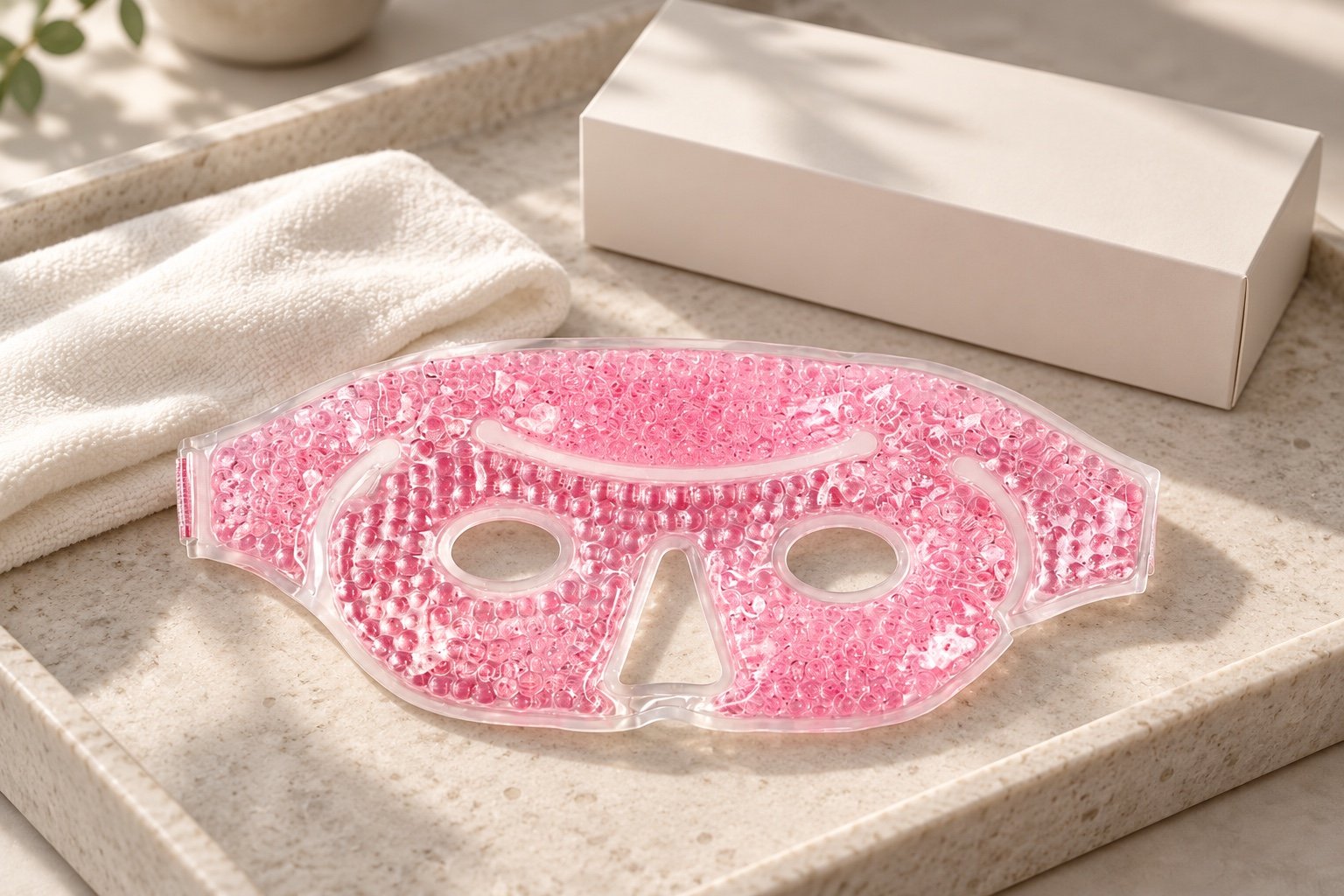
Cover image: AI-assisted editorial scene based on the catalog mask. The blank box is illustrative; no fit or performance test is shown.
A gel eye mask with eye holes leaves the eye openings uncovered while placing filled sections around them. A full-coverage design extends across that area. Choose between them by the coverage your product brief needs, then check the nose contour, opening positions, backing, and strap on the prepared sample. Eye holes alone do not establish a better fit, a medical benefit, or suitability for wearing the mask during other activities.
For a beauty brand, distributor, or retail buyer, this is a product-format decision before it is an artwork decision. Two masks with similar outside dimensions can cover different areas, fasten differently, and need different instructions. This guide helps buyers decide which format to sample and what to compare before requesting a production quotation.
On this page
Open-eye vs full-coverage gel masks at a glance
| Decision | Gel eye mask with eye holes | Full-coverage gel eye mask |
|---|---|---|
| Coverage brief | Filled sections around separate eye openings | A filled mask body extending across the eye area |
| Geometry to review | Eye-hole spacing, opening edges, brow and cheek sections, nose clearance | Nose contour, central coverage, outer edges and contact surface |
| Fit question | Do the openings align without pulling the mask out of position? | Does the mask sit as intended without unwanted folds or concentrated pressure? |
| Strap question | Does fastening move the openings or distort their edges? | Does fastening draw the body evenly toward its intended position? |
| Retail decision | Whether the opening layout solves the specified coverage need | Whether continuous coverage matches the intended product use |
Neither column is a performance ranking. A mask with openings is also different from a sleep mask with recessed cups, an under-eye cosmetic patch, or a disposable steam mask. If a supplier uses “eye mask” for several formats, identify the exact construction before comparing offers.
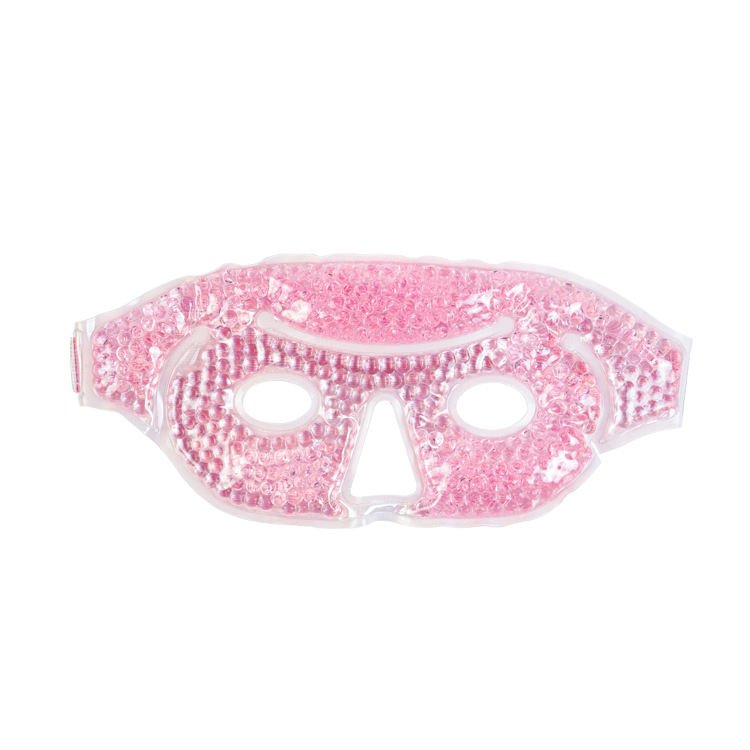
For visible examples, Cryozin’s open-eye gel-bead mask with a nose opening has separate openings in the mask body. Its gel-bead eye mask with a plush side and adjustable strap uses a full eye-covering format. The examples show different constructions; instructions and suitability must be established for each configuration.
Start with a coverage drawing, not the outside dimensions
Mark which areas the filled mask should cover and which should remain clear. On an open-eye design, record each opening’s dimensions and position relative to the centerline. Include the bridge between openings and the distance from the openings to the outside edge. On a full-coverage design, mark the nose contour and the intended central contact area.
Review the drawing with the filled sample. An empty outline cannot show how filling, a shaped border, or strap tension changes the final position. Use the custom ice pack size guide to keep overall dimensions, filled area, and sealed borders distinct.
A useful sample comparison changes one major variable at a time. If the opening layout, fill amount, backing, and strap all differ, the buyer cannot tell which change caused a fit difference. Record the actual configuration rather than treating one photograph as the specification.
Inspect opening edges and nose clearance together
For an open-eye mask, check where each opening edge sits when the mask is positioned and fastened as proposed. Look for twisting, a border rolling inward, or filling shifting into a section that changes the opening shape. Record the condition in which the observation was made.
Do the same for nose clearance. A large eye opening does not compensate for an unsuitable nose contour or a strap that pulls the whole mask downward. Ask for the proposed size range and the evidence behind it; do not approve “one size fits all” from a single model photograph.
For full-coverage samples, inspect how the center and outer edges sit together. A wider mask may add coverage but can also change where the fastening loads the body. There is no universal opening size, mask width, or strap tension that this article can prescribe for every product and user.
Treat the backing and strap as part of the finished mask
A plush reverse side, exposed film surface, or separate cover changes the finished construction. Confirm which surface is intended to face the user, whether it is permanently attached, and how it is cleaned. “Reversible” should describe an approved use configuration, not simply two different-looking surfaces.
Compare strap width, length, attachment points, closure overlap, and the handling sequence. Review whether the closure can be adjusted and released as intended. If the strap is elastic, define how the supplier measures it rather than comparing an unstretched length with another supplier’s extended measurement.
Gel type is a separate decision. Both an open-eye and a full-coverage mask can be offered with different filling structures. Use the existing gel vs gel-bead ice pack comparison for that question; choose the coverage layout here without assuming that bead filling guarantees flexibility or comfort.

Separate the format choice from heating and health claims
“Gel eye mask” is not a universal preparation instruction. Settle whether the exact project is cold-only or supports a separately validated hot-use mode. Require instructions for the selected fill, outer material, backing, strap, and packaging. Do not transfer a competing brand’s microwave time or conditioning method to your product.
The FTC’s Health Products Compliance Guidance explains that express and implied health claims need appropriate scientific support. For this project, review the claims conveyed by the name, packaging, pictures, and online copy together. An opening layout does not prove that a mask treats dry eyes, removes dark circles, or improves sleep.
If the proposed U.S. positioning includes a medical purpose, use the FDA’s device-determination framework to guide a qualified review of the exact intended use. This framework does not classify or approve a Cryozin mask by itself.
Use a two-sample selection card
Complete the following for one open-eye and one full-coverage candidate. This is an editorial buying tool, not a clinical protocol or standard test method.
| Field | Record for each candidate |
|---|---|
| Product identity | Supplier, sample code, drawing revision and complete set contents |
| Coverage | Areas intended to be covered and areas intended to remain clear |
| Geometry | Overall size, filled area, opening positions or nose contour |
| Prepared condition | Exact instructions and sample condition during comparison |
| Positioning | Edge position, folds, opening alignment and movement observations |
| Retention | Strap construction, adjustment range and closure access |
| User-contact surface | Backing, cover, proposed barrier and matching care instructions |
| Evidence gaps | Unconfirmed size range, use mode, claims or documentation |
| Selection | Preferred format, reason, and changes needed before approval |
If neither sample meets the coverage brief, request a revised layout rather than forcing a choice. Once the format is selected, move to the ice pack sample approval checklist for the broader approval process.
Questions buyers ask before sampling
Can an open-eye mask replace a full-coverage mask?
Only when the changed coverage still meets the intended product use and the revised configuration is reviewed. Matching the outside dimensions or gel color does not make the formats interchangeable.
Does a full-coverage gel mask work as a sleep mask?
Coverage alone does not establish light blocking, overnight suitability, or a sleep benefit. Treat those as separate product requirements with corresponding evidence and instructions.
What should go into an eye-mask RFQ?
Send the chosen format, coverage drawing, proposed size range, preparation requirements, backing and strap preferences, target market, complete packaging contents, and expected quantity. Identify any claims that still need review.
The decision is clearer when the buyer can explain why the openings or continuous coverage are needed. Browse the existing cooling gel eye mask range for formats, then send Cryozin the selected design and sample requirements. The next step is a configuration discussion, not a promise that one mask fits every brief.
Sources and further reading
- FTC — Health Products Compliance Guidance: advertising claim support, including implied claims; not a product approval.
- FDA — How to Determine if Your Product is a Medical Device: intended-use review for U.S. positioning.
- Cryozin product pages linked above: current visible formats and project inputs; no comparative clinical or fit result is asserted.
