

A custom sample should not be approved because it “looks about right.” Before mass production, B2B buyers need a written ice pack sample approval checklist that connects the approved drawing, materials, fill, seals, artwork, packaging, and performance requirements to objective evidence.
This guide provides a practical approval gate for brand owners, distributors, clinics, and procurement teams. The exact tests and acceptance limits must be selected for the finished product, intended use, sales market, claims, and distribution route; the examples below are not universal specifications.
On this page
Why sample approval is a production-control decision
A sample is a snapshot of one configuration. Mass production depends on whether that configuration is defined clearly enough to reproduce and inspect. If the drawing says one dimension, the sample uses another, and the email thread approves a third, production has no reliable reference.
The approval package should therefore answer three questions:
- What exactly was approved? Identify the sample, revision, material set, artwork, packaging, and any deviations.
- How was it evaluated? Record conditioning, methods, equipment, sample count, results, and reviewer.
- What happens if production differs? Define critical characteristics, inspection rules, and change-control requirements.
A signed “golden sample” can help with visual comparison, but it should not replace controlled specifications or measurable criteria. Physical samples can age, become damaged, or fail to show hidden construction details.
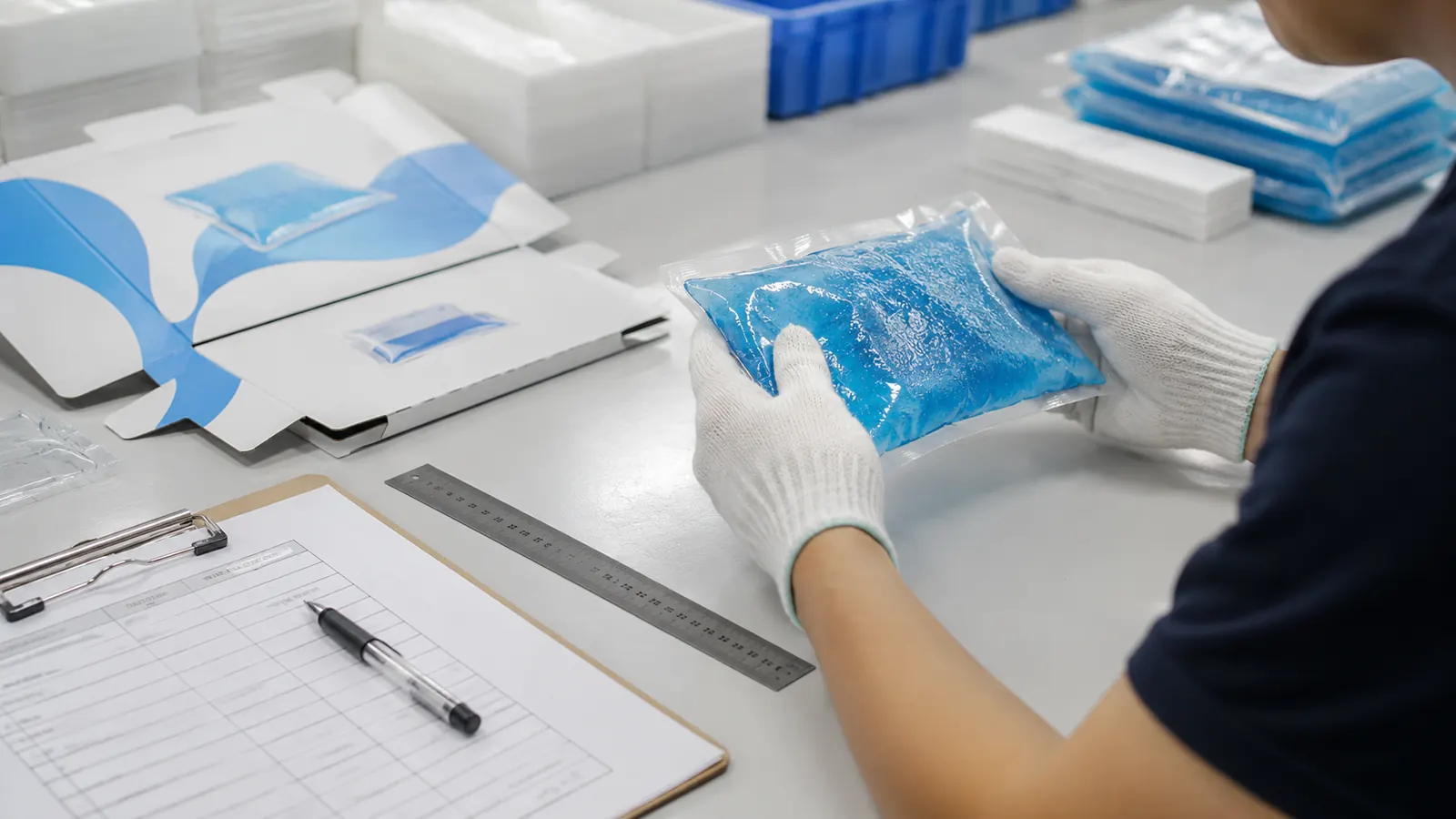
Freeze the approval basis before testing
Collect the current documents before the review begins. At minimum, the packet should identify:
- Product name, project code, sample number, date, and revision
- Dimensioned drawing and tolerance table
- Bill of materials or an agreed material specification
- Fill type, target fill mass, and allowable tolerance
- Seal layout, chamber pattern, valve or closure details where applicable
- Artwork revision, print position, color reference, and required text
- Cover, strap, closure, care-label, and packaging specifications
- Conditioning instructions and performance test plan
- Applicable regulatory, labeling, and documentation requirements
- List of approved deviations and the date each deviation expires
If these inputs are not settled, record the sample as an engineering or appearance sample rather than a mass-production approval sample. The custom ice pack product specification template can be used to organize the approval basis.
Custom ice pack sample approval checklist
| Review area | What the buyer should verify | Record to keep |
|---|---|---|
| Identity and revision | Sample label matches the project, drawing, artwork, and material revisions | Photo, sample ID, revision list |
| Appearance and workmanship | Surface, contamination, wrinkles, trim, corners, seals, chambers, and finish meet defined criteria | Inspection sheet and annotated photos |
| Dimensions and mass | Overall size, seal width, chamber position, fill mass, and total mass are within tolerance | Actual measurements and equipment ID |
| Materials and construction | Film or laminate, fill, cover, strap, closure, thread, and packaging match the approved specification | Material records, supplier documents, sample cross-reference |
| Leak and seal integrity | Applicable visual, leak, seal-strength, pressure, or burst evaluations meet agreed limits | Method, parameters, sample count, results, failure mode |
| Thermal and flexibility performance | Conditioned pack meets defined temperature, duration, and handling criteria | Conditioning and test report |
| Fit and usability | Pack, cover, and closure work for the intended user and use sequence | Fit protocol, observations, approved size range |
| Printing and labeling | Artwork, color, location, legibility, barcode, warnings, and instructions are correct | Signed artwork and scan/inspection results |
| Packaging and distribution | Retail pack, inner pack, carton, orientation, labels, and protective components are correct | Pack-out specification and distribution-test report if required |
| Documentation | Required declarations, test evidence, traceability, and market documents are complete and applicable | Approved document index |
How to inspect the critical areas
1. Appearance, dimensions, and workmanship
Use an inspection form with photos of acceptable and unacceptable conditions. Measure the points shown on the drawing rather than whichever points are easiest to reach. Record actual values, not only “pass.” Note the tool, gauge resolution, and calibration status when the result depends on measurement accuracy.
For flexible packs, agree how the product is positioned and whether dimensions are measured filled, unfilled, conditioned, or at room temperature. Otherwise, two inspectors can obtain different values from the same sample.
2. Fill mass and distribution
Confirm both net fill and total product mass where each matters. A scale check is useful only when the allowable tolerance and weighing method are defined. Review distribution after the intended conditioning cycle because a room-temperature sample may not reveal stiffness, migration, voids, or chamber imbalance.
3. Leak, seal, and pressure performance
“No leaks” is not a complete test requirement. Define the method, conditioning, sample count, pressure or load, duration, inspection point, and acceptance rule. Different methods answer different questions. For example, ASTM F2096 addresses detection of gross package leaks by internal pressurization, while ASTM F88/F88M addresses seal strength of flexible barrier materials. Neither designation should be copied into a specification until its scope and applicability to the pack construction are reviewed.

Record the failure location and mode, not only the maximum value. A material rupture, seal peel, corner failure, and fixture-related failure may require different corrective actions. If burst testing is part of the plan, the ice pack burst-pressure buyer guide explains why fixtures, pressurization rate, geometry, and conditioning should be controlled.
4. Thermal behavior and cold flexibility
Use the intended conditioning time and temperature, then evaluate the pack in a defined setup. Record starting temperature, ambient conditions, load or contact surface, insulation, sensor locations, and endpoint. Confirm whether the sample remains pliable enough for its intended fit; do not assume one gel or fill behaves the same at every freezer temperature.
See how gel packs stay flexible after freezing and the cooling-duration test guide for the variables that should accompany thermal results.
5. Fit, cover, straps, and usability
For wearable products, evaluate the complete assembly. Check positioning, strap reach, closure security, pressure points, movement, visibility, donning and removal, cleaning instructions, and pack insertion. Define the intended user range instead of approving fit on one convenient reviewer.
If the product will be marketed as a medical device, FDA human-factors information emphasizes the interaction among intended users, use environments, and the device interface. Fit approval should be supported by a product-specific risk and usability plan, not treated as a universal guarantee.
6. Artwork, labels, and barcode
Compare the printed sample with the signed artwork revision. Verify orientation, print location, legibility, required symbols, warnings, instructions, country-of-origin or importer information where applicable, and barcode data. Scan the actual barcode using the intended symbology and size rather than approving it visually.
For logoed packs, use the custom ice pack printing quality guide to define color, adhesion, exposure, visual-defect, and production-lot records before approval.

7. Packaging and distribution readiness
Confirm the exact pack-out: fold pattern, pouch or box, inserts, protective layers, inner quantity, master-carton quantity, labels, orientation, and pallet assumptions. A product sample can pass while its shipping configuration fails.
Where distribution testing is required, condition and test the final packaging configuration. ASTM D4332 describes conditioning atmospheres for packages and components, while ASTM D5276 addresses free-fall drop testing of loaded containers. Select a protocol that reflects the product and distribution route rather than listing a standard as a generic badge. The bulk shipping and storage guide covers additional controls buyers should define.
The ice pack packaging drop-test guide explains how to connect the packaged sample, distribution route, test sequence, damage criteria, and approval record.
Approve, conditionally approve, or reject
Use a clear disposition:
- Approved for mass production: all required characteristics and documents passed, with no open changes.
- Conditionally approved: only when remaining items are explicitly listed, low risk, assigned to an owner, and verified before production or shipment. State which activity may proceed.
- Rejected / resample required: a critical requirement failed, the configuration changed, or evidence is insufficient.
The approval record should include the sample ID, document revisions, results, deviations, photos, disposition, approver names, date, and retained-sample location. If a later change affects material, tooling, process, fill, print, supplier, packaging, or a critical dimension, define whether requalification and a new approval sample are required.
Medical-device and compliance note
If the finished product is a medical device for the U.S. market, the FDA’s QMSR has been effective since February 2, 2026 and incorporates ISO 13485:2016 by reference. A signed sample does not by itself establish regulatory compliance, validate a manufacturing process, or prove that the finished device meets all applicable requirements.
Confirm device status, claims, responsible manufacturer, risk controls, required validation, records, labeling, and market obligations with qualified quality and regulatory professionals. Also verify which tests and documents a supplier can provide for the exact project; this checklist does not claim that Cryozin performs every cited method or holds every certification for every product.
Release production with one controlled reference
The best sample approval package leaves little room for interpretation. It identifies the configuration, records the evidence, documents deviations, and connects production inspection to the same critical characteristics. That gives procurement, engineering, quality, and the supplier one controlled basis for mass production.
Preparing a custom ice pack sample review? Review Cryozin’s customization process and quality control framework. Share your drawing, intended use, target market, order volume, artwork, packaging plan, and required test evidence through the Cryozin contact page. The team can clarify project-specific sample options and what should be confirmed before production approval.
Sample approval is one stage of the broader OEM product-development process; the released sample, specification, artwork, and quality plan should identify the same product configuration.
Sources & Further Reading
- ASTM F2096 — Detecting Gross Leaks in Packaging by Internal Pressurization
- ASTM F88/F88M-23 — Seal Strength of Flexible Barrier Materials
- ASTM D4332 — Conditioning Containers, Packages, or Packaging Components for Testing
- ASTM D5276-19(2023) — Drop Testing of Loaded Containers by Free Fall
- U.S. FDA — Quality Management System Regulation
Sources accessed September 7, 2026. Select applicable tests and approval criteria for the finished product, packaging, intended use, claims, market, and agreed quality plan.
