

Quick answer: A useful custom ice pack product specification template is the controlled definition of what the supplier must build, what evidence the buyer will review, and which version is approved for production. It should connect the intended use to measurable requirements for dimensions, materials, fill, seals, chambers, conditioning instructions, artwork, packaging, inspection, and change control. It should also identify every open item instead of disguising an assumption as a final requirement.
This guide is for U.S. brand owners, procurement teams, product engineers, and wholesale buyers developing reusable gel packs, hot-and-cold packs, wearable wraps, or private-label cooling products. It is a practical starting framework, not a universal engineering standard. The right values, tests, warnings, and regulatory path depend on the approved product, claims, sales channel, and destination market.
On this page
A master specification is not the same as an RFQ
An RFQ helps suppliers price a defined opportunity. A master product specification controls the technical and presentation details after choices are reviewed. Early in development, the two documents may share information, but they serve different decisions. Buyers who still need to organize quantities, timing, and commercial inputs can begin with a commercial RFQ checklist, then carry the selected construction into the controlled specification.
| Document | Primary question | Typical status |
|---|---|---|
| RFQ | What can the supplier offer, at what scope and commercial terms? | May contain options and open questions |
| Master specification | Exactly what product, packaging, evidence, and approved version will control the order? | Released only after defined reviews |
| Inspection plan | How will agreed characteristics be checked and recorded? | References the released specification |
| Golden sample | What approved physical reference helps interpret visual or tactile characteristics? | Identified, dated, and protected from unauthorized substitution |
The specification should have an owner, document number, revision, date, SKU, market, approval names, and a visible status such as “draft,” “sample release,” or “production release.” Keep unknown items labeled TBD with an owner and due date. A blank cell is too easy to interpret as “not required.”

Start with the intended use and measurable performance targets
Describe who will use the product, where it will be sold, how it will be conditioned, the body area or pack-out it must fit, and the expected handling cycle. “Reusable cold pack” is not enough. A clinic kit, sports-recovery wrap, beauty mask, meal-delivery coolant, and retail general-purpose pack can require different materials, instructions, packaging, and evidence.
Translate the use case into targets that can be evaluated. Examples include fit around a defined body model, flexibility after conditioning at an agreed temperature and time, filled weight, temperature profile under a stated test setup, condensation management, maximum package dimensions, or compatibility with a designated cover. Do not copy a competitor’s claim or set a cooling-duration number without defining the test conditions. Ambient temperature, starting temperature, contact surface, insulation, gel mass, and measurement location can change the result.
For a product promoted for diagnosis, cure, mitigation, treatment, or prevention of disease, intended use may affect whether it is regulated as a medical device in the United States. The FDA advises manufacturers to define intended use and indications for use when assessing device status. The brand owner should obtain qualified regulatory advice for its exact product and claims; a supplier quotation, test report, or generic “medical-grade” statement does not determine market authorization.
Define the physical product without prescribing an untested guess
Dimensions, tolerances, and measurement points
Attach a numbered drawing. State overall length and width, filled or unfilled measurement condition, thickness where relevant, corner radii, seal width, chamber positions, openings, strap anchors, and print-safe area. Put a tolerance beside each critical dimension and explain the measurement method. Tight tolerances can affect tooling, yield, and price, so reserve them for characteristics that matter to fit, safety, packaging, or function.
Outer material, cover, and fill system
Identify the material family, construction or laminate, nominal thickness or weight, color, surface finish, and any required documentation. For textile covers, define fiber content, fabric weight if material, stretch direction, closure, seam construction, and care expectations. For the thermal core, specify the approved fill type, nominal fill weight with tolerance, color or appearance, and required behavior after the stated conditioning cycle.
A material name alone does not guarantee finished-product performance. Film, fill, seal geometry, chambers, and use conditions work as a system. Review the relevant trade-offs in Cryozin’s hot and cold pack material selection guide, then validate the selected combination in representative samples.
Seals, chambers, edges, and accessories
Show the perimeter seal, internal welds, fill opening, rounded or straight edges, and any reinforcement on the drawing. Define the number of chambers, target fill distribution, and acceptable cosmetic appearance. List every accessory—cover, strap, hook-and-loop panel, buckle, label, insert, storage bag, or carton—as a controlled component with its own material, size, color, and supplier-approved reference.
Buyer-ready custom ice pack product specification template
Copy the table into your controlled document and replace prompts with project-specific requirements. Add a column for supplier comments during feasibility review, but keep final authority for brand claims, legal content, and product release with the appropriate buyer functions.
| Section | Requirement to record | Approval evidence |
|---|---|---|
| Document control | Project/SKU, specification number, revision, status, owner, approval date, destination market | Signed or system-approved release record |
| Intended use | User, application, sales channel, conditioning method, contact conditions, exclusions | Approved product brief and claims review |
| Performance targets | Flexibility, fit, thermal target, reuse expectation, handling and storage conditions | Defined method, sample size, data, and acceptance criteria |
| Geometry | Drawing, overall dimensions, thickness, seal width, chamber layout, tolerances | Dimensional report and approved drawing |
| Pack material | Material family, structure, nominal thickness, color, finish, supplier reference | Material record and approved sample |
| Fill | Type, nominal weight and tolerance, color, viscosity or phase behavior as applicable | Batch/fill records and functional review |
| Cover/accessories | Fabric, stretch, closure, stitching, straps, fasteners, labels, dimensions | Component references and assembly sample |
| Heating/cooling | Permitted methods, time/temperature limits, handling, inspection-before-use, warnings | Approved instructions supported by product-specific review |
| Artwork | File revision, print method, size, placement, colors, safe area, proof route | Approved proof and production-representative sample |
| Packaging/labeling | Unit pack, insert, carton, pack count, barcode, lot coding, shipping marks | Approved dielines, text, barcode verification, pack-out sample |
| Inspection/testing | Characteristic, method, conditioning, frequency, sample size, limit, record | Approved inspection plan and report format |
| Change control | Golden sample ID, approved deviations, substitution rules, revalidation triggers | Authorized change record and revised release |
Control heating, cooling, artwork, packaging, and labeling together
If the product may be heated, do not write “microwaveable” as a stand-alone feature. Define the approved heating method, relevant appliance assumptions, starting condition, time and power instructions, maximum limits, kneading or temperature-check steps, contraindications, and what the user should do if the pack is damaged. These instructions require validation for the exact construction; they should not be inherited from another SKU.
For cold use, state the freezer or refrigerator method, conditioning time range, whether a cover or barrier is required, inspection-before-use guidance, and storage precautions. Claims and warnings should match the intended use and supporting evidence. If a U.S. product is an over-the-counter medical device, applicable FDA labeling requirements can include identity, intended action, directions, and net quantity; confirm all requirements for the specific classification rather than treating this list as complete.
Artwork control should identify the file revision, final print size, placement coordinates, colors, print method, material, and proof type. Cryozin’s logo file requirements for custom ice pack printing explain why a vector file, measurable safe area, and controlled proof reduce ambiguity.
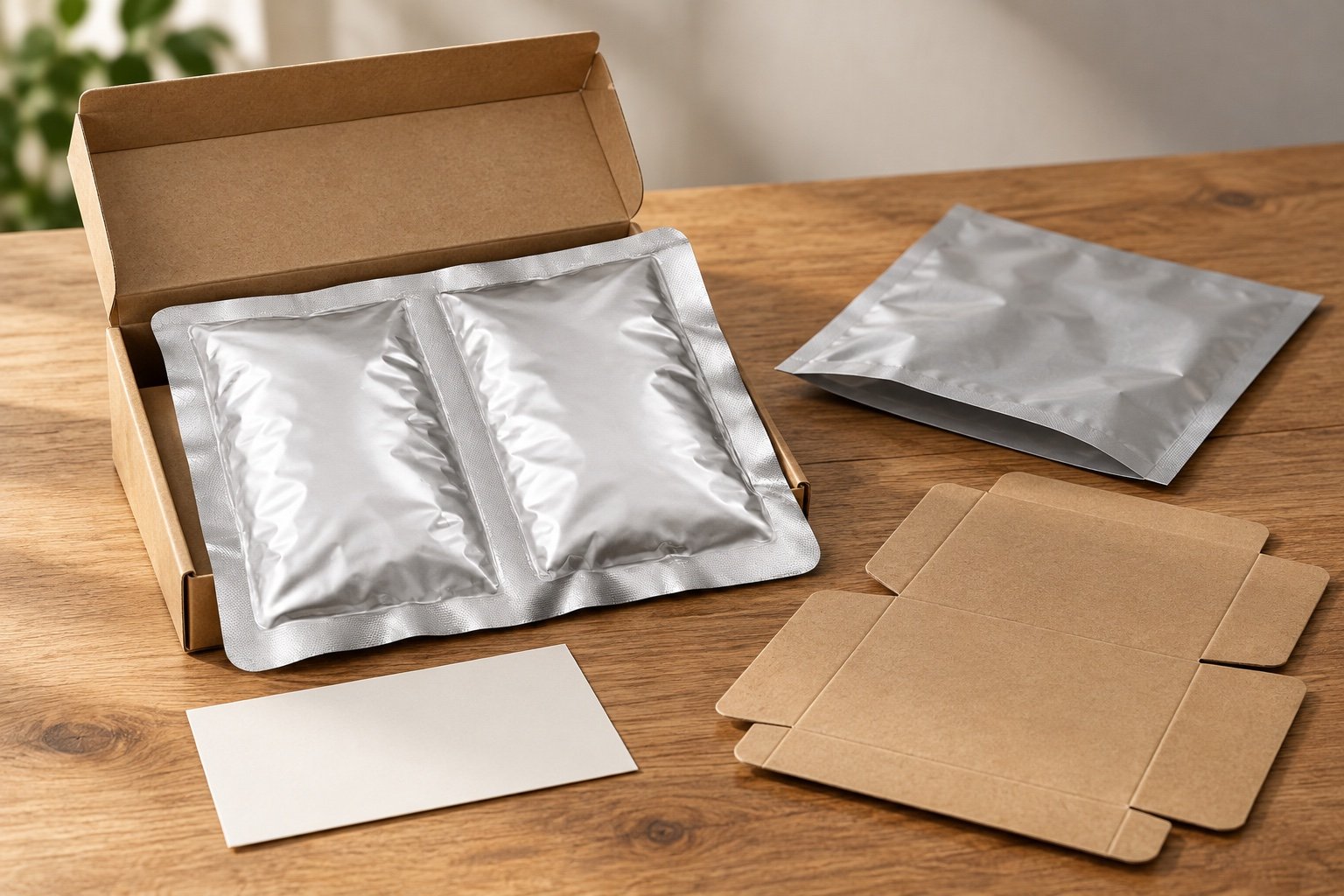
Packaging is part of the product definition. Specify the retail or bulk format, insert, individual bag, carton dimensions, units per carton, gross-weight limit, pallet or shipping requirements, label location, country-of-origin presentation, lot/date coding, and barcode ownership. The GS1 GTIN Management Standard explains when a new product or certain product changes require a new GTIN. The brand owner should assign and manage identifiers and verify that printed symbols encode the released data.
Build the test and inspection plan around decisions
A test name without a method and limit is not an acceptance criterion. For each critical characteristic, record the sample condition, equipment or reference method, number of units, measurement location, pass/fail limit, frequency, responsible party, and report required. Separate development validation from routine production inspection: a detailed engineering test may establish the design, while a faster in-process check monitors continued production.
Possible checks include incoming-material identity, dimensions, fill weight, seal appearance, leakage or pressure evaluation, print registration, color, strap function, package count, barcode readability, and thermal behavior under agreed conditions. Not every test belongs in every project, and no single packaging test proves overall fitness for use. The buyer’s risk assessment, claims, distribution conditions, and applicable requirements should determine the plan.
Use Cryozin’s ice pack quality-control overview to map the released specification to incoming, in-process, packaging, and final-release checks. When requesting external laboratory work, name the standard edition, specimen preparation, conditioning, deviations, and report deliverables. A supplier’s internal result and a third-party accredited-laboratory result are different evidence; the specification should say which is required.
Approve a golden sample—but do not let it replace the drawing
A golden sample can help interpret color, hand feel, print appearance, shape, and assembly. Assign it an ID, revision, approval date, storage owner, and retention period. Record any known deviation from planned mass production. Photographs are useful for access, but lighting and scale make them weak substitutes for controlled color and dimensional requirements.
The written specification remains the primary definition. If the sample conflicts with the drawing or bill of materials, stop and resolve the conflict before production. Changes to film, fill, dimensions, seal route, artwork, packaging, supplier, or process may require a new risk review, test, proof, sample, or GTIN decision.
This discipline is consistent with documented quality management, but it does not prove certification. ISO describes ISO 9001 as a general quality-management framework covering documented information, controlled operations, performance evaluation, and improvement. Buyers should verify any supplier certification, scope, issuing body, and current status separately.

Use five gates from quotation to repeat production
- Feasibility gate: Confirm which requirements are fixed, optional, or unresolved. Record supplier assumptions and alternative constructions.
- Quotation gate: Align quoted price, tooling, MOQ, packaging, testing, and timing with one dated specification revision. Do not compare offers built against different scopes.
- Sample gate: State which sample features are production-representative and which are temporary. Review every failure or deviation against a written criterion.
- Production-release gate: Freeze the drawing, materials, fill, artwork, packaging, inspection plan, golden sample ID, and authorized deviations. Obtain approvals from purchasing, engineering/quality, brand, and regulatory functions as applicable.
- Reorder gate: Reference the released revision and ask whether any material, process, tooling, facility, label, or regulatory detail has changed. Do not assume “same as last time” is sufficiently precise.
Turn the template into a supplier-ready project record
A strong specification does not make every decision on day one. It makes the status of every decision visible, connects claims to evidence, and prevents one team’s approval from being mistaken for approval of the whole product. Keep the document concise enough to use, attach drawings and artwork instead of embedding unreadable screenshots, and assign one owner to consolidate feedback.
Planning an OEM or private-label program? Review Cryozin’s OEM ice pack development overview and custom manufacturing process, then send the project team your intended use, target market, drawing, materials under consideration, performance targets, quantity, artwork status, and packaging channel. Request a project-specific feasibility review before treating any construction, test plan, timing, or commercial term as confirmed; final specifications, claims, approvals, and market obligations remain project-specific.
Sources & Further Reading
- U.S. FDA — How to Determine if Your Product Is a Medical Device
- U.S. FDA — Labeling Requirements for Over-the-Counter Medical Devices
- GS1 — GTIN Management Standard
- ISO — ISO 9001:2015 Quality Management Systems
Sources accessed September 7, 2026. Device status, labeling, identifiers, specifications, and quality-system requirements depend on the finished product, claims, responsible party, and destination market.
Scene images are editorial concepts based on catalog references, not evidence of a factory, customer project, test or approved configuration. Catalog images illustrate visible product form only.
