

Neoprene ice pack wraps should not be specified as “neoprene + gel pack” and left at that. For a B2B buyer, the real specification includes the cellular sheet, textile lamination, stretch direction, closure layout, pocket geometry, edge construction, cleaning method, and the removable or integrated cold-pack format. Those decisions affect fit, handling, repeatability, and how a sample can be inspected.
This guide shows brand owners, distributors, and procurement teams how to turn a neoprene wrap idea into a buyer-ready specification. It does not assume that one material grade, thickness, or test method fits every product. The approved construction and intended market should control the final requirements.
On this page
What is a neoprene ice pack wrap?
In sourcing conversations, “neoprene” usually refers to a flexible cellular rubber layer, often laminated to one or two textile faces. The wrap may hold a separate reusable gel pack in a pocket, retain an integrated cooling insert, or act as the fastening and comfort layer around another cold-pack construction.
The term alone does not define density, cell structure, thickness, stretch, surface fabric, adhesive, odor, color, or skin-contact finish. Two black sheets can look similar in a photograph and behave differently when stretched, sewn, laminated, repeatedly opened, or conditioned at low temperature.

Start with the product architecture, not a material name
Before asking for a neoprene sample, decide how the user, retailer, and quality team will interact with the product. A useful architecture brief answers five questions:
- What body area and size range must the wrap cover? A flat rectangular sleeve, a contoured shoulder piece, and an ankle wrap place different demands on stretch and fastening.
- Is the gel pack removable? A removable insert can simplify washing and replacement, while an integrated construction reduces loose components. Each route creates different seam, labeling, and sample checks.
- Where should pressure come from? Pressure should be treated as a fit variable, not a medical claim. Strap length, overlap, elasticity, and closure position determine how consistently the product can be adjusted.
- Which surface touches the user? The skin-facing textile, edge binding, seam placement, and closure exposure may matter more to comfort than the foam sheet itself.
- How will the product be cleaned and stored? Cleaning instructions must match the complete construction, including fabric, adhesive, hook-and-loop, printing, and gel insert—not only the base sheet.
If these inputs are still open, use the custom ice pack design input framework before locking the material.
Seven specifications buyers should define
| Specification | Why it matters | What to put in the RFQ or sample plan |
|---|---|---|
| Foam construction | Cell structure and compound influence recovery, water uptake, compression behavior, and aging. | Supplier material designation, target construction, color, and required evidence or comparison method. |
| Finished thickness | Thickness changes bulk, edge feel, insulation, flexibility, and sewing or bonding choices. | Nominal thickness, tolerance, measurement method, and whether the value applies before or after lamination. |
| Textile lamination | The face fabric influences hand feel, printing, abrasion, seam behavior, and cleaning. | Fiber or fabric description, face/back orientation, color reference, and lamination acceptance checks. |
| Stretch direction and recovery | A wrap can fit differently along and across the material. | Required direction of stretch in the cut pattern, test orientation, conditioning, and recovery check. |
| Closure system | Hook-and-loop area, strap length, and edge exposure affect adjustability and handling. | Closure dimensions, sewing/bonding method, overlap range, pull direction, and cycle or peel check if required. |
| Pocket and insert retention | A removable gel pack must stay positioned without making loading or removal difficult. | Pocket opening, flap, orientation mark, retention feature, and compatibility with the approved insert dimensions. |
| Edge and seam construction | Cut edges, binding, stitching, and bonded seams create different bulk and failure modes. | Edge finish, stitch type or bonding route, seam allowance, stress points, and visual acceptance criteria. |
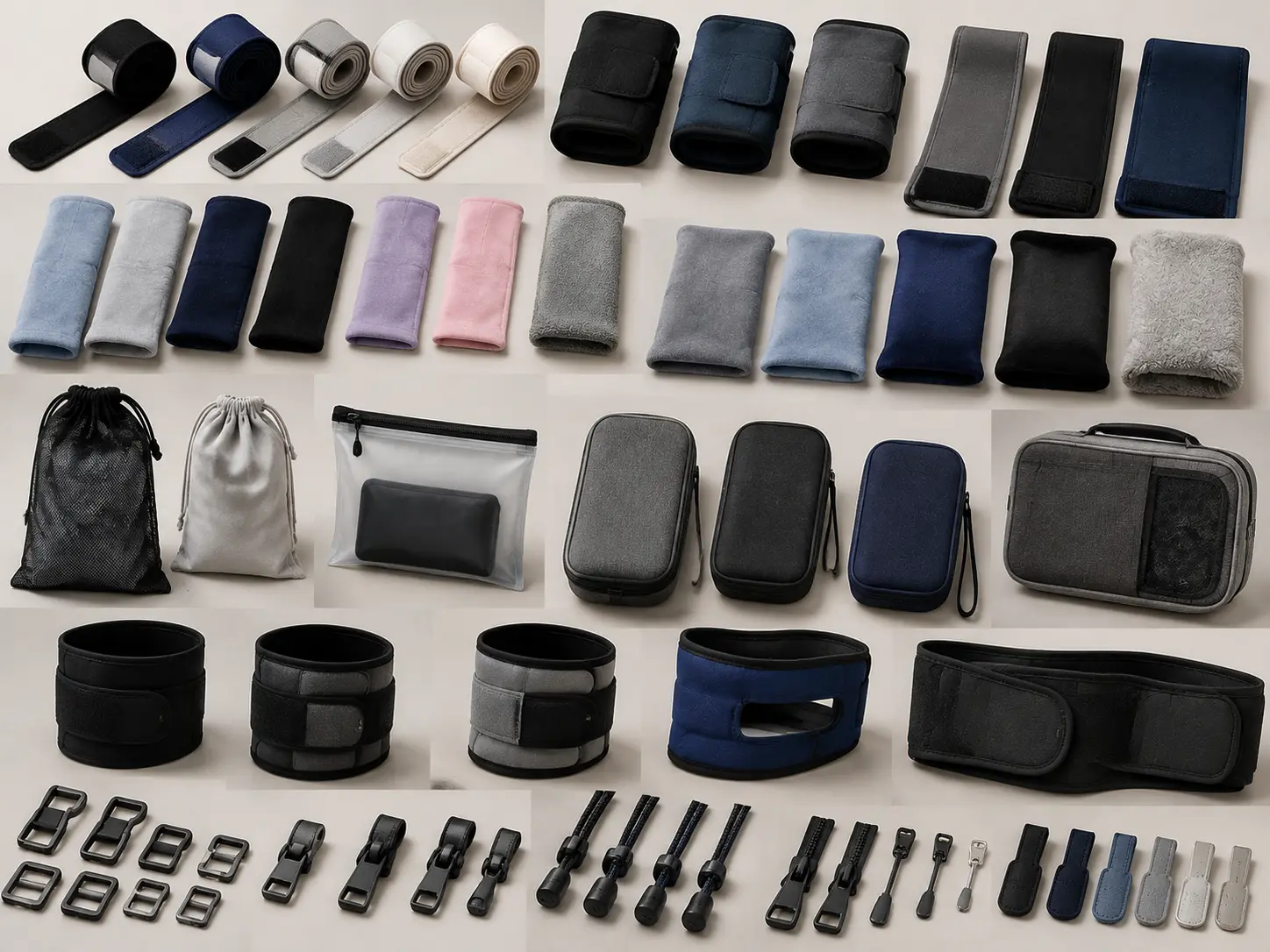
These fields should connect to the broader strap, cover, fastener, and accessory specification. A closure cannot be approved independently of the material it grips and the load created by the complete wrap.
How to compare material samples without overclaiming
A supplier may provide a datasheet, but a datasheet is not a finished-product approval. Buyers should compare candidate materials under the same specimen geometry, orientation, conditioning, and test method. ASTM D1056 covers classification and selected physical-property tests for flexible cellular rubber materials. Its scope also notes that small molded or extruded shapes may need special procedures and that the requested test should be identified rather than cited vaguely.
For tensile behavior, ASTM D412 provides methods for vulcanized rubber and thermoplastic elastomers. ASTM specifically cautions that tensile properties depend on test conditions and do not by themselves describe total end-use performance. A buyer should therefore avoid turning one tensile number into a universal durability claim.
Where aging comparisons are relevant, ASTM D573 evaluates the effect of elevated temperature on vulcanized-rubber properties under accelerated conditions. The standard states that the result may not correlate exactly with service performance. In practical terms, accelerated aging can support a controlled comparison, but it does not prove a fixed service life for a finished wrap.
A practical material comparison record
For each candidate, record the supplier lot, sample date, nominal construction, actual thickness, cut direction, conditioning, test method, result, and observations. Photograph edge quality, lamination behavior, and any cracking, delamination, permanent set, odor change, or closure damage. The goal is traceable comparison—not a collection of unrepeatable impressions such as “soft” or “premium.”
Fit and thermal performance must be tested together
A wrap can fit well but position the gel insert poorly. It can also hold an insert securely while creating excessive bulk at an edge or closure. Evaluate the assembled sample on the intended body-area form or agreed fit model, not only on a flat table.
For a body-contoured format example, review Cryozin’s contoured shoulder gel wrap with adjustable straps. Use it to compare coverage and strap routing; the linked format does not establish that every project uses neoprene, and material, sizing, insert, and performance requirements still need project approval.
- Confirm the cold area stays within the intended coverage zone through ordinary movement.
- Check that straps do not pull the insert away from the body when adjusted.
- Inspect whether the pocket opening, seam, or closure creates a concentrated pressure point.
- Condition the approved gel insert as specified and repeat the fit check; low-temperature stiffness can change handling.
- Document the environmental conditions and the complete pack-plus-wrap configuration for any temperature or duration comparison.
Do not promise a fixed cooling time based on the cover material alone. Cooling behavior depends on the insert, fill mass, conditioning, ambient temperature, contact, insulation, and test endpoint. The separate ice pack cooling-duration guide explains how to define those variables.
Choose removable or integrated construction deliberately
Removable insert
A removable gel pack can support separate cleaning instructions, replacement, and easier visual inspection. The buyer must define insertion direction, pocket closure, maximum opening, and whether the pack can migrate or fold during use. The label and instructions should make it clear which insert belongs with the wrap.
Integrated construction
An integrated pack can reduce loose parts, but it may require a different production route and cleaning statement. The buyer should approve the interface between the sealed pack and the textile component, the stress points around welds or seams, and the complete-product inspection method. Do not assume that a material test on the cover validates the sealed gel pack or vice versa.

Build a sample approval plan around failure modes
A useful approval plan covers the material, the assembled wrap, and the gel insert as separate layers before evaluating the finished set. At minimum, buyers should review:
- Identity and dimensions: material lot, finished thickness, cut size, strap length, closure area, pocket size, and insert match.
- Visual workmanship: delamination, bubbles, exposed adhesive, rough edges, skipped stitches, loose threads, contamination, color mismatch, or misplaced printing.
- Fit and adjustability: coverage, overlap range, retention, edge comfort, and repeatable positioning.
- Handling cycles: repeated opening, insertion/removal, bending, and the agreed cleaning or wipe-down procedure.
- Conditioned use: fit, flexibility, and pocket retention with the approved insert after defined cooling or heating preparation.
- Packaging and instructions: component count, orientation, care statement, warnings, lot or traceability fields, and market-specific labeling review.
Acceptance criteria should be written before the supplier produces the sample. Use the ice pack sample approval checklist to connect the material review to golden-sample control and mass-production release.
Common sourcing mistakes
- Specifying only “3 mm neoprene.” Thickness alone does not define the compound, cell structure, textile faces, tolerance, or finished behavior.
- Approving a swatch instead of an assembled sample. Lamination, cutting, seams, closures, and insert geometry can change performance.
- Using “waterproof” as an unqualified claim. The foam, textile face, seams, pocket opening, and finished assembly may have different water behavior. Define the intended exposure and test the complete construction.
- Copying a test standard into an RFQ without scope. State the specimen, property, conditioning, method, units, and acceptance limit that actually matter.
- Assuming one size fits a full product line. Body-area geometry and user-size range may require different patterns, strap lengths, or inserts.
What to send a supplier for an efficient quotation
Send a drawing or dimensioned sketch, target body area and size range, removable/integrated route, insert dimensions, material construction, thickness and tolerance, textile face, stretch direction, closure layout, edge finish, printing, cleaning concept, packaging, target market, sample checks, and estimated order quantity.
If the body-area format is not yet fixed, compare Cryozin’s cold therapy wrap product range before narrowing the drawing, insert, fastening, and sample requirements.
For Cryozin projects, the standard MOQ is 500 pcs for this product family. Typical renderings are 1–3 business days, samples are 3–7 business days, and regular production is 18–25 business days; custom timing can be longer and must be confirmed for the approved specification. These are general commercial conditions, not a promise that every wrap construction follows the same schedule.
Review material alternatives through Cryozin’s material selection framework, then use the custom ice pack program to discuss the product architecture. A complete specification is the fastest route to a comparable quote and a sample that can be approved objectively.
FAQ
Is every neoprene ice pack wrap waterproof?
No. “Neoprene” does not define the water behavior of the textile laminate, seams, openings, closures, or finished assembly. State the expected exposure and validate the complete product against an agreed method.
What thickness is best for a therapy wrap?
There is no universal best thickness. Coverage, stretch, edge bulk, insert format, fastening, comfort target, production method, and test results all matter. Compare complete samples made to the intended pattern.
Can a neoprene wrap prove how long an ice pack stays cold?
No. A cover can influence heat transfer, but duration depends on the entire test configuration. Define the gel insert, conditioning, ambient conditions, contact setup, insulation, and endpoint before comparing results.
Should buyers request ASTM reports for every wrap?
Buyers should request evidence that matches the actual risk and claim. If an ASTM method is used, confirm that its material scope, specimen preparation, conditioning, and reported property apply to the chosen construction. A standard number alone is not an approval.
Sources and further reading
- ASTM D1056 — Standard Specification for Flexible Cellular Materials—Sponge or Expanded Rubber
- ASTM D412 — Standard Test Methods for Vulcanized Rubber and Thermoplastic Elastomers—Tension
- ASTM D573 — Standard Test Method for Rubber—Deterioration in an Air Oven
Ready to compare a neoprene wrap concept? Send Cryozin your drawing, target body area, gel insert, material preference, closure layout, sample checks, packaging, and estimated quantity. The team can review the inputs and identify which items still need confirmation before sampling.
