
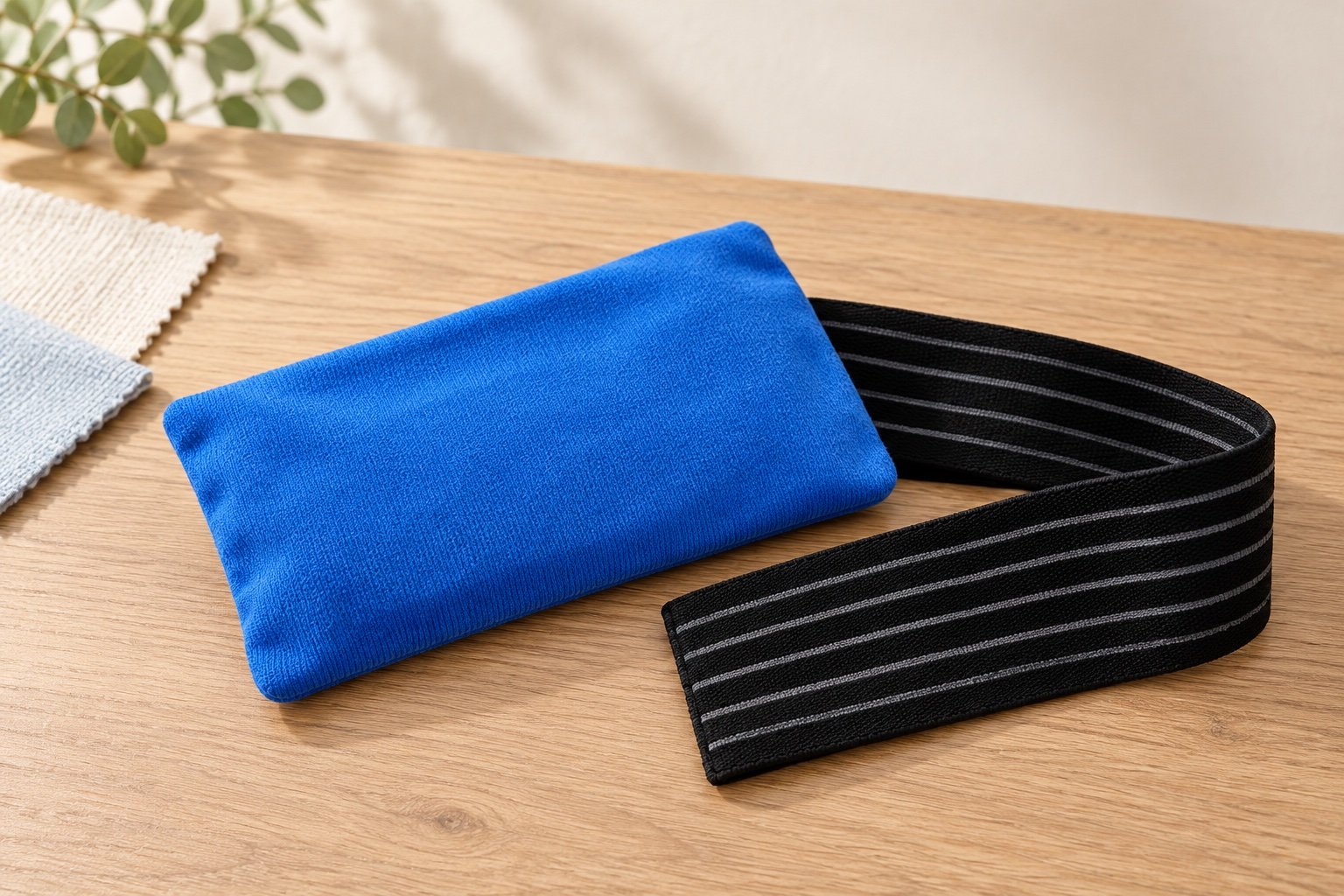
Choose an ice pack cover by its job: a sleeve or wrap pocket holds a pack during use; an insulated bag stores or carries packs before use. They are not interchangeable. Ice pack cover insulation can slow heat transfer, but the same barrier can also reduce cooling through the contact side. A thicker cover is not automatically the better product.
For brands and procurement teams, start with the format customers need, then compare fit, moisture, cleaning, and temperature behavior. This guide explains those choices before the sample checks. It does not prescribe treatment times or prove safe skin contact.
On this page
Ice pack sleeve vs insulated bag: which do you need?
Choose a removable sleeve for a covered pack during use
A sleeve encloses one pouch and adds a replaceable contact surface. Consider it when buyers need an easy way to insert, remove, and clean a cover. Check the opening against the filled pack, not only its flat length and width. An oversized sleeve can let the pouch move; a tight one can make loading difficult or force a fold near the seal.
Choose a wrap pocket when the pack must stay in position
A pocket within a wrap combines the cover with retention. Choose this route when the product brief includes straps or fastening and the user needs the insert held in a defined position. Review the complete fitted assembly: adding padding to a loose sleeve is not equivalent to changing the pocket of a tensioned wrap.
Choose an insulated bag for storage or transport before use
A bag is a separate enclosure for carrying or holding packs. Compare usable capacity, closure, access, and the actual storage conditions. It does not replace a contact cover. If the product is intended to ship temperature-sensitive goods, that is a different pack-out decision; use the cold packs for shipping overview rather than treating a small sleeve as a validated shipping system.
Do covers keep ice packs cold longer?
An insulating layer can reduce heat entering a cold pack, but it does not guarantee a useful extra number of minutes. The result depends on the pouch, starting condition, exposed area, fit, environment, and what “cold” means in the comparison. Keeping the pouch colder is also not the same as delivering more cooling through the outside of the cover.
If customers want a pack that remains cold in storage, compare the bag-and-pack system. If they want cooling through a sleeve, compare the contact-side temperature as well as the pack itself. Do not choose the winner using only the coldest reading inside the pouch. General duration factors belong in the ice pack cooling-duration guide; the decision here is the cover’s role.
Define what the selected cover needs to accomplish
Start with the product’s job. A transport sleeve, a removable contact cover, and the pocket of a wearable wrap may look similar but have different requirements. A transport sleeve might prioritize slowing warming before use. A contact cover introduces a layer between the pouch and another surface. A wrap pocket also needs to retain the insert while the assembly bends and moves.
Write the desired outcome without assuming a fabric delivers it. For example, “compare the contact-side temperature profile of two approved sleeve constructions” is a testable development question. “Make it stay cold twice as long” is a performance claim that needs a defined baseline, endpoint, conditions, and data.
If the initial problem is choosing fibers, use the nylon and polyester cover material comparison. This article focuses on the thermal role of the assembled cover, rather than repeating that material-selection guide.
Separate pack temperature from contact-side temperature
A cold pouch takes in heat from its surroundings. Its cover changes the path between the pouch and the environment or contact surface. A temperature reading inside the pack, on its film, and outside the textile therefore answers three different questions.
- Pack-side profile: how the selected pouch changes temperature under the specified trial conditions.
- Contact-side profile: the temperature measured at a defined location on the outer surface or an agreed test fixture.
- Handling condition: whether the assembly remains usable, retained, and free of unacceptable wetness during the trial.
Do not use one favorable sensor trace as proof of all three. A pouch can remain cold while the outside layer provides less cooling than intended. Conversely, an initially cool outside surface does not establish how long the complete assembly meets the project’s requirements.
Keep preparation and environment controls consistent when isolating the effect of a cover. Agree on the outside temperature or other measured endpoint that matters to the intended product, rather than comparing unrelated duration claims.
Compare construction, not just fabric names
Cover insulation is an assembly question. Record the fiber composition, knit or woven structure, fabric weight, layer arrangement, padding, seams, pocket openings, and finished fit. Two covers sold under the same broad material name can have different construction and contact geometry.
Thin sleeve
A single-layer sleeve is a candidate when the project needs a removable contact surface with relatively little added bulk. Evaluate its actual temperature profile, retention, and care route. “Thin” is not a substitute for a thickness or construction specification, and it does not prove that direct contact is suitable.
Padded or multilayer cover
A padded construction is worth comparing when the brief calls for a different thermal barrier, handling feel, or assembly geometry. Specify where padding is located. Padding on the contact side, the outward-facing side, or both sides creates different configurations that should not share an approval automatically.
Wrap pocket
A pocket adds geometry and retention to the comparison. Its opening, seam position, strap routing, and fit can change how the pouch rests against the cover. If fastening is part of the product, evaluate the complete wrap rather than laying a loose swatch over the pouch.

What evidence supports an insulation claim?
A supplier’s material report can help screen candidates, but ask what was actually tested: an uncompressed swatch, a multilayer stack, or the finished cover. Check specimen identity, conditioning, thickness, method edition, units, and the laboratory’s stated limitations.
ISO 11092:2026 covers steady-state thermal and water-vapor resistance measurements for textiles and related materials, including layered assemblies. Its public abstract expressly separates those laboratory conditions from particular comfort situations and does not set comfort-performance requirements. A result under this method is not, by itself, a cooling-duration result or approval for a specific skin-contact product.
Ask a qualified laboratory whether that method suits the material-screening question. Use an additional finished-assembly protocol for the actual product decision. No full paid standard procedure is reproduced here, and this guide sets no universal pass value.
Compare two sample covers without changing the pack
Use the same approved pouch design and preparation instructions for each candidate cover. Changing the gel fill, pouch size, starting condition, and cover at the same time makes the result difficult to interpret.
- Identify samples. Give each cover a revision and record the matching pouch version.
- Match preparation. Record the actual starting condition, not simply that both samples were placed in a freezer.
- Define the environment. Document ambient temperature, humidity, airflow, support surface, and whether the assembly is enclosed or exposed.
- Map sensors. Define pack-side and contact-side locations. Keep positions and attachment methods consistent.
- Represent fit. Use the agreed mounting, contact area, fastening, and loading condition. Do not substitute a flat loose layer for a fitted wrap.
- Set endpoints in advance. Agree on the measured outcomes and acceptance criteria before comparing traces.
- Check changes after care. Compare the approved cleaning route and record shrinkage, layer movement, opening fit, and repeat-trial results.
This is a development checklist, not a prescribed standard test or a record of Cryozin testing. Use a controlled fixture first; any human-use evaluation needs appropriate product-specific safety review and authorization.
Include moisture and compressed fit in the review
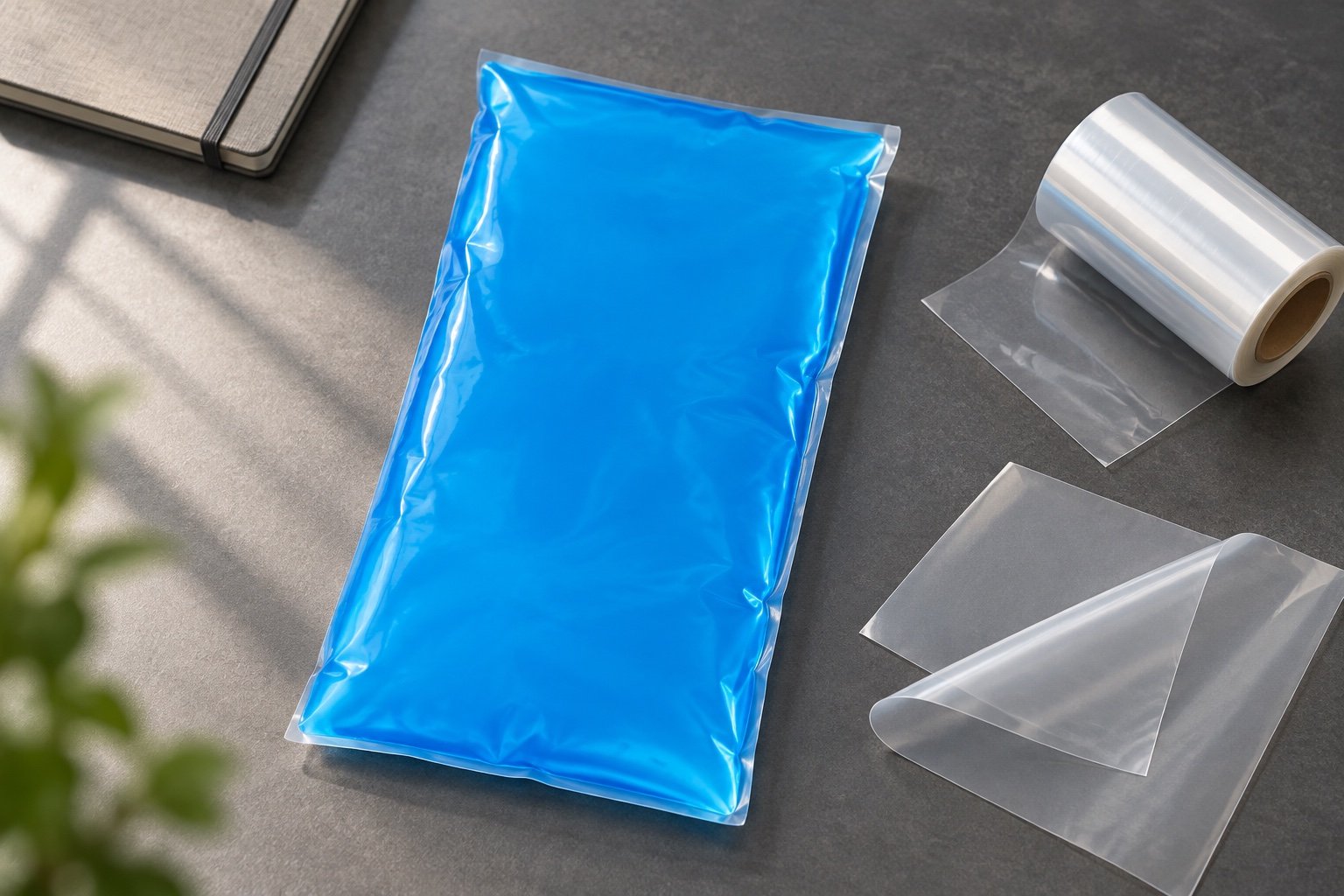
Do not approve a cover using dry, loose material alone if the expected assembly will become damp or be held under fastening tension. Those are different trial states. Define which states are relevant, then compare them without assuming that every textile behaves the same way.
Record where moisture appears and whether it comes from surface condensation or a damaged pouch. The condensation-control guide addresses that distinction. A cover that manages visible moisture does not automatically make the pouch leak-resistant or the assembly condensation-free.
Send a usable cover-insulation brief
Copy these fields into the sample request:
- Product and use boundary: transport, removable contact cover, or fitted wrap; intended market.
- Fixed pouch: approved drawing, fill, dimensions, and preparation instructions.
- Cover candidates: composition, construction, layer placement, and revision.
- Fit: pocket opening, contact area, retention, and fastening condition.
- Trial states: dry, relevant damp condition, and post-care state.
- Measurements: sensor map, environment, duration, and agreed endpoints.
- Acceptance: required outcomes, handling observations, and reasons to revise or hold.
- Claims: exact proposed wording and the evidence needed before it appears on packaging.
For an existing format reference, review the gel pack with a mesh pouch and adjustable band. A catalog format is not evidence that a different insulated cover fits it or achieves the same result. For project-specific construction, use the custom ice pack development options.
Questions to resolve before approval
Does a thicker cover always keep an ice pack cold longer?
No universal outcome should be assumed. Thickness is one input; the complete construction, exposed area, fit, preparation, and environment determine what the comparison can show. Specify which temperature and endpoint you mean by “cold longer.”
Can a thermal-resistance report prove safe skin contact?
No. Material resistance, finished-product temperature, instructions, and product-specific safety are separate evidence questions. The FTC’s health-products guidance also requires appropriate support for objective benefit and safety claims; a fabric result does not establish clinical benefit.
Can the same cover be approved for several pouch sizes?
Only after the relevant configurations have been evaluated. A new pouch size can change fit, exposure, contact area, and retention. Define the approved size range rather than extending a single sample result to every SKU.
Choose the assembly that meets the brief
The useful purchasing outcome is a documented cover-and-pouch pairing, not a general ranking of fabrics. Send the cover-insulation brief and candidate construction details to Cryozin to discuss the sample scope. Available materials, compatibility, testing responsibilities, and any public performance claims need confirmation for the specific project.
Sources and further reading
- ISO 11092:2026 public scope — steady-state textile thermal and water-vapor resistance; not a finished-product comfort or clinical approval.
- FTC Health Products Compliance Guidance — substantiation and scope of health-related advertising claims.
Scene images are editorial concepts based on catalog references, not evidence of a factory, customer project, test or approved configuration. Catalog images illustrate visible product form only.
