

A gel-filled dog cooling mat should be sourced as a complete product system—not as a blue cover with an unspecified gel inside. Buyers need to define the outer construction, fill, internal support, seam geometry, finished size and mass, cleaning method, supervision language, packaging, and the sample checks that will be repeated before a bulk order.
The most important distinction is between comfort support and medical or safety claims. A cooling mat may offer a cooler resting surface under defined conditions, but it must not be positioned as a substitute for fresh water, shade, a cool environment, responsible activity limits, or veterinary care.
On this page
What is a gel-filled dog cooling mat?
In this guide, a gel-filled dog cooling mat is a reusable sealed pad that contains a gel or gel-like thermal medium. The product may be a single chamber or a segmented construction, and it may use a wipe-clean film, a coated textile, a textile cover, or a layered combination.
“Self-cooling” and “pressure activated” are marketing terms that may describe different mechanisms across suppliers. A buyer should ask what physically creates the temperature difference, what conditioning is required, how the performance was measured, and when the mat returns to its starting condition. Do not assume a chemical reaction, fixed duration, or universal result from the product name.
Gel-filled dog cooling mat: construction map
| Construction element | Buyer decision | What to verify on the sample |
|---|---|---|
| Outer surface | Film, coated textile, fabric cover, texture, color, and print | Grip, wipeability, hair pickup, odor after cleaning, abrasion, and claw marking |
| Thermal fill | Composition, supplier record, nominal fill mass, and performance method | Distribution, settling, temperature behavior, consistency, and documentation |
| Internal support | Foam, fiber, spacer layer, chambers, or no support | Thickness, compression recovery, bunching, and hard spots |
| Seams and edges | Weld or stitch architecture, seal width, corners, and folding lines | Skipped areas, sharp edges, wrinkles, leakage, delamination, and stress concentration |
| Size and shape | Resting posture, crate or floor dimensions, foldability, and pack-out | Usable area, finished tolerance, dog movement, and storage |
| Care and warnings | Wipe, wash, dry, inspect, supervise, and replace | Readable instructions, realistic routine, and visible retirement criteria |
This framework protects the commercial owner page. Buyers seeking current products can browse Cryozin’s Pet Care product category; this article focuses only on gel-filled construction and sample acceptance.
Start with the outer material and body interface
The surface is the part the animal and owner touch, clean, fold, drag, and store. Its specification affects grip, flexibility, heat transfer, hair pickup, odor retention, water resistance, seam process, printing, and packaging.
A smooth film can be easy to wipe but may feel slippery or show claw marks. A coated textile can add structure and texture, but coating adhesion, cut edges, moisture entry, and drying need review. A removable fabric cover can improve feel and merchandising while adding a second set of tolerances, laundering instructions, fasteners, and replacement questions.
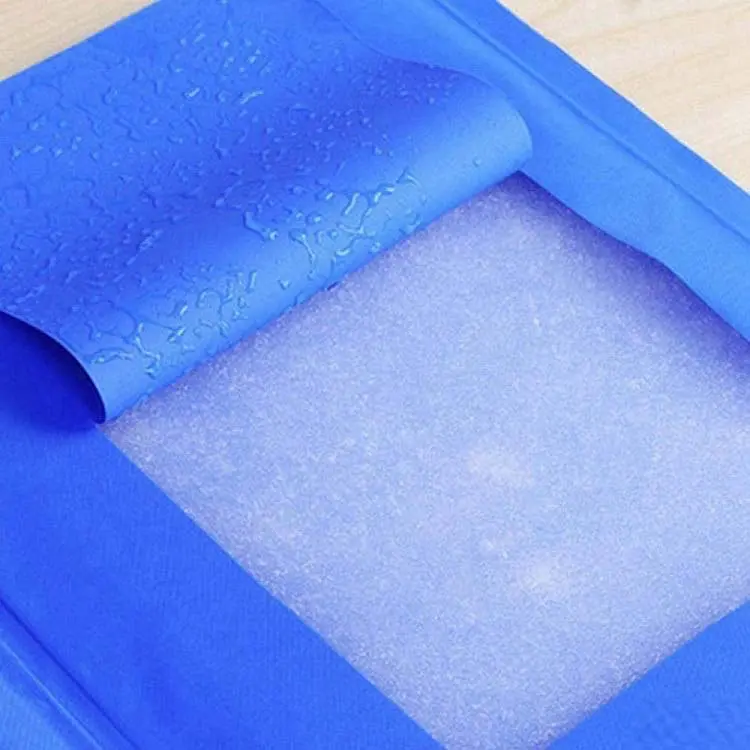
Do not accept “pet safe,” “non-toxic,” “bite resistant,” or “puncture proof” as self-supporting material descriptions. Ask for the formulation or component identity that can be shared, the applicable supplier documents, intended market, restrictions, and finished-product tests. Evidence for one component is not automatically evidence for the finished mat.
Specify the gel instead of approving a color
A gel’s color does not establish thermal behavior, ingestion safety, stability, or compatibility with the shell. The product brief should identify the approved formulation or controlled supplier reference, nominal fill mass, acceptable variation, viscosity or flow expectation at the relevant condition, and any required documentation for the target market.
During sampling, review:
- Whether the fill distributes evenly when the mat is flat and after storage
- Whether it collects into uncomfortable lumps or leaves large empty areas
- How the mat responds after folding, compression, and temperature conditioning
- Whether fill and shell remain compatible through the proposed care routine
- Whether odor, color transfer, separation, or visible migration changes after cycling
These observations are comparative. If a performance claim is required, define the test conditions, instruments, endpoint, sample count, and acceptance limit before asking a laboratory or supplier to run it.
Seams are a product feature, not leftover border
Large filled mats place repeated stress on perimeter seams and any internal chamber lines. Corners, fold lines, valve or fill points, and changes in material thickness deserve particular attention. The seam also reduces usable resting area, so the finished outer dimensions and the active filled area should be recorded separately.
Use Cryozin’s guide to seal width and edge design to structure the discussion. The correct seal width is not a universal number: it depends on material system, welding or sealing process, thickness, fill, geometry, expected handling, and validated test method.
Visual inspection should look for inconsistent width, skipped areas, channels, wrinkles, contamination, sharp corners, edge lift, delamination, and fill caught in the seal. Mechanical and leak checks should be agreed for the exact construction instead of copied from an unrelated small gel pack.
Size the mat for posture and placement
“Small, medium, and large” are not enough for a private-label specification. Record finished length and width, usable filled area, thickness under a defined condition, total mass, fold pattern, and packed size. Then connect those values to the intended resting posture and location.
Ask the product team to define:
- Target dog size range and whether full-body or partial contact is intended
- Use on floor, bed, crate, vehicle cargo area, outdoor shade, or another supervised setting
- Flat, segmented, rollable, or foldable storage
- Whether claws, digging, chewing, or frequent relocation are foreseeable
- Whether a cover, non-slip backing, carry handle, or storage bag is part of the product
- Carton dimensions, retail shelf format, and e-commerce parcel constraints
A larger mat increases contact area but also adds fill mass, seam length, package volume, and handling load. A segmented design may control fill movement and folding, while creating more internal seams to inspect.
Build pet-safety communication into the product
A gel mat can be damaged by chewing, claws, sharp crate edges, or unsuitable storage. The instructions should tell owners to supervise initial use, inspect before each use, remove the product if the shell or seam is damaged, prevent access to exposed fill, follow the stated cleaning method, and contact a veterinarian or animal poison resource if ingestion or illness is suspected.

The ASPCA advises providing pets with fresh clean water, shade, and a cool indoor area during hot weather, and warns owners to recognize signs of overheating and contact a veterinarian. The American Veterinary Medical Association’s pet first-aid guidance treats heatstroke as an emergency. A mat must not carry the full burden of heat-safety communication.
A practical sample-check protocol
Step 1: freeze the specification
Record the sample version, finished dimensions, usable area, materials, fill reference and mass, chamber map, seam process, color, print, cover, cleaning method, labels, warnings, packaging, and target market. Photographs should identify the approved sample and any accepted cosmetic boundary.
Step 2: measure before use
Measure length, width, usable filled area, mass, seam width at planned locations, and package size. Inspect surface, corners, fill point, internal chambers, printing, and closure or accessories. Compare the record with the approved specification.

Step 3: simulate the actual routine
Prepare the mat exactly as the instructions state. Place it on each intended surface, allow a supervised dog to approach voluntarily, and observe grip, noise, bunching, edge lift, posture, and ease of leaving the mat. Do not restrain an animal on the product or extend exposure to prove a marketing claim.
Step 4: record thermal behavior
If the program needs a cooling-performance statement, define room conditions, starting temperature, contact method or test load, sensor position, recording interval, duration, and endpoint. Test multiple samples. Report the method with the result so that a buyer can reproduce it.
Step 5: check cleaning and storage
Use the proposed cleaning method, then inspect for residue, odor, discoloration, delamination, swelling, seam change, and retained moisture. Dry and store the mat as instructed, including any fold or roll, before repeating the inspection.
Step 6: challenge likely failure points
Agree project-specific compression, flexing, edge, seam, leak, abrasion, packaging, and transport checks. If puncture or chew resistance is a requirement, define a repeatable test and an honest limitation. “Indestructible” is not a credible acceptance criterion.
Turn sample observations into acceptance rules
A sample checklist is useful only when it leads to a release decision. Separate defects by consequence—for example, leakage or exposed fill, functional fit or seam failures, and cosmetic variation—then agree the inspection method and sampling plan.
ISO 28590 introduces the ISO 2859 series for acceptance sampling by attributes. It does not choose an AQL, inspection level, or critical-defect policy for a pet mat. Buyer and supplier must define those values from risk, market, contract, and quality-system needs. High-consequence defects may require controls beyond routine sampling.
Cryozin’s sample approval checklist, leak-testing overview, and post-production inspection guide can help teams organize the record without pretending that one test suits every construction.
What to send in an OEM dog-mat brief
- Target market, sales channel, intended use, and claim boundaries
- Target dog size range, resting posture, and use locations
- Finished dimensions, usable area, thickness, mass, fold or chamber pattern
- Outer material, backing, cover, texture, color, and artwork
- Controlled gel or fill specification and required documents
- Seam method, corner geometry, fill point, and inspection points
- Cleaning, drying, storage, supervision, damage, and disposal instructions
- Performance, seam, leak, abrasion, packaging, and transport test methods
- Retail packaging, barcode, manual languages, carton, and e-commerce needs
- Quantity, sample variants, approval owners, and change-control process
The Cryozin Pet Care solution page is the OEM-project hub; the Pet Care product category remains the place to compare current formats. Use the product specification template to consolidate decisions before quotation.
For Pet Cooling Mats & Pads, the currently confirmed standard MOQ is 300 pieces. Current baseline timing is 1–3 business days for renderings, 3–7 business days for samples, and 18–25 business days for standard production. Custom work can take longer and is confirmed by project. The actual quotation should state the start event, approval sequence, component availability, test scope, and shipping time.
Frequently asked questions
Do gel-filled dog cooling mats need refrigeration?
It depends on the approved construction and instructions. Some products are designed for room-temperature use, while others require refrigeration or another preparation method. The supplier should state the mechanism and the buyer should test the exact sample accordingly.
Are dog cooling mats chew proof?
No broad promise is credible. Material, thickness, seams, animal behavior, claws, teeth, supervision, and product condition all affect damage risk. Instructions should require inspection and removal when damage appears.
Can a pet cooling mat prevent heatstroke?
It should not be marketed as a substitute for water, shade, a cool environment, appropriate activity, supervision, or veterinary care. Signs of overheating require prompt professional attention.
How should buyers compare cooling duration?
Use the same room conditions, starting condition, test load or contact method, sensor position, recording interval, and endpoint across multiple samples. A duration without those conditions is not a reliable procurement metric.
What is the first sample check?
Confirm the bill of materials and construction against the written specification, then measure finished size, usable area, mass, seams, surface, and packaging before conditioning or use. This creates a baseline for every later observation.
Source the mat that can be verified
A stronger gel-filled dog cooling mat brief turns every attractive feature into a measurable decision: surface, fill, support, seams, size, care, warnings, packaging, and acceptance. That record helps product teams compare suppliers, approve samples, control changes, and respond honestly to customer questions.
To start a project, send Cryozin the target market, dog size range, dimensions, construction, performance method, safety communication, quantity, artwork, and packaging plan. The team can identify confirmed options, conditional requirements, and tests that must be agreed before mass production.
