

A lunch bag can have room for an ice pack and still fail to close once the meal is packed. For lunch box ice packs, start with the space left around the loaded food containers, then compare a soft pouch and a hard-shell block in that space.
On this page
A pouch is worth sampling when a broad, thin format suits the layout. A hard-shell block is worth sampling when the container has room for a defined molded shape. The useful comparison is the complete, prepared pack—including its edges, closure, and any sleeve—inside the lunch set you plan to sell.
This guide helps lunch-bag brands, container suppliers, and retail buyers make that choice and record it in a copyable container-fit card.
Soft pouches vs. hard-shell lunch box ice packs
Neither format wins on fit in every bag. Use the following checks to shortlist samples before discussing artwork or a retail bundle.
| Fit decision | Soft pouch | Hard-shell block |
|---|---|---|
| Space above a lunch container | Check the thickest filled area and the perimeter seal, including any sleeve. | Check the full body thickness, raised features, and filling closure. |
| Space beside a bottle or food box | Sample the intended shape in that position. A flexible outer film does not establish how the prepared filling will bend. | Confirm that the molded footprint clears the container wall, bottle, and dividers. |
| A dedicated pocket | Check the pocket opening as well as its inside dimensions; include the pouch seam and sleeve opening. | Check that the whole block can pass through the opening without catching its closure or molded edges. |
| Repeatable loading | Record orientation and where the filled pouch sits. Check whether the shape shifts during handling. | Record which face points toward the food container and where the closure sits. |
| A coordinated retail set | Specify whether a sleeve is included, removable, and counted as a separate component. | Identify the exact mold and fill state. Similar-looking blocks are not automatically interchangeable. |
Both formats appear in current retail ranges. Bentgo’s Chillers listing identifies an HDPE-shell product, while Yumbox’s gel-pack set includes removable fabric sleeves. These are useful examples of different assemblies to measure; their specifications and claims apply to their own products.
Measure the space that remains after lunch is packed
Start with the intended food boxes, bottle, cutlery, and dividers in place. A bag’s advertised capacity or outside dimensions will not tell a supplier how much room remains for a cooling pack.
Mark the proposed pack position on a photograph or drawing. Distinguish a pack placed above a closed food box from one inside the lunch box itself, or one held in a separate bag pocket. These arrangements have different clearance and contact requirements.
- Inside length and width: measure the usable space at the proposed pack position, including rounded corners and tapered walls.
- Closed-lid clearance: include any inward-projecting lid, gasket, cutlery holder, or pocket. Check the lid’s path as it closes.
- Loading access: measure the narrowest opening the pack must pass through, rather than only the larger space beyond it.
- Competing items: keep the bottle, food containers, and required accessories in the layout while checking fit.
Agree how much clearance the design needs. Do not use a zipper or latch to force an oversized pack into place, or assume that a tight sample fit allows for normal variation in the bag and pack.
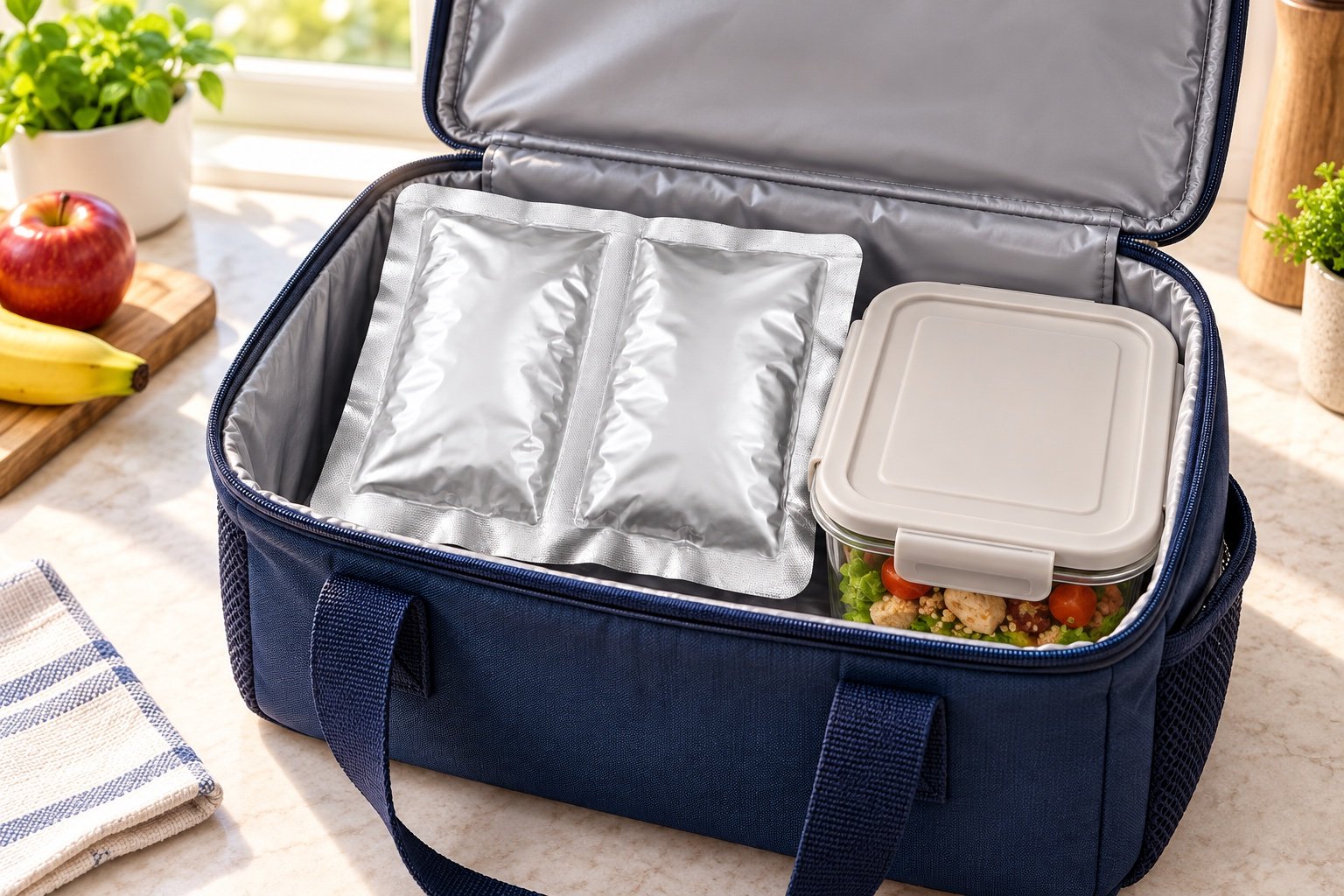
Compare the prepared samples, not just flat drawings
For a soft pouch, the flat outline is only part of the fit record. Ask for the filled thickness, the perimeter-seal dimensions, and the shape after the agreed preparation. If a fabric sleeve is part of the retail set, measure the assembly with that sleeve fitted.
For a hard-shell block, include the molded ribs, dimples, neck, and completed closure in the overall envelope. A body dimension that leaves out a protruding cap can give a misleading fit result. For a buyer-filled configuration, approve the selected fill amount and closed assembly before treating it as the reference sample.
Use the preparation instructions agreed for each candidate. “Soft pouch” describes the outer construction; it does not guarantee flexibility when frozen. Record the sample’s condition when you measure it so the supplier and buyer can repeat the check.
Run a close, carry, and reload check
A pack that fits in an open bag still needs a handling check. Use the actual lunch set and the intended contents or representative packaged items, with the agreed separation between the pack and the food.
- Load the set: place the containers and pack in their marked positions. Photograph the arrangement.
- Close it normally: check the lid, zipper, or latch without extra force. Look for a trapped pouch seal, sleeve edge, cap, or rib.
- Carry it as intended: use the handle or carry position the customer will use. Inspect where the pack and containers have moved.
- Remove and replace the pack: check whether a user can retrieve it without forcing a food-box lid open or unloading the entire bag.
- Record the outcome: note the sample ID, container version, loading photograph, and any change needed before approval.
Define acceptance points in advance: normal closure, accessible removal, no trapped edges or closures, and movement within the position your design permits. This is a fit and handling check. Any cooling-duration or food-temperature claim needs a separate evaluation of the complete lunch arrangement; a neat fit alone does not establish it.
Choose the retail bundle after the fit is clear
A single accessory pack, a pair of packs, and a bag-and-pack bundle are different purchasing units. State the pack count per retail package, whether a sleeve is included, and which lunch-container models the package will identify. A spare-pack offer should name the approved item, rather than simply say “universal replacement.”
Check the assembly with the intended retail artwork and labels, too. A label, hangtag, or sleeve added after the fit trial may change how the pack enters a pocket or sits against a container. Keep those components in the final sample record.
For Cryozin samples, these three existing forms provide different starting points:
- Thin square cooling pouch: a single-pouch form to assess against a broad, flat space. Confirm its selected dimensions and prepared thickness from the project record.
- Flat hard-shell brick with four molded dimples: check the complete footprint, thickness, and closure against the proposed layout.
- Ribbed hard-shell brick with a notched edge: measure the ribs and notch on the selected mold. Approve that mold’s dimensions rather than measurements from a similar-looking block.
These are sample candidates, not confirmed matches for a particular lunch box. The food and lunch-container cooling-pack directory remains the place to compare available product forms.

Copy this lunch-container fit card
Send the completed card with your container drawing or loading photographs. Use it as a working sample record, adding the tolerances and acceptance limits agreed for your project.
PROJECT / RETAIL SET:
Target market and intended user:
Lunch container or bag model / revision:
Food boxes, bottle, dividers, and accessories included:

AVAILABLE SPACE
Proposed pack position and orientation:
Usable internal length × width × height:
Narrowest loading opening:
Lid / hinge / gasket / pocket restrictions:
Required clearance and agreed tolerances:

COMPLETE PACK SAMPLE
Supplier / item / sample ID / revision:
Soft pouch or exact hard-shell mold:
Selected fill state and finished weight:
Agreed preparation and condition when measured:
Prepared length × width × maximum thickness:
Seals / ribs / neck / cap included in measurements:
Sleeve or other fitted components included:

LAYOUT AND APPROVAL
Separation from food and its packaging:
Pack quantity per lunch set / per retail package:
Loading photo or drawing reference:
Close / carry / remove / reload observations:
Fit decision, required changes, reviewer, and date:
Approved sample and artwork references:
Questions buyers ask before approving a set
Can one pack work with several lunch-bag models?
Possibly, but check each named model with its intended contents. Make a simple compatibility list tied to the same pack sample. A pass in one bag does not establish fit in a smaller opening, a divided box, or a different lid design.
Can a soft pouch bend around the lunch container?
Only if the selected, prepared sample allows the required shape without stressing its seams or obstructing the closure. If bending is part of the design, show the supplier the required position and approve it on that sample. Do not infer it from an empty-film photograph.
Should we choose the largest pack that fits?
Choose a candidate that leaves the required room for food and normal handling. Then assess cooling performance separately. Increasing pack size can change usable space, weight, and loading; size by itself does not establish a longer safe holding time.
Send the container layout with your sample request
Cryozin can review a pouch or hard-shell format against your lunch-set brief. Send the container drawing or sample, the completed fit card, expected quantity, and retail artwork needs. Identify whether you want a standard product or a custom geometry, and confirm the selected fill state for any hard-shell sample.
