

Reusable ice pack storage life does not have one responsible universal value. The useful answer for a buyer comes from a defined product configuration, storage conditions, use cycle, failure criteria, and evidence plan. A pack that still looks acceptable may no longer meet a leakage, flexibility, labeling, or thermal requirement.
This guide explains how a B2B buyer can turn “storage life” into a measurable specification. It does not assign a shelf-life period or reuse-cycle count to every ice pack. Those values must be supported for the exact film, seal geometry, fill, printing, closure, packaging, and intended use.
On this page
Buyer takeaway
- Define whether the claim concerns unopened storage, repeated-use service life, or thermal performance per use.
- Write the failure criteria and acceptance limits before testing.
- Test the approved product revision in its real unit packaging and master-carton configuration.
- Keep real-time evidence, retained samples, lot identity, deviations, and material changes traceable.
Start by defining which kind of life you mean
Several different questions are often compressed into one request for “lifespan.” Separating them prevents an attractive but untestable claim.
| Term | Buyer question | Typical evidence |
|---|---|---|
| Unopened storage life | How long can finished, unused packs remain in their specified warehouse and retail packaging? | Real-time storage data, packaging inspection, seal/leak checks, print and label review |
| In-use service life | How long does the pack remain fit for the intended repeated-use program? | Defined conditioning and use-cycle protocol followed by functional checks |
| Thermal hold time per use | How long does one conditioned pack help maintain a defined temperature in a specific setup? | Instrumented thermal trial with a documented pack-out and acceptance limits |
| Warranty or replacement interval | What commercial commitment will the supplier or brand make? | Approved commercial terms supported by product evidence |
These are not interchangeable. In particular, a thermal hold-time study does not establish storage life, and a visually acceptable stored pack does not prove performance after repeated freezing, flexing, or heating.

What can change while a reusable ice pack is stored or used?
The critical failure modes depend on the construction. A buyer should review at least the following areas instead of asking only whether the gel is “still cold.”
- Film or laminate: cracking, pinholes, delamination, embrittlement, blocking, discoloration, or loss of flexibility.
- Heat seals and welded features: channel leaks, edge damage, seal creep, stress concentration at corners, or damage around chambers and attachments.
- Fill system: phase separation, evaporation through the package, hardening, viscosity change, microbial concerns where relevant, or an altered freeze/thaw response.
- Printing and labels: abrasion, ink transfer, loss of legibility, adhesive failure, or a lot code that cannot be traced.
- Accessories: hook-and-loop wear, strap elongation, fabric damage, stitching failure, or cover shrinkage.
- Secondary packaging: carton deformation, moisture exposure, compression, contamination, and orientation during storage or distribution.
Not every project needs every test. The point is to connect the intended claim to plausible failure modes and then select a proportionate evidence plan.
Build a storage-life validation matrix
A useful protocol compares the approved baseline with samples after defined storage and conditioning. Record the exact product revision, lot, sample quantity, environment, orientation, package configuration, inspection intervals, and acceptance criteria before testing begins.
| Checkpoint | What to record | Example decision |
|---|---|---|
| Initial baseline | Appearance, dimensions, filled mass, seal geometry, flexibility, leakage status, and agreed thermal method | Samples match the approved specification |
| Stored condition | Temperature/humidity range, duration, packaging state, orientation, and any excursions | Condition is representative and fully documented |
| Post-storage inspection | Package, label, fill, seams, accessories, odor where appropriate, and traceability | No predefined critical defect |
| Functional verification | Leak or seal method, flexibility or mechanical check, and thermal trial if the claim requires it | Results stay within approved limits |
| Disposition | Pass, investigation, retest rationale, or specification/change-control action | Decision is traceable to the acceptance plan |
ASTM publishes methods that may help a qualified buyer or laboratory design parts of this program. For example, ASTM F88/F88M addresses seal strength of flexible barrier materials, ASTM D3078 addresses gross leaks in flexible packaging by bubble emission, and ASTM D4332 covers conditioning of packages or packaging components before testing. These standards do not prescribe a universal ice-pack lifespan. Their applicability, sample preparation, acceptance limits, and any deviations must be decided for the actual product and claim.
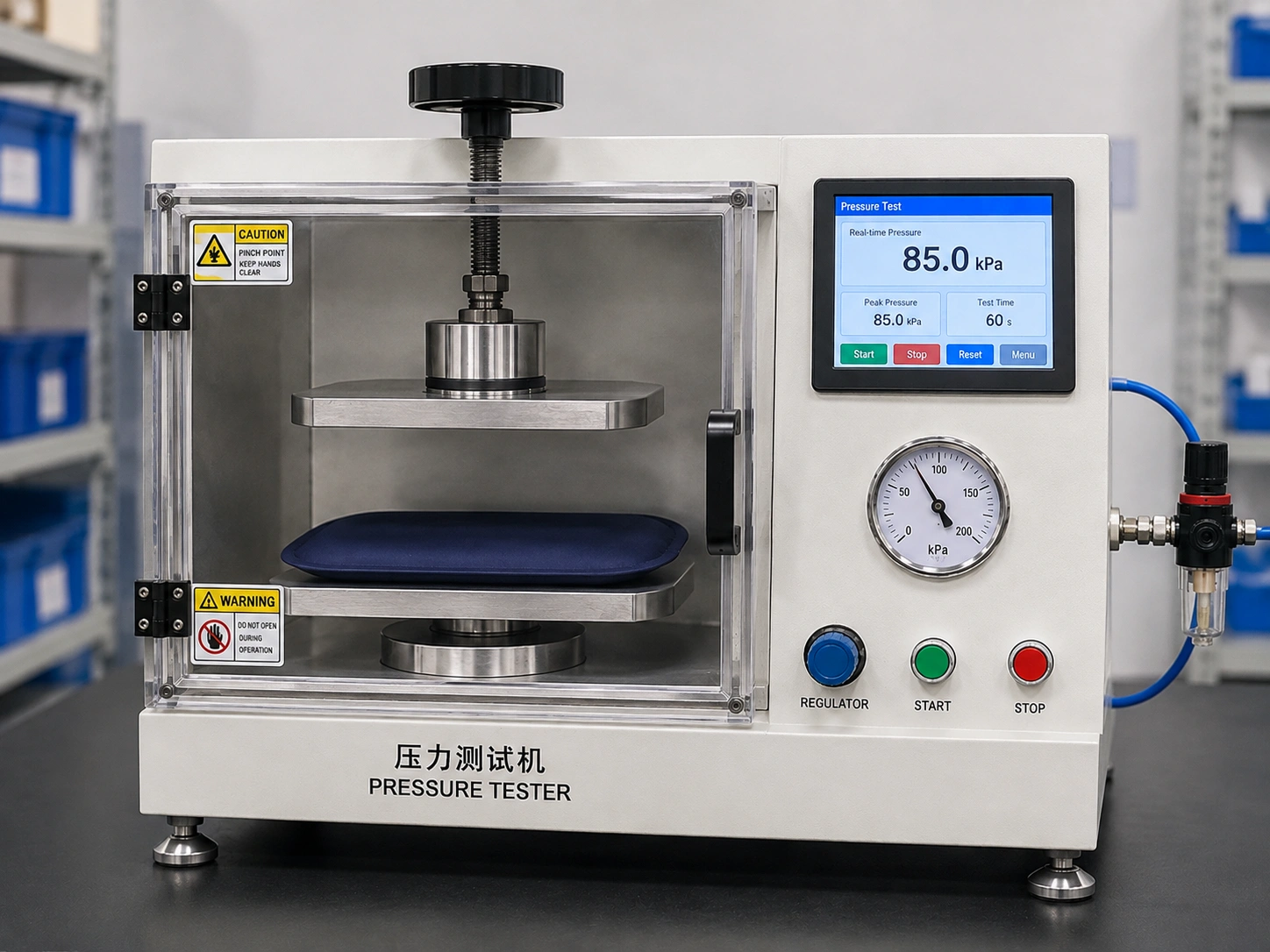
Real-time storage, accelerated conditioning, and cycle tests answer different questions
Real-time storage
Real-time samples are kept in the specified packaging and environment for the actual elapsed period. This is the most direct evidence for an unopened storage-life claim, but it takes time. Retained samples and scheduled inspections allow a brand to build evidence after launch without losing lot traceability.
Accelerated or stressed conditioning
Elevated or cycling conditions can reveal failure modes faster, but a severe condition is not automatically equivalent to a stated number of months or years. The relationship must be justified for the particular material system, and stressed samples should not replace ongoing real-time evidence without a sound technical basis.
Repeated-use cycling
Cycle testing should describe one complete use cycle: conditioning temperature and time, thaw or heat exposure, load, flexing, cleaning if applicable, rest time, and inspection. A supplier should not promise a cycle count based on an unrelated material or a different pack geometry.
Thermal performance needs a separate, controlled test
If the business claim includes temperature performance, define the entire setup: pack dimensions and fill mass, conditioning state, number and position of packs, payload type and starting temperature, cooler or shipper construction, ambient profile, sensor locations, door-opening or handling events, and the pass/fail temperature range. For more detail, see our B2B guide to ice-pack cooling-duration factors.

Set acceptance criteria before seeing the results
“No obvious problem” is not an acceptance plan. The buyer and supplier should agree which defects are critical, major, or minor and which numeric limits apply. Depending on the product, the plan may include:
- no visible leakage or channel leak;
- mass change within an approved tolerance;
- seal width and appearance within the controlled drawing;
- no cracking, delamination, severe blocking, or sharp edge;
- required flexibility after the defined conditioning step;
- label and lot code remain legible;
- accessories remain functional; and
- thermal results meet the project-specific protocol when thermal performance is part of the claim.
Sampling also matters. A result from one hand-selected unit cannot describe a production lot. Define the number of lots, samples per lot, destructive versus non-destructive checks, and the response to a failure.
Storage instructions should protect the validated state
Labels, cartons, and buyer documents should state the storage conditions that the evidence supports. Avoid direct sunlight, sharp objects, excessive stacking, contamination, and unapproved temperature exposure where those conditions could damage the product or package. The exact limits must come from the approved product record. Our separate bulk shipping and storage guide covers warehouse and distribution controls in more detail. When distribution damage is part of the risk assessment, ASTM D5276 is one recognized reference for free-fall drop testing of loaded containers; the buyer still has to define the actual package, drop sequence, conditioning, and acceptance criteria.

Documents to request from a reusable ice pack supplier
- The controlled product specification, drawing, bill of materials, and revision.
- The proposed storage statement and the evidence supporting it.
- The test protocol, sample identity, dates, raw or summarized results, deviations, and approval status.
- Leak, seal, dimensional, filled-mass, and functional acceptance criteria.
- Lot-coding and retained-sample procedure.
- Material or process change-notification expectations.
- Packaging specification, carton configuration, and storage/handling instructions.
- The investigation and disposition process if monitoring finds an out-of-limit result.
For a broader view of production controls, review Cryozin’s quality-control overview and our explanation of ice-pack leak-testing methods. Buyers who are still choosing a format can also compare the current reusable ice pack range; projects that require controlled dimensions, chambers, printing, or packaging should move into a documented custom ice pack brief. These pages support product selection and sourcing; final methods and claims remain product- and project-specific.
Common storage-life mistakes
- Copying a competitor’s year or cycle claim: their materials, fill, sealing process, package, and use pattern may differ.
- Testing only thermal performance: a pack can cool while still failing a seal, label, flexibility, or packaging requirement.
- Using accelerated data as an automatic calendar conversion: the equivalence needs a defensible model and real-time follow-up.
- Changing a film or gel without reassessment: even a cost-saving change can alter sealing, migration, flexibility, or thermal behavior.
- Ignoring the secondary package: retail bags and cartons influence moisture, abrasion, contamination, and stacking exposure.
Frequently asked questions
Do reusable ice packs expire?
A manufacturer or brand may assign a storage period or replacement rule, but it should be tied to the exact product, packaging, conditions, and evidence. There is no single expiration period that applies to every reusable ice pack.
Can visual inspection prove that a stored pack is still good?
Visual inspection can identify swelling, leakage, delamination, print damage, or contamination, but it may not detect a weak seal, small leak, material change, or altered thermal performance. Use functional checks when the claim requires them.
Should buyers specify a number of freeze-thaw cycles?
Only if a repeated-use claim is commercially important and the cycle is fully defined. A cycle count without conditioning, handling, inspection, and failure criteria is not reproducible.
When should storage-life testing be repeated?
Reassessment may be appropriate after a material, supplier, thickness, formula, seal-tool, process, package, or intended-use change, and when complaints or monitoring identify a new failure mode. The change-control plan should define the trigger.
Plan the evidence before approving the claim
A credible reusable ice pack storage-life claim is the output of a controlled specification and validation plan—not a generic number added to a sales sheet. If you are developing a private-label or OEM format, send Cryozin the intended dimensions, materials, fill, use cycle, package, target market, and claim you need to support. The team can then discuss samples and an appropriate verification plan; final capabilities and acceptance criteria are confirmed for the project.
