

A PCM cooling neck ring and a flexible cooling neck wrap solve different product-design problems. A ring is a self-contained wearable with an enclosed phase-change fill, fixed geometry, and defined conditioning method. A wrap uses a flexible pack, textile carrier, or both to create broader and more adjustable contact around the neck and sometimes the shoulders.
For a B2B buyer, the better choice depends on intended use, fit range, conditioning, freedom of movement, surface feel, cleaning, packaging, and the evidence behind any cooling claim. Do not choose by a supplier’s advertised duration alone: compare the exact sample under the conditions written into the proposed instructions.
On this page
Cooling neck ring vs. cooling neck wrap: quick comparison
| Decision point | PCM cooling neck ring | Flexible cooling neck wrap |
|---|---|---|
| Basic construction | Enclosed PCM in a ring-shaped shell | Flexible gel, water-based, or PCM insert; may include textile sleeve, strap, or shaped pouch |
| Fit | Driven by internal opening, tube profile, gap, and finished weight | Driven by pack contour, contact area, strap path, closure, and adjustment range |
| Movement | Simple, untethered form with no loose strap when fit is correct | Can offer more retention and coverage, but closures and fabric must be positioned well |
| Conditioning | Must match the selected PCM and approved instructions | Depends on the insert: refrigerator, freezer, water activation, or another defined route |
| Cleaning | Usually focuses on wiping the sealed surface and checking for damage | May separate insert cleaning from textile washing, drying, and reassembly |
| Retail story | Compact, recognizable seasonal accessory | Broader comfort, adjustable fit, and body-contour story |
| Main sample risk | Poor opening geometry, pressure points, excessive weight, or uneven fill | Slipping, bulky closures, hard edges, poor frozen flexibility, or difficult care |
This table is a specification guide, not a performance ranking. “Ring” and “wrap” describe form factors; they do not establish a universal temperature, duration, safety outcome, or user preference.
Why these products are often confused
Searches for a neck cooler, cooling neck ring, neck cooling tube, cold neck wrap, or ice-pack neck wrap can lead to very different products. A buyer may encounter rigid or semi-rigid PCM rings, flexible gel wraps, water-soaked evaporative textiles, towel products, or fan-assisted devices.
That overlap matters. If the brief says only “neck cooler,” suppliers can quote products with different mechanisms, care routines, costs, and user experiences. Start the RFQ by naming the intended format and mechanism. Cryozin’s current PCM cooling neck ring range is the commercial owner for ring products. This comparison includes flexible wraps to clarify the buying decision; it does not imply that every neck-cooling technology is a Cryozin offering.
How a PCM cooling neck ring works
A PCM ring contains a phase-change material selected to absorb heat while changing phase around a specified temperature range. A peer-reviewed review of wearable thermal-management methods explains that PCMs store heat through latent heat during the transition, but also notes that usefulness depends on the selected phase-change temperature and the operating environment. The nominal phase-change point is a material property—not a guaranteed skin temperature or wear duration.
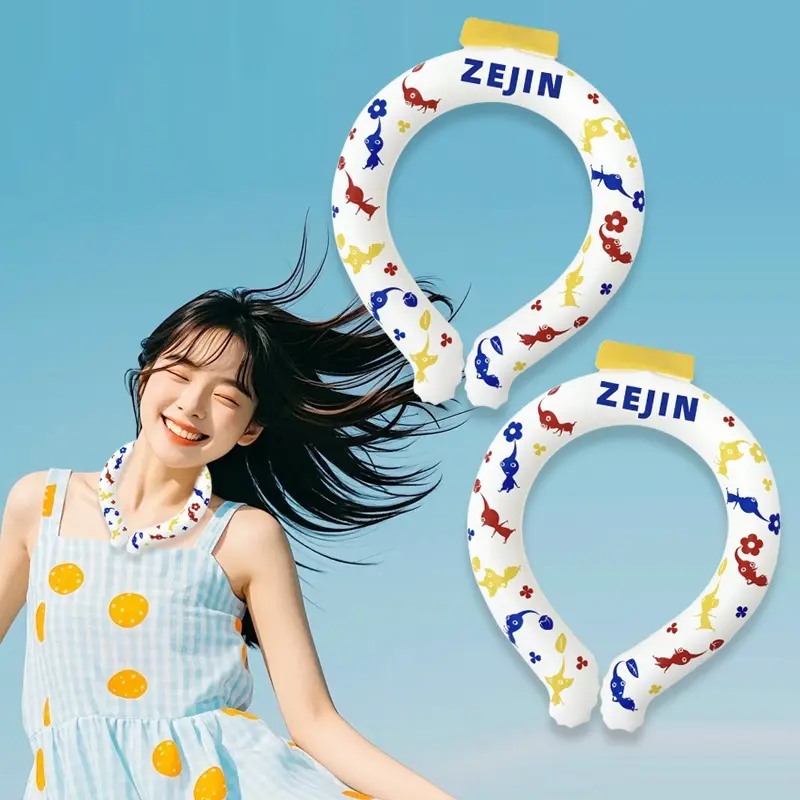
The ring format can suit retail or promotional programs that value a compact item, simple placement, and a recognizable silhouette. Its limitations are equally important: the opening is less adjustable than a wrap, total mass sits around a small body area, and an unsuitable tube profile or gap can create pressure or poor retention.
Specify the exact PCM, shell material, internal opening, tube diameter, finished mass, opening gap, closure detail, conditioning method, storage limits, and inspection instructions. Buyers comparing PCM options can use Cryozin’s guide to PCM phase-change temperature to understand why the target transition range must be connected to the use environment and test method.
How a flexible cooling neck wrap differs
A cooling neck wrap uses a flexible thermal element shaped around the back or sides of the neck. The element may be a sealed gel pouch, segmented insert, water-based pack, or another approved medium. A textile carrier can add softness, friction, adjustment, and removable components, but it also creates washing, drying, insertion, closure, and replacement questions.
A wrap may fit buyers who need:
- Broader coverage across the neck or shoulders
- An adjustable strap or closure for a wider fit range
- A fabric interface instead of direct contact with a sealed shell
- A removable insert or replaceable textile carrier
- A product architecture that can be extended to other body areas

Its tradeoffs include more components, a larger pack-out, possible slippage, edge or closure pressure, and a more involved care routine. A wrap conditioned in a freezer may also change flexibility and surface feel. Evaluate the finished product at the actual preparation condition, not only at room temperature.
Choose by use scenario, not by product name
| Buyer scenario | Likely starting point | What the sample must prove |
|---|---|---|
| Seasonal retail accessory for commuting or travel | PCM ring | Fit range, compact packaging, conditioning clarity, surface comfort, artwork durability |
| Outdoor-work comfort accessory | PCM ring or secured wrap | Movement, PPE interaction, loaded weight, retention, cleaning, and safe-use communication |
| Broader neck-and-shoulder contact | Contoured flexible wrap | Coverage, frozen flexibility, strap path, pressure distribution, and care |
| Private-label recovery range | Gel insert plus textile carrier | Body-area fit, insert retention, skin-facing layer, cleaning, labeling, and replacement logic |
| Promotional product with simple branding | Printed PCM ring | Print area, color reference, logo legibility, packaging, and approved claims |
These are routing examples, not medical or workplace-safety recommendations. A neck product should not be marketed as preventing heat illness or treating a condition unless the final product, intended use, evidence, labeling, and target-market requirements support that claim.
Write a measurable neck-product specification
1. Define the intended user and environment
State adult or youth-oriented fit, indoor or outdoor use, expected activity, clothing layers, ambient range to be evaluated, and whether the item is intended for work, recreation, commuting, retail gifting, or another context. Avoid a vague “one size fits all” brief.
2. Specify finished geometry
For a ring, record internal opening dimensions, tube profile, gap, closure, total mass, and acceptable dimensional tolerance. For a wrap, record overall size, active contact area, chamber layout, strap length and stretch, closure position, and the intended wearing direction.
3. Define the thermal system and preparation
Name the PCM or gel specification, preparation route, preparation position, starting condition, and the performance test. If a duration is required, define the ambient conditions, airflow, contact method, endpoint, sample size, and measurement equipment. Do not accept “lasts X hours” without those conditions.
4. Resolve the body interface
Choose direct sealed surface, textile backing, removable cover, or full carrier. Document surface feel, edge construction, condensation expectations, barrier instructions, pressure points, and any restrictions for prolonged or unsupervised use.
5. Plan cleaning, storage, and retirement
Instructions should separate wiping the sealed element from laundering a textile component. Define drying, storage orientation, folding limits, inspection points, and visible conditions that mean the item should no longer be used.
Run a sample protocol before approving artwork
A strong sample review moves from construction to conditioned use. Use the same draft instructions that customers would receive, and record any change made after the trial.
- Document check: match the sample to the bill of materials, dimensions, fill or PCM specification, artwork version, packaging, and target market.
- Room-temperature inspection: record finished dimensions, mass, symmetry, shell or fabric condition, edges, seals, closures, print, and labeling.
- Conditioning: prepare the product exactly as instructed and verify whether the complete fill reaches the intended condition.
- Fit ladder: assess more than one representative neck size. Record opening, pressure, movement, hair or clothing interaction, and ease of removal.
- Movement sequence: turn, bend, walk, sit, and perform the intended task while checking retention and pressure points.
- Thermal record: log starting condition, ambient conditions, contact setup, time, and endpoint. Compare options under the same method.
- Care cycle: clean, dry, store, and recondition according to the proposed instructions; inspect the surface, seams, fill distribution, and accessories again.
- Pack-out review: verify retail presentation, instructions, barcode area, carton orientation, deformation risk, and shipment protection.

Use Cryozin’s sample approval checklist and seal and edge-design guide to turn observations into written approval criteria.
Do not let a cooling accessory replace heat controls
For occupational use, CDC/NIOSH describes heat stress as the combined effect of environmental heat, metabolic heat, and clothing or PPE. NIOSH recognizes personal cooling systems as possible auxiliary measures but also notes limits involving weight, bulk, cooling duration, movement, and over-cooling. OSHA emphasizes water, rest, shade or a cool recovery area, acclimatization, training, monitoring, and emergency planning.
A neck ring or wrap is therefore one possible comfort component inside a broader program. It should not be used to justify longer exposure, replace site controls, or promise prevention of heat illness.
Commercial brief for a PCM neck-ring project
For a Cryozin PCM neck-ring inquiry, provide the user and environment, target phase-change range, internal opening, tube profile, finished weight, color, artwork, packaging, instructions, required documents, quantity, and market. Discuss the available 28°C, 18°C, 10°C, and 5°C nominal PCM options and TPU film enclosure, then confirm applicability to the selected neck-ring configuration. The transition point is not a guaranteed skin temperature or cooling duration; insert count, fill amount, and conditioning remain product-specific.
For a standard product, the starting quantity is 500 without printing or 1,000 per design with printing, subject to the exact configuration and sales unit. The 300 minimum for PCM cooling vests does not apply to neck rings. Use the custom ice pack MOQ guide to separate quantity by artwork from quantity by finished product.
Current baseline timing is 1–3 business days for renderings, 3–7 business days for samples, and 18–25 business days for standard production. Custom work can take longer and is confirmed by project. The quotation should state the actual start event, approval sequence, component availability, and shipping scope.
Review the current PCM cooling neck ring formats, then use Cryozin’s material-selection framework and quality-control overview to prepare the RFQ.
To compare actual constructions, review the plain PCM neck ring with two profiles and the pocketed scarf with removable gel packs. Approve fit and preparation for each selected format.
Frequently asked questions
Is a PCM neck ring the same as a gel neck wrap?
No. A PCM ring has an enclosed ring geometry and a specified phase-change fill. A gel neck wrap is typically a flexible pouch or insert, often with a textile carrier or strap. Their fit, preparation, care, and sample criteria differ.
Which product stays cool longer?
There is no reliable answer without a defined configuration and test. Fill type and mass, phase-change behavior, surface area, preparation, ambient temperature, airflow, body contact, clothing, and endpoint all affect the result. Compare samples under the same written method.
Can one neck-ring size fit every adult?
A universal claim should be avoided. Internal opening, tube profile, gap, material stiffness, finished mass, and individual anatomy change fit. Use a representative fit set and approve a size strategy from recorded observations.
Can a PCM neck ring prevent heat stroke?
It should not be presented as a stand-alone prevention method. For workplace heat, follow qualified occupational-safety guidance and a complete heat program. For individual health concerns, seek appropriate professional advice.
Select the architecture before requesting price
Choose a ring when the program values a compact, self-contained PCM format and the fit can be controlled. Choose a wrap when broader coverage, adjustment, textile comfort, or replaceable components are more important. Then test the exact sample at its real conditioning and use conditions.
To request a project review, send Cryozin the intended use, target market, fit range, thermal specification, preparation method, quantity, artwork, instructions, and packaging requirements. The team can review what is confirmed, what remains conditional, and what needs sample validation before production.
