
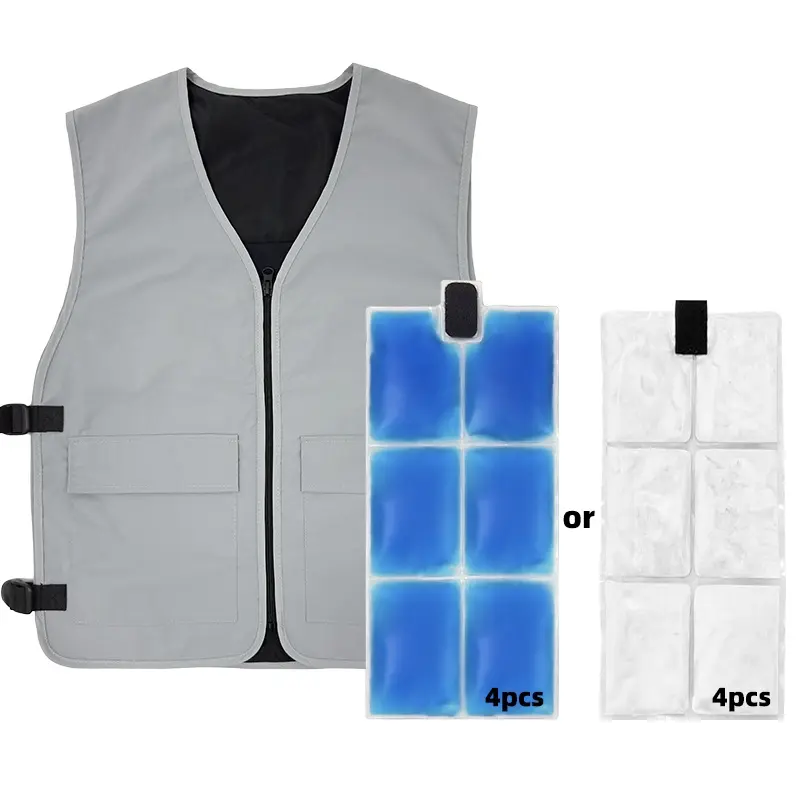
A PCM cooling vest sizing guide should do more than translate S, M, and L from another garment. A buyer needs three connected records: the intended wearer’s measurements, the finished vest and adjustment range, and the fit of the vest when its specified cooling modules are installed. A vest that looks right empty may sit differently once loaded.
This guide is for workwear brands, distributors, and procurement teams developing or selecting a phase change material (PCM) vest. It covers fit and pack placement—not whether PCM, evaporative, or fan-assisted technology is the right route. Start with that broader decision in our cooling-vest technology comparison.
On this page
Choose the vest architecture before writing a size chart
The carrier and cooling cells form one worn system. Changing from integrated cells to removable inserts changes the pockets, loaded thickness, weight distribution, laundering plan, and what must be checked during a fit trial. Cryozin’s current product library shows several construction directions; these are product examples, not a universal menu of interchangeable parts.
Integrated segmented vest
Visible construction: Front, back, and shoulder cell zones with buckle adjustments. Verify before approval: Exact cell specification, loaded dimensions and weight, strap range, and movement clearance for the selected model.
Removable-module vest
Visible construction: Zip-front carrier with separate inserts and side adjustments. Verify before approval: Pocket map, insert count and orientation, pocket retention, carrier size range, and care separation.
Pocketed gray vest
Visible construction: Front pockets and a pictured four-pack configuration. Verify before approval: Which packs are included in the agreed SKU, actual pack mass, pocket-to-pack fit, and replacement-pack identification.
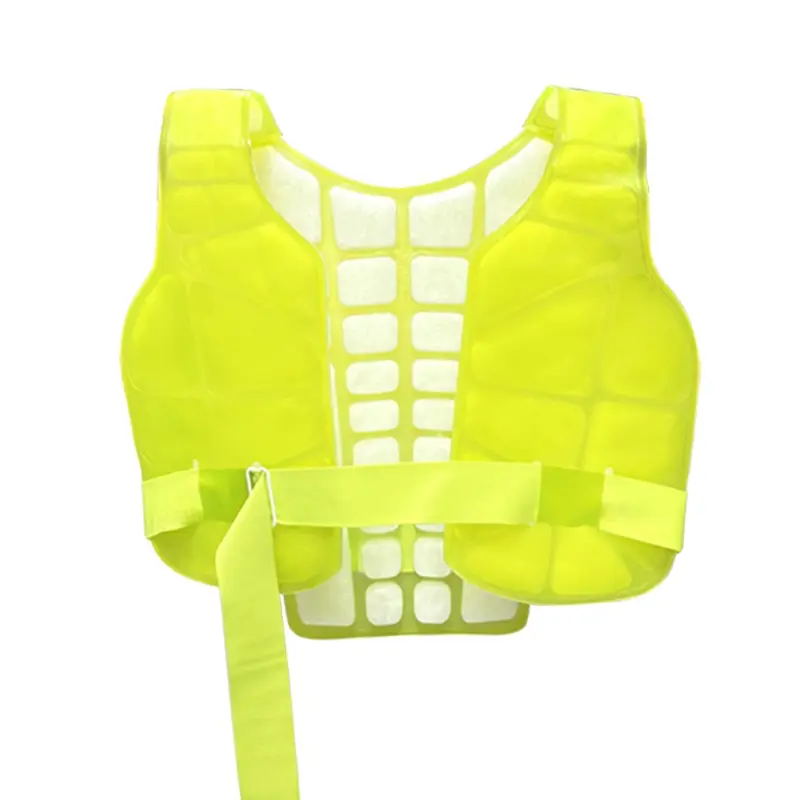
Wrap-adjusted cell vest
Visible construction: Cell layout and a broad external wrap strap. Verify before approval: Strap travel, contact and clearance at both ends of the proposed fit range, plus the approved PCM and care instructions.
These observations come from current product descriptions and images. They do not prove a particular temperature, cooling duration, workplace suitability, or size range. Confirm every selected configuration against its drawing and conditioned sample.
Measure people and the garment with the same landmarks
A label such as “one size adjustable” cannot replace a defined fit interval. Decide which body dimensions matter for the selected construction—usually chest and waist circumference, torso length, and the intended layer of clothing beneath the vest. Document the tape location and the wearer’s posture so two teams do not measure different things under the same field name.
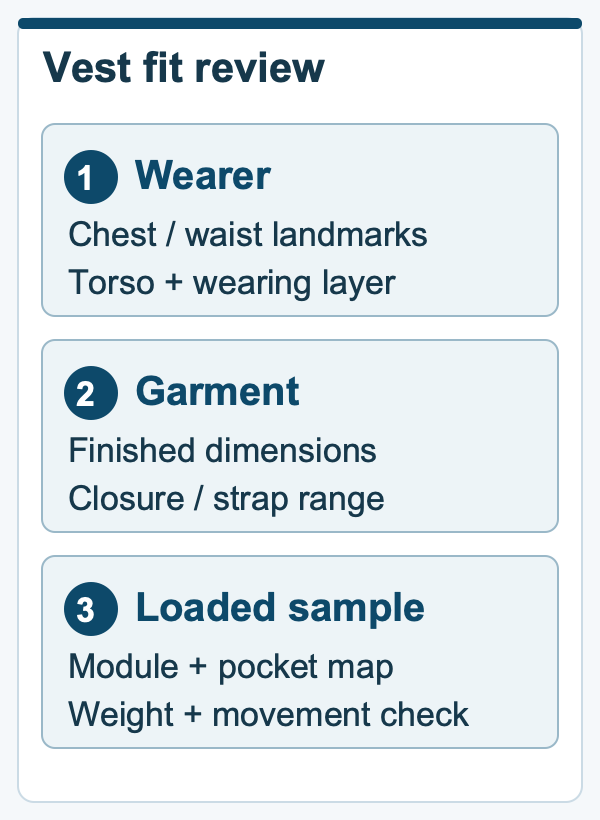
On the garment, ask for finished chest and waist width, length, shoulder opening, closure overlap, and the minimum and maximum usable strap positions. Distinguish a flat garment measurement from a body measurement. A size range should be approved against people or appropriately chosen fit forms at both ends—not inferred from strap length alone.
Record the intended wearing layer as part of the brief. A vest that fits over a light shirt may behave differently under a jacket or alongside other required equipment. Do not claim PPE compatibility from a catalog image. The buyer and workplace safety team must check the exact clothing combination and work tasks.
Check the loaded module map, not just an empty vest
For a removable-pack design, label every pocket and insert on the same drawing. Record pack dimensions and mass, insertion direction, pocket opening, and which module belongs in each position. For an integrated-cell design, record the cell pattern and areas that must bend or remain clear. A change in cell layout can alter fit even if the outer vest dimensions stay the same.
During a sample review, put the specified inserts into the specified pockets and use the approved conditioning instructions. Observe whether loaded modules shift, a pocket opens during movement, a cell edge presses at a bend, or the garment rotates. Record each observation against the sample revision. “It felt comfortable” is useful feedback but is not a substitute for a repeatable acceptance record.
For PCM selection and how to verify a phase-change specification, use the separate PCM phase-change temperature guide. The temperature choice cannot be made from vest fit alone.
Run a fit trial that resembles the intended task
Approve the sample in the condition and clothing system in which it will be assessed. For a workplace program, involve the employer’s safety lead; this article does not assess individual workers or certify a vest as protective equipment. A small trial can reveal design issues before a bulk order, but it must not be presented as proof of heat-illness prevention.
- Identify the build. Record vest revision, size, pack map, insert specification, preparation instructions, and total loaded mass.
- Test the proposed fit limits. Check representatives at the low and high ends of the intended measurement range, using the documented wearing layer and safe fitting procedure.
- Move through representative tasks. Observe reach, bend, sit, lift, and any task-specific posture that can change pocket position or closure tension. Do not simulate hazardous work without an appropriate safety plan.
- Check the interfaces. Record whether the vest interferes with required PPE, tools, harnesses, visibility garments, seating, or the worker’s normal range of motion.
- Repeat assembly and removal. Confirm that pack positions and closure steps can be understood and repeated without misplacing components.
- Log changes. Photograph the same sample ID and position; note the issue, proposed revision, recheck owner, and approval status.
OSHA’s heat-exposure control guidance describes cooling garments as one possible measure within a broader heat-safety program, alongside engineering and work-practice controls. A cooling vest should not be marketed or specified as a replacement for those controls.
Make the RFQ and sample approval specific
Send a short, versioned brief rather than a request for “standard cooling vests.” A useful first inquiry includes the target market and use setting, carrier architecture, wearer measurements, required wearing layers, size distribution, pocket or cell map, module specification to be verified, expected pack count, branding, packaging, and any workplace constraints. Attach a drawing when available and flag every undecided field.
Copy-ready PCM vest fit and module worksheet
Copy these fields into a versioned buyer brief; leave undecided items marked as open rather than guessing.
- Use and layers: Work or retail setting ____; garments/PPE worn with vest ____; market and instruction language ____.
- Wearer range: Chest and waist measurement landmarks ____; torso length method ____; target range and size distribution ____.
- Vest: Carrier/model and drawing revision ____; finished garment dimensions ____; usable closure/strap range ____.
- Modules: PCM/fill specification to verify ____; pocket map and insert count ____; pack dimensions and total loaded mass ____.
- Trial: Sample IDs and conditioning record ____; people/fit forms and task sequence ____; acceptance observations and recheck owner ____.
- Commercial handoff: Branding and pack-out ____; sample/drawing approvals ____; unresolved documents or exclusions ____.
This worksheet is a buying aid, not an existing Cryozin test record. Keep the completed version with the approved sample and follow the sample-approval checklist when changes are made after sign-off.
Questions to resolve before ordering
Can the same size chart cover every PCM vest model?
No. The outer pattern, adjustable closure, carrier fabric, cell thickness, and module position may differ. Approve a size chart for the exact configuration and a documented wearing layer.
Should we specify the coolest available PCM?
Not from the size brief alone. Select and verify the phase-change specification against the intended use, conditioning method, product instructions, and finished-vest tests. A catalog temperature is not a garment performance result.
Do removable inserts make fit easier?
They can give a buyer more flexibility in pack replacement or configuration, but they also introduce pocket-retention and assembly checks. Compare the complete loaded sample with an integrated-cell option before deciding.
What should a supplier receive first?
The intended user and wearing context, a proposed vest architecture, measurement ranges, a draft size/pack map, target market, and the questions that remain open. Cryozin’s PCM cooling vest catalog shows current formats; send the project brief to discuss which configuration should be sampled.
Choose a fit range you can actually verify
The strongest next step is not to add more sizes to a product listing. It is to connect wearer measurements, garment dimensions, the approved loaded pack map, and task observations to one sample revision. That gives the buyer and supplier a common basis for reviewing changes and preparing a useful RFQ.
Buying a PCM vest for a program? Compare the current vest formats and bring your measurement range, module map, target market, and packaging needs to the discussion.
Request a specification discussion
The standard MOQ for PCM cooling vests is 300 pcs; exact configuration and customized production timing require project confirmation.
Sources and further reading
- OSHA: Heat — Engineering Controls, Work Practices, and Personal Protective Equipment — context for workplace heat controls and cooling garments, not Cryozin product approval.
- Cooling Vests for Workers: PCM vs. Evaporative vs. Fan-Assisted Designs — technology selection before product fit.
- Why PCM Phase Change Temperature Matters in Custom Cooling Products — material specification and validation questions.
