
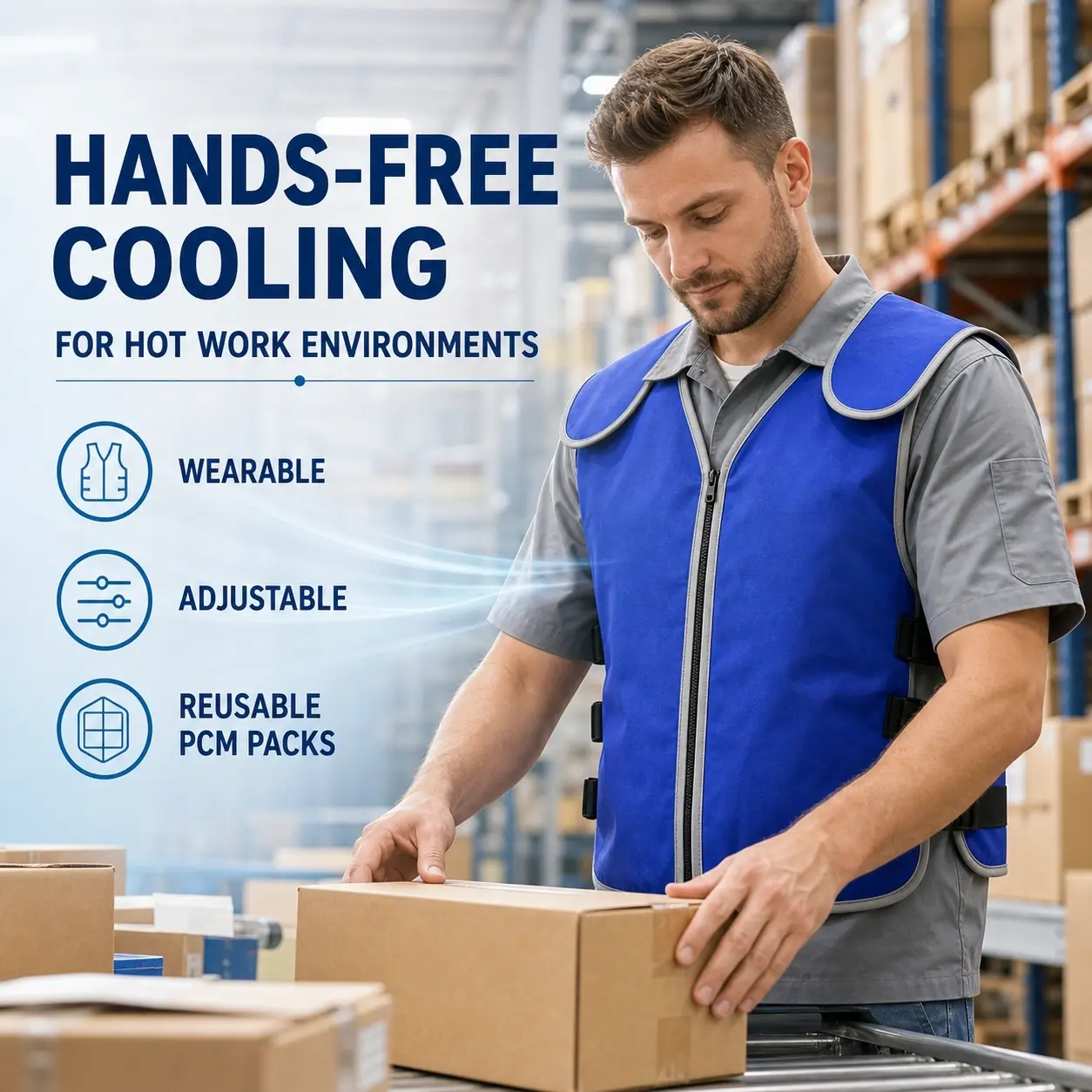
No single cooling-vest technology is best for every worker or worksite. Phase-change-material (PCM) vests are often considered when buyers want untethered cooling modules with a defined phase-change specification. Evaporative vests depend on water evaporation and therefore on humidity and airflow. Fan-assisted designs depend on powered airflow, clear intake and exhaust paths, and battery management.
For procurement teams, the choice should begin with the heat-risk assessment, task, environment, required PPE, mobility, shift plan, maintenance capability, and an occupational-safety review. A vest is one possible auxiliary control. It does not replace engineering controls, work practices, hydration, rest, acclimatization, supervision, or emergency procedures.
On this page
Cooling vests for workers: quick comparison
| Technology | Cooling mechanism | Operational dependencies | Common sourcing questions |
|---|---|---|---|
| PCM vest | Conditioned modules absorb heat as the material changes phase | Correct module specification, conditioning, rotation, loaded weight, and pocket retention | Phase-change point, module count, mass, pocket map, conditioning, replacement, and test conditions |
| Evaporative vest | Water evaporating from a wetted material removes heat | Water access, drying, airflow, humidity, hygiene, and wet-garment management | Activation method, absorbed water, dry/wet weight, drip control, drying time, laundering, and useful climate range |
| Fan-assisted vest | Battery-powered fans move ambient air through or under the garment | Battery, charging, airflow path, ambient air, dust/liquid conditions, noise, and snag control | Airflow, runtime test, battery standard, ingress protection, fan guards, placement, charging, and spares |
The table is a routing aid, not a performance ranking. Actual comfort and heat transfer depend on the complete garment, wearer, work rate, environment, clothing system, and test method.
First decide whether a vest belongs in the heat program
NIOSH describes occupational heat stress as the combination of environmental heat, metabolic heat, and clothing or PPE. The same outdoor temperature can create very different risk for a shaded forklift operator, a roofer in sun, a worker near a radiant furnace, and a person wearing impermeable protective clothing.
Before choosing a vest, document:
- Indoor or outdoor location, season, sunlight, radiant sources, humidity, and air movement
- Work rate, task duration, lifting, climbing, bending, and restricted postures
- Required PPE, high-visibility garments, harnesses, respirators, or protective coveralls
- Need for mobility versus access to tethered air, water, power, refrigeration, or a cool rest area
- Shift length, work/rest plan, module or battery rotation, and cleaning capacity
- Worker variability, medical restrictions handled by qualified personnel, training, and emergency response
NIOSH recommends reducing heat through engineering and administrative controls and providing training, water, rest, acclimatization, and monitoring appropriate to the worksite. OSHA likewise states that cooling devices may be useful in limited situations, but most heat programs should begin with engineering controls and work-practice changes. Treat those controls as the system; evaluate a vest within it.
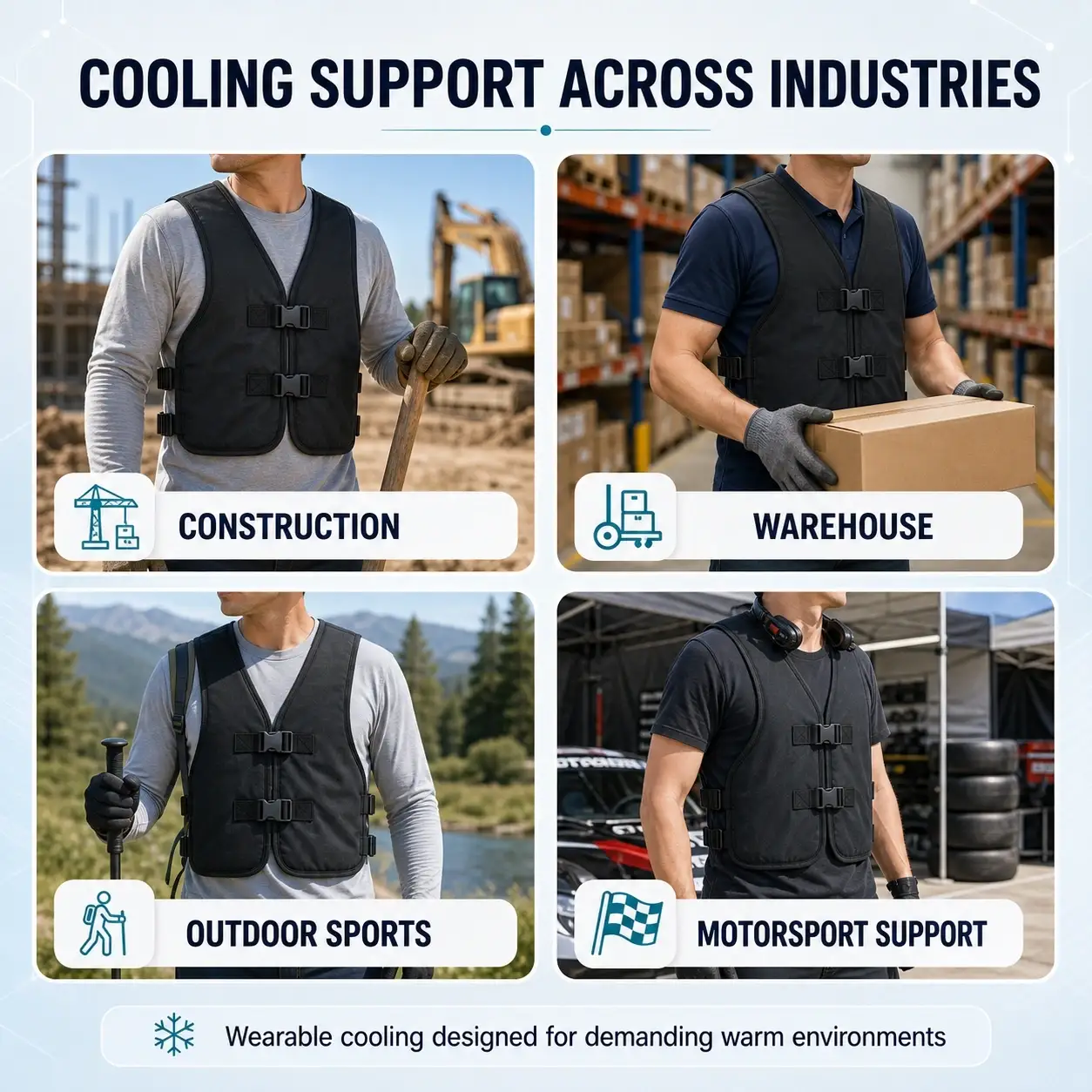
How a PCM cooling vest works
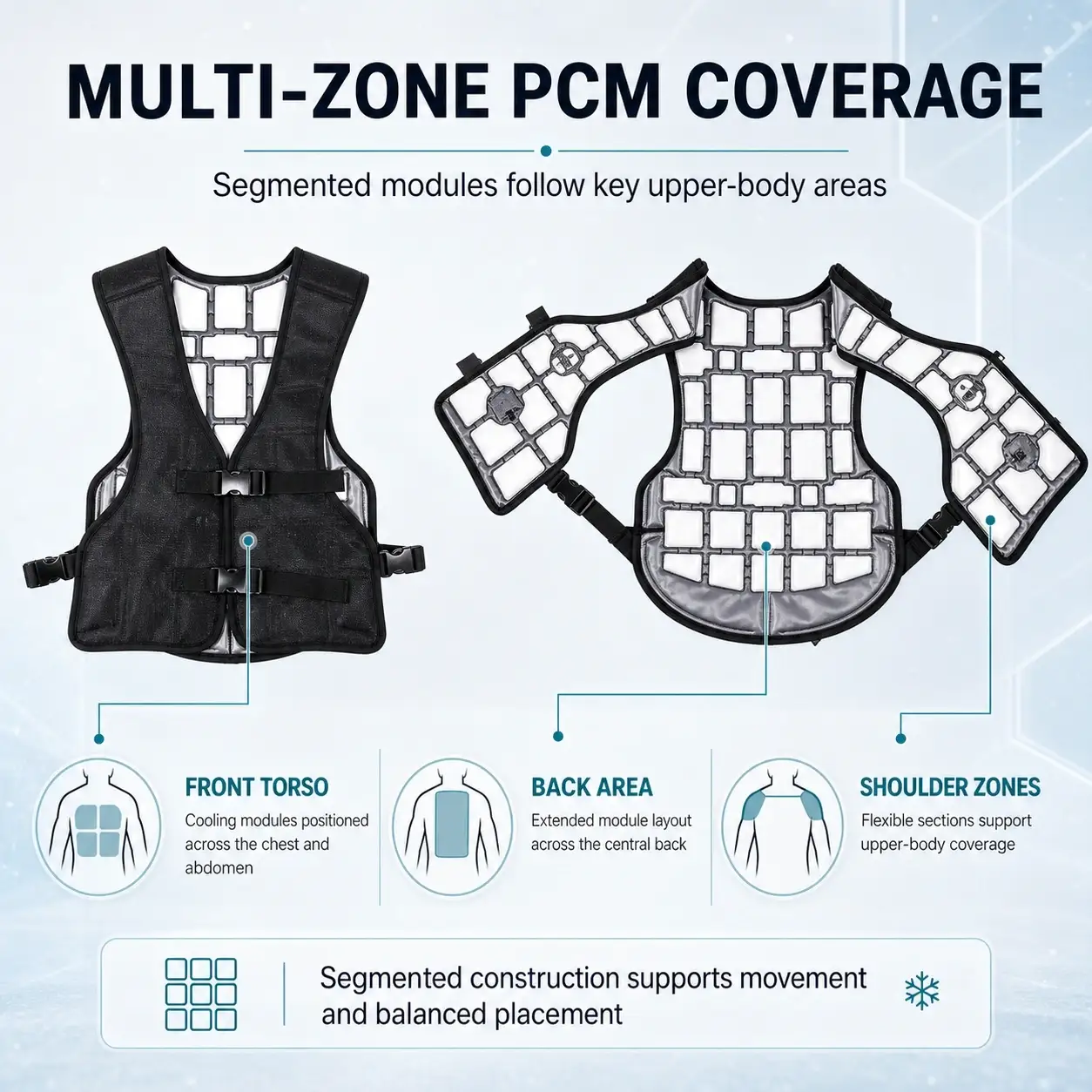
A PCM vest places conditioned modules near selected body areas. As the material absorbs heat around its phase-change range, it can provide a more defined transition behavior than a simple frozen-water pack. The nominal phase-change point is a material property; it is not a guaranteed skin temperature, core temperature, cooling duration, or heat-illness outcome.
PCM can be attractive when:
- The user must remain untethered and fan airflow would be blocked by other garments
- Humidity makes evaporation less dependable for the planned environment
- The operation can condition, identify, inspect, and rotate modules consistently
- A buyer wants removable coolant modules and a reusable vest shell
The tradeoffs include loaded weight, bulk, local cold sensation, module stiffness, conditioning equipment, rotation inventory, pocket retention, and performance that changes with activity and ambient conditions. Extremely cold modules are not automatically better. NIOSH notes practical limitations for wearable cooling systems, including weight, bulk, cooling that may not last long enough for some work, and problems when a system is too cold or restricts movement.
Buyers comparing PCM options should review Cryozin’s guide to PCM phase-change temperature. The correct project specification still requires a matched material record, module construction, conditioning method, vest layout, wearer interface, and finished-product test.
How an evaporative cooling vest works
An evaporative vest is wetted or filled with water so that evaporation removes heat from the garment surface. The mechanism needs an evaporation gradient and air exchange. As relative humidity rises or airflow falls, the drying rate—and therefore the potential cooling effect—can decrease. Clothing worn over the vest can also restrict evaporation.
This route can fit operations with ready water access, adequate airflow, and a manageable process for activation, dripping, drying, laundering, and storage. Procurement teams should ask for dry weight, saturated weight, activation time, retained water, drip behavior, drying time, useful environmental limits, material hygiene, odor control, and cleaning instructions.
A wet garment may be unsuitable around certain products, electrical tasks, contamination-controlled areas, or PPE systems. That is a worksite-compatibility question, not a universal defect. Cryozin does not use this comparison to claim that it manufactures evaporative vests; the category is included so buyers can choose the correct technology route before requesting a PCM product.
How a fan-assisted cooling vest works
A fan-assisted vest uses small powered fans to move ambient air through the garment or across an underlayer. Air movement can support convective and evaporative heat transfer when the intake, exhaust, clothing layers, and environment allow it. A fan does not make the incoming air colder, and its practical value changes with ambient temperature, humidity, radiant heat, work rate, and garment design.
Key tradeoffs include batteries, charging, electrical connectors, fan guards, noise, dust or liquid ingress, cable routing, snag risk, cleaning, spare parts, and the possibility that required outer PPE blocks airflow. Some hazardous locations may impose additional electrical-equipment restrictions that require a competent safety review.
Ask vendors to state the fan and battery model, voltage, capacity, charging system, airflow test method, operating modes, runtime test conditions, ingress or safety ratings with evidence, serviceability, replacement availability, and disposal instructions. Cryozin does not imply that it supplies fan-assisted designs merely by discussing them here.
Match the technology to the work environment
| Worksite condition | Question for PCM | Question for evaporative | Question for fan-assisted |
|---|---|---|---|
| High humidity | Can modules be rotated and conditioned for the shift? | Is there enough evaporation to justify the wet weight? | Will moving humid ambient air provide a useful effect? |
| Restricted or impermeable PPE | Can the loaded vest fit without changing PPE function? | Can moisture escape, and is wetting acceptable? | Are intake and exhaust paths blocked? |
| High mobility or climbing | Are modules retained and weight balanced? | Does the wet vest shift, drip, or restrict movement? | Are fans, cables, and batteries protected from snagging? |
| Dust, washdown, or rain | Can the shell and modules be cleaned and inspected? | Can the garment be dried and stored hygienically? | Is documented ingress protection suitable for the site? |
| Long shift | Is there a practical module-rotation and reconditioning plan? | Can workers reactivate and manage wet garments? | Are battery swaps, charging, and spare management controlled? |
| Remote work | What conditioning equipment is available before and during the shift? | Is clean water available? | Is charging or spare battery capacity adequate? |
Do not choose solely by a supplier’s advertised “hours.” Ask for the exact configuration and test conditions, then run a work-representative pilot. Any comparison should record ambient conditions, clothing, task, work rate, vest size, loaded weight, preparation, operating mode, duration, and endpoint.
Specify fit, movement, and PPE compatibility
A vest that feels acceptable while standing can interfere with bending, ladder use, driving, lifting, harnesses, high-visibility requirements, or emergency removal. The purchase specification should include garment measurements rather than “one size,” the adjustment range, total loaded weight, weight distribution, closures, module or fan retention, edge comfort, and compatibility with the intended base layer and outer PPE.
During sample review, check:
- Donning and doffing with the actual work clothing
- Reach, squat, climb, twist, carry, and seated tasks
- Visibility, identification, and any required reflective or high-visibility zones
- Interference with fall protection, vehicle restraints, tools, radios, or respirators
- Cold spots, wetness, pressure points, noise, vibration, and heat trapped by the shell
- Secure retention of modules, fans, batteries, cables, and closures
- Cleaning, drying, inspection, damage criteria, and replacement steps
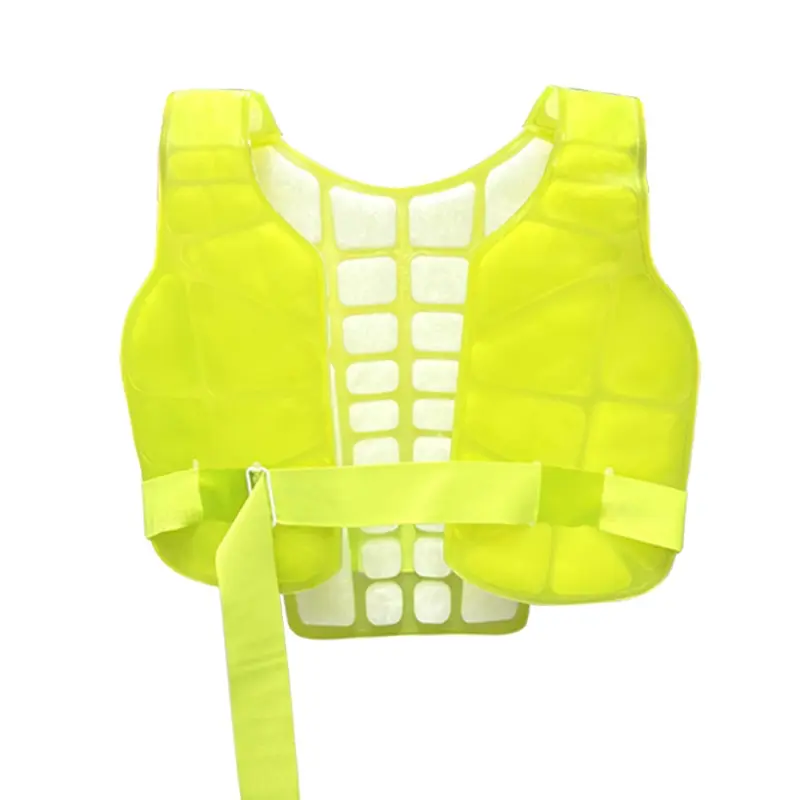
Run a controlled worker pilot
A pilot should be planned with the employer’s safety and health professionals and should not expose workers to unsafe conditions merely to test a product. Use the site’s established heat-risk controls and stop criteria. Cooling garments should not be used to extend work beyond safe limits or to conceal a deficient heat program.
Evaluate the vest during representative—but controlled—tasks and rest periods. Record environmental conditions, work duration, task, clothing, size, configuration, preparation, module or battery changes, subjective comfort, movement interference, wetness, visible damage, and cleaning observations. Decide in advance what would make the sample unacceptable.
NIOSH says wearable personal cooling systems may also be used during rest periods to accelerate cooling, while noting that worksite systems have practical limitations. OSHA’s heat guidance emphasizes water, rest, shade or a cool recovery area, acclimatization, training, monitoring, and emergency planning. A vest should support those measures, not replace them.
B2B cooling-vest procurement checklist
- Worksites, tasks, climate, heat sources, work rate, and required PPE
- Selected technology and why it fits the operating environment
- Garment dimensions, size range, adjustment method, and total loaded weight
- Cooling zones, module/fan layout, retention, and replacement parts
- PCM specification and conditioning; water activation and drying; or battery/fan specification
- Representative performance test method and conditions
- Worker pilot plan, safety oversight, stop criteria, and acceptance record
- Shell, lining, fasteners, labels, visibility, logo, instructions, and packaging
- Cleaning, hygiene, inspection, storage, service, and end-of-life process
- Target market, claims, required documents, quantity, delivery, and change control
The Cryozin PCM cooling-clothes category is the product owner for current PCM vest formats. Cryozin can discuss vest dimensions, pocket or module layout, colors, logo, instructions, and packaging as project inputs. Exact materials, PCM, included components, performance, workplace compatibility, and claims must be confirmed for the approved configuration.
For PCM Cooling Vests, the currently confirmed standard MOQ is 300 pieces. Current baseline timing is 1–3 business days for renderings, 3–7 business days for samples, and 18–25 business days for standard production. Custom production can take longer and is confirmed by project. The applicable start event, approval sequence, component availability, and shipping time must be stated in the quotation or schedule.
Frequently asked questions
Are PCM cooling vests better than evaporative vests?
Not universally. PCM may be more predictable where evaporation is constrained, but it adds conditioned modules and loaded weight. Evaporative designs can be simple and light when dry, but they depend on water, airflow, humidity, and wet-garment management. Compare the actual worksite and samples.
Do cooling vests prevent heat illness?
No product should be treated as a stand-alone prevention guarantee. Employers need a comprehensive heat program with hazard assessment, engineering and administrative controls, water, rest, acclimatization, training, monitoring, and emergency response. A vest may be one auxiliary measure after competent review.
How long does a cooling vest last?
A universal duration is not reliable. Technology, coolant or battery, preparation, garment construction, ambient conditions, humidity, airflow, activity, clothing, fit, and endpoint all affect the result. Ask for the test conditions and repeat the test in the intended operating context.
Can the same vest be worn under all PPE?
No. Additional bulk, moisture, fans, batteries, modules, closures, or straps may interfere with required PPE or movement. The employer should evaluate the exact clothing ensemble and task with qualified safety personnel.
Choose the route, then specify the product
Start with the worksite: heat sources, humidity, airflow, task, PPE, mobility, replenishment, cleaning, and shift controls. Then choose PCM, evaporative, fan-assisted, or another approach based on those constraints. Only after that choice should the team compare vest construction, performance evidence, and commercial terms.
For a PCM program, use Cryozin’s material-selection framework and quality-control process to organize supplier questions. To request a project review, send the work context, target market, vest measurements, PPE interface, PCM requirements, expected wear cycle, quantity, branding, instructions, and packaging needs.
Sources and further reading
- CDC/NIOSH: Heat Stress and Workers
- CDC/NIOSH: Workplace Recommendations for Heat Stress
- CDC/NIOSH: PPE Heat Burden and Wearable Personal Cooling Systems
- U.S. Occupational Safety and Health Administration: Heat Engineering Controls, Work Practices, and PPE
- U.S. Occupational Safety and Health Administration: Water, Rest, Shade
