
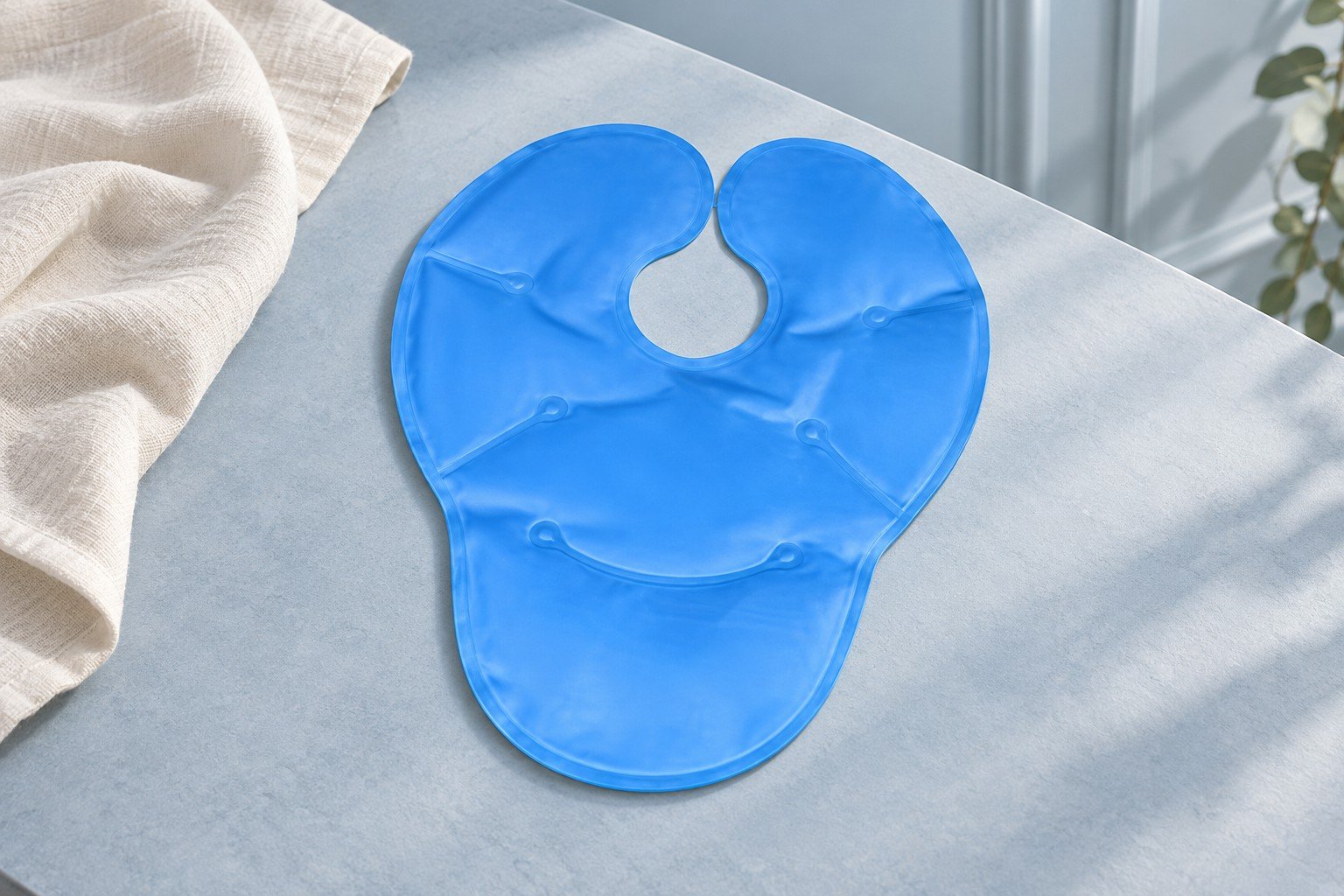
Cover image: AI-assisted editorial scene based on the catalog contoured pad. The textile is a styling prop; no body fit or product-compatibility test is shown.
Breast ice pack shapes change where the filled sections sit, what remains open, and how the pad works with its cover or holder. A round outline may still have a center hole and a side slit. A U-shaped pad has an open gap, while a contoured design can extend coverage beyond a roughly circular body. Choose the required coverage and clearance first, then compare the complete sample.
For a maternity-care brand or distributor, the useful question is not which outline looks most familiar. It is which geometry fits the product brief, how it stays in the intended position, and what claims and instructions the supplier can support. This guide focuses on those buying decisions, rather than clinical treatment or a universal compatibility promise.
Three outlines that need different drawings
| Format | Visible design distinction | What to define before sampling |
|---|---|---|
| Ring with a slit | A rounded outer body around a center opening, with a route from the edge to the opening | Outside profile, opening position, slit direction, and how its edges meet |
| U-shaped pad | Filled sections surrounding a gap that remains open to the outside | Gap width, arm lengths, inside curve, and intended orientation |
| Extended contoured pad | A shaped body with an opening and an additional panel or lobe | Extension direction, opening, overlap, and the coverage drawing |
These descriptions classify the visible shape. They do not establish a medical benefit, breast-size range, or compatibility with a pump or garment. Also, “contoured” is a broad catalog term: ask the supplier to identify the actual drawing rather than treating it as a standardized shape.
Start with a coverage map
Mark the areas the filled pad is meant to cover and the areas that must remain clear. Then show the proposed opening and slit on that same drawing. Record the intended top, bottom, and contact side so that the sample is not evaluated in a different orientation from the product brief.
For a ring, specify the opening separately from the outside diameter. For a U shape, include the inside gap and both arms. For an extended panel, identify the extension rather than describing the product only by its maximum length and width.
This is why overall dimensions alone are insufficient. Two pads can fit inside a similar rectangle while leaving different central clearances and placing very different amounts of material near the edges. Use the custom ice pack size guide for measurement inputs, then add the shape-specific details here.
Compare the opening and slit on the filled sample
An opening in an empty drawing is not the same as the usable clearance in a filled and covered pad. Review the selected sample in its specified prepared condition. Check whether the opening remains as intended, whether the slit edges overlap or separate, and whether the covering changes that behavior.
Cryozin’s round gel-bead pad with a plush side is a useful visible example: the catalog image shows a central hole and a slit despite the round outside profile. A buyer should not describe that pictured ring as a solid disc with uninterrupted center coverage.

The U-shaped gel-bead pad with a removable cover has a different opening arrangement. Compare how the arms sit, what the gap leaves clear, and whether the covered shape follows the same outline as the insert. Do not assume a larger-looking gap is automatically more comfortable or more compatible.
Include the backing and cover in the shape decision
An integrated plush side and a removable fabric cover are different assemblies. With an integrated side, the backing is part of the pad. With a separate cover, insertion, opening position, seams, and care instructions become additional approval points.
Ask for the complete covered sample. Check whether the fabric bridges an opening, pulls the arms of a U shape together, or obscures the direction of an extended panel. If the cover has a fastening, inspect it in the intended closed position. A well-matched empty cover can behave differently once the insert is inside it.
For component terminology and related fastening questions, see the ice pack accessories guide. Keep this review specific to the chosen breast-pad outline rather than adding every possible accessory to the brief.

Treat pump and garment compatibility as separate requirements
A central hole does not establish compatibility with every flange. A shaped pad does not establish compatibility with every garment pocket. Name the intended accessory and version in the brief, then evaluate the assembled configuration and relevant instructions.
There are useful named examples in the market. Lansinoh’s breast therapy pack page describes placement with a pump flange and specifies its own packs and covers. Nyssa’s breast and chest pack page ties its shaped packs to a particular bralette pocket. These are product-system descriptions, not universal interfaces that another pad inherits.
If the planned product will be used independently, say so. If a pump or holder is part of the brief, give the supplier the exact reference and identify what must remain accessible. Approve any compatibility statement only after the configuration and evidence have been reviewed.
Cryozin’s extended-panel pad with a keyhole opening shows why orientation matters. Its lower extension and opening should be identified in the drawing and sample notes. The catalog shape alone does not establish a supported body position or fit with a third-party product.
Keep filling, preparation, and claims separate from the outline
Shape and filling are different selections. A ring can be made with different fill constructions, and bead segmentation is not the same thing as the outside U-shaped outline. Review the gel vs gel-bead comparison when the filling itself is the unresolved decision.
For the selected assembly, request the model-specific preparation, contact-layer, care, replacement, and warning instructions. Do not transfer heating directions from a similar-looking listing. A cover or material change can be relevant to the instructions and evidence that need review.
Consumer-facing claims need their own check. The FTC’s guidance on health-product advertising calls for support relevant to the message and product. A ring, U shape, or extended panel does not by itself substantiate claims about milk flow, mastitis, swelling, pain relief, or faster recovery. In the United States, use the FDA’s device-determination framework to begin the intended-use review with qualified support where needed.
A sample card for comparing breast ice pack shapes
Use one record for each actual configuration. This editorial worksheet is a way to document a buying decision, not evidence that a product fits a person or accessory.
| Sample field | What to record |
|---|---|
| Identity | Supplier, sample reference, drawing version, and selected materials |
| Coverage | Marked filled areas, intended clear areas, and orientation |
| Opening | Shape, dimensions, location, slit or gap, and edge relationship |
| Assembly | Integrated backing or separate cover; fastening and insertion details |
| Intended holder | Independent use or an identified garment/pump configuration to assess |
| Preparation | Exact instructions used for reviewing the prepared sample |
| Retail quantity | Number of pads, number of covers, and any other supplied components |
| Outcome | Keep for further review, revise a stated detail, or set aside; record why |
If two samples change shape, filling, and cover at the same time, record all three differences. Otherwise, a useful observation about one complete sample can be misreported as proof that its outline is better.
Questions to settle before the purchase order
Is a ring the same as a U-shaped breast pad?
No. Look at the actual opening. A ring may have a narrow slit connecting the outside to a central hole; a U-shaped pad has an open gap between its arms. Catalog names alone may blur the distinction.
Does an extended panel mean a larger supported size range?
No. It adds a particular coverage area. The relevant fit range needs its own sample and evidence, including the intended orientation and cover.
What does a two-pack contain?
Ask for the component list. Two pads plus two covers, one pad with one cover, and two complete covered assemblies can be described inconsistently in quotations. Specify pads and covers on separate lines.
Choose the geometry that meets the coverage and clearance brief, then approve the complete configuration. Start with the breast-pack catalog, identify the actual samples to compare, and send Cryozin the shape and kit requirements. Include the drawing, cover preference, target market, quantity, and any intended compatibility statement so the next discussion can resolve concrete details.
Sources and further reading
- Lansinoh — Hot & Cold Breast Therapy Packs: named pack, cover, and placement configuration.
- Nyssa — Breast Ice and Heat Therapy Packs: a named shaped-pack and garment-pocket system.
- FDA — How to Determine if Your Product is a Medical Device: U.S. intended-use review framework.
- FTC — Health Products Compliance Guidance: support for express and implied health-related advertising claims.
