
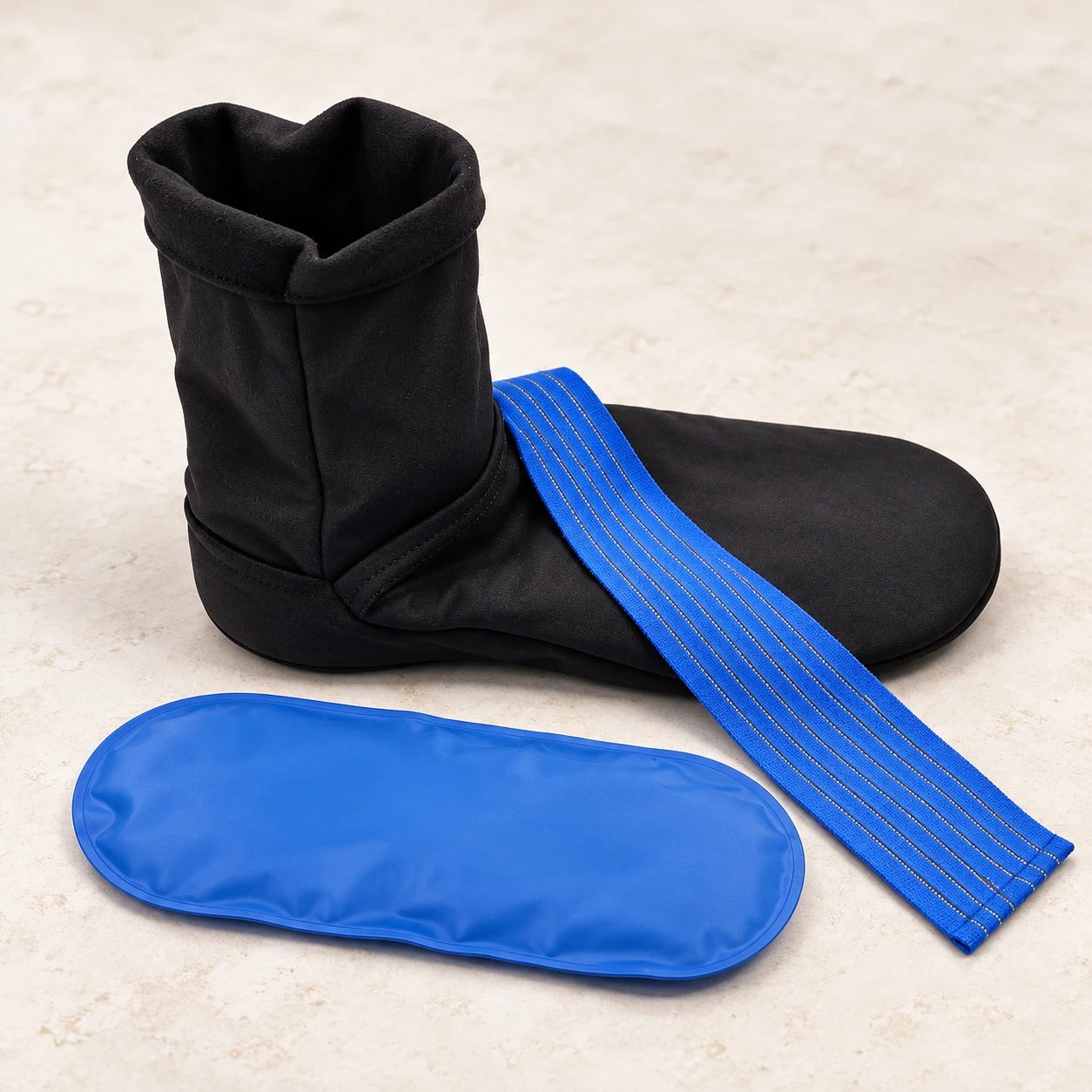
Choose cold therapy socks with gel inserts as a complete assembly: the sock, the fitted packs, and the fastening. Set the required sole or upper-foot coverage first, then check how much room the inserts leave inside the sock. An empty sock that looks the right size still needs a fit review with its agreed gel packs in place.
On this page
For foot-care brands, distributors, and private-label buyers, the next decision is what one retail set contains. Two socks, the packs fitted inside them, and any spare inserts need separate counts. This guide helps you choose that configuration and turn it into a sampling brief.
Choose the insert layout before the sock size
A removable-pack sock holds its cold source in pockets. Define the pocket positions and pack shapes in the product specification; the word “sock” does not define them.
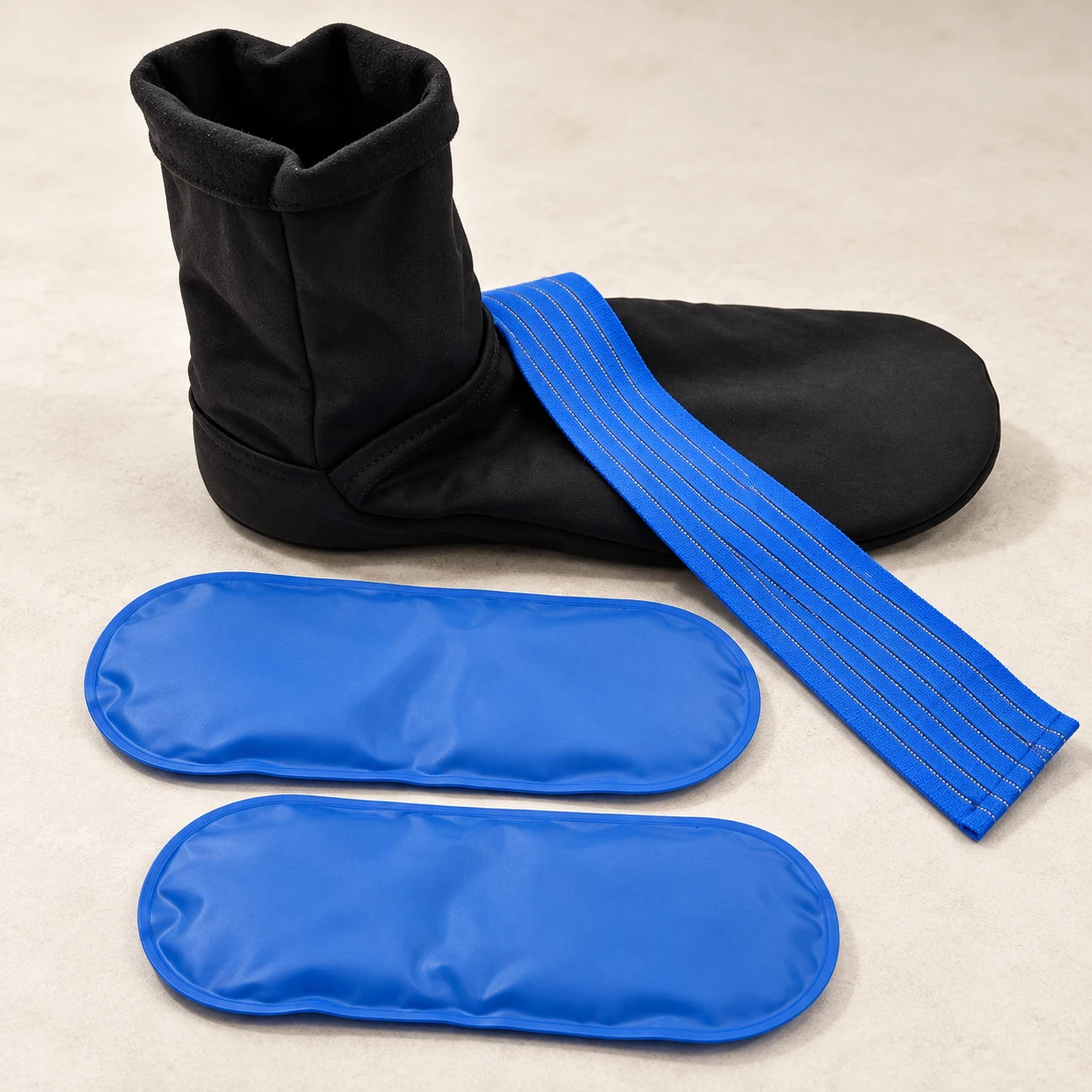
Cryozin’s closed-toe cold therapy sock with a crossover band provides a reference for this layout. The selected configuration can have one or two gel packs per sock. A single-pack version can use sole or upper-foot placement. For a two-pack version, approve both positions, shapes, and thicknesses together.
| Configuration per sock | What to check on the complete sample | What to put on the order |
|---|---|---|
| One sole insert | Where the insert begins and ends beneath the foot; its position inside the pocket; room around the toes and heel. | One fitted sole insert per sock, with its own drawing or component code. |
| One upper-foot insert | The insert outline over the foot, pocket access, and whether the pack folds or shifts when the sock is put on and removed. | One fitted upper-foot insert per sock, identified separately from a sole insert. |
| Sole and upper-foot inserts | The space occupied by both packs, the foot between them, and the crossover band’s position over the assembled sock. | Two fitted inserts per sock; list each position and component code. |
Approve the layout on a marked sketch before discussing changes to gel weight. Record each pack’s outline, filled thickness, and intended pocket. A request for “more gel” leaves those fit decisions unresolved.
Measure the usable room with the inserts fitted
Ask for the sock body’s measurements and the complete assembly’s fit range. Use the same landmarks and preparation state for each sample so the comparison remains useful.
- Usable foot length: identify the internal heel-to-toe measurement and check where the closed textile toe sits with the insert fitted.
- Forefoot room: record width at an agreed landmark and inspect the space remaining around the prepared pack. A flat width alone does not describe the fitted assembly.
- Upper-foot clearance: check the combined depth of the sole pack, foot form, upper pack, and fabric where that layout uses both inserts.
- Ankle opening: define how it is measured, then check access while putting the sock on and taking it off. Include any seam or pocket edge along that path.
Start with a representative foot form. Record the proposed size limits and the result at each limit. Any human fitting review should follow the approved instructions and the safety review for the selected product.
Convert the approved fit range into retail size labels afterward. BIOS Medical publishes model-specific size ranges for its own therapy socks; those ranges do not establish the fit of another sock and insert combination. Keep your own size chart linked to the sample it describes.
Review pocket access, removal, and the crossover band
Use the same sock and insert set through the assembly review. Check that each removable pack reaches its intended position without being forced, folded at an edge, or left partly outside the pocket. Record the insertion direction and photograph the finished position.
Then review putting on and removing the complete sock. Decide whether the intended sequence places the packs before or after the sock goes on, and confirm that the pocket remains reachable in that sequence. Check removal as carefully as insertion: the sock body, pocket opening, and pack should remain in the agreed condition afterward.
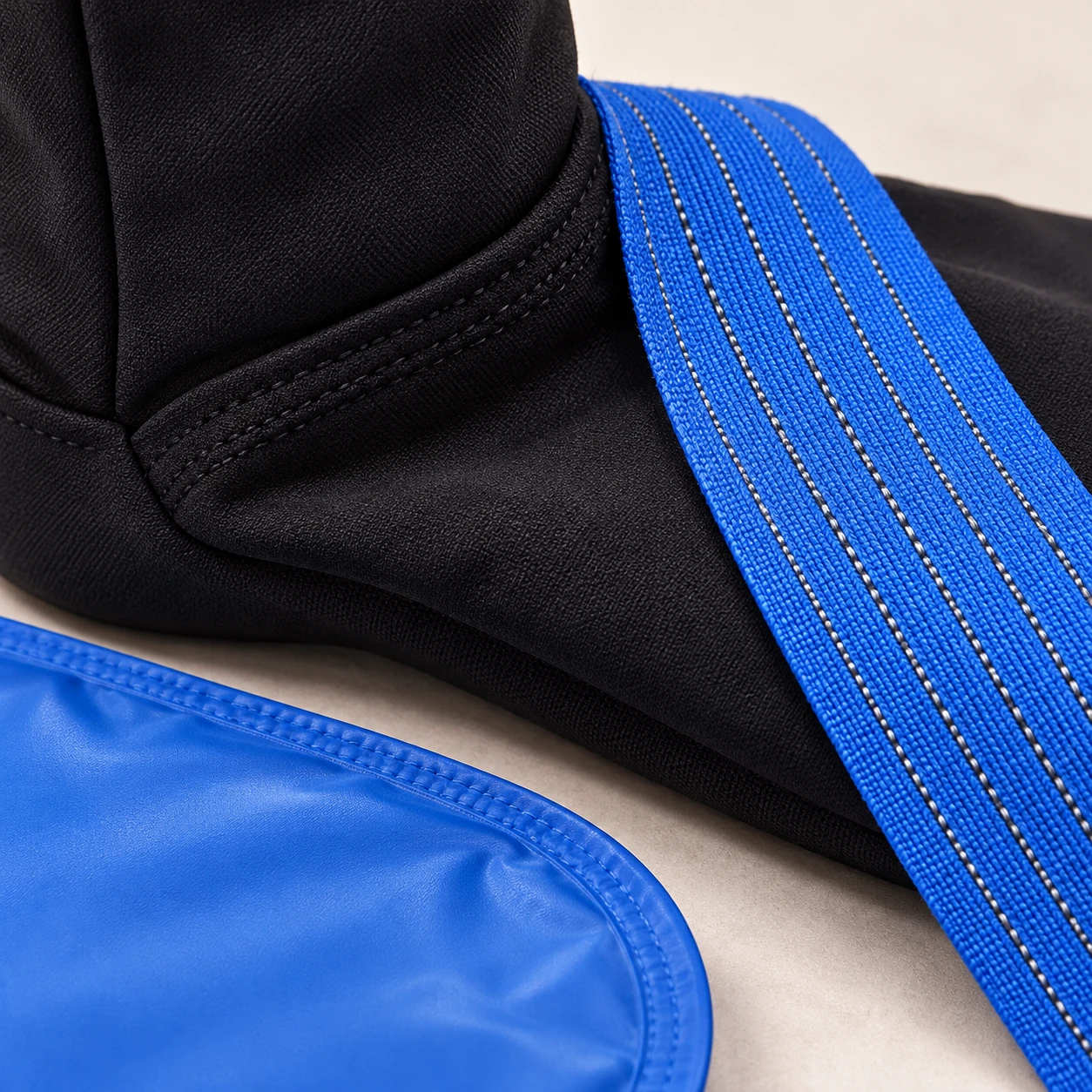
For the crossover band, mark the anchor point, route, usable length, and fastening overlap on the sample record. Look for twisting, exposed fastening material, or a band that pulls the insert away from its agreed position. Resolve a poor pocket match through the pocket or pack design before relying on tighter fastening.
Keeping an insert in place and providing a measured compression level are separate specifications. The sock’s shape and crossover band also do not establish suitability for walking, wearing inside shoes, or overnight use. Review the intended positioning and use limits for the selected construction before writing the retail instructions.
If the brief calls for an open-heel wrap or a different foot format, compare the ankle and foot ice pack range before developing the sock pattern further.
Define one complete pair, then add spare inserts
For the Cryozin reference format, one supply set is a pair: two complete socks. Specify the fitted packs inside each sock and list spare packs separately.
The count changes with the chosen layout. One fitted pack in each of two socks gives two fitted packs per pair. Two fitted packs in each sock gives four fitted packs per pair. Spare inserts are additional components; their quantity and packaging need their own agreement.
Give sole and upper-foot inserts distinct component codes when their shapes or dimensions differ. A spare-pack label should identify the sock size, insert position, and approved revision it matches. This also gives the buyer a clear way to describe a replacement request.
Copy this complete-pair order card
Use one card for each proposed size and configuration. These are sampling and quotation fields; complete them with the supplier before approving the retail set.
| Field | Record for this configuration |
|---|---|
| Model and size | Model / size code: ____ Drawing and sample revision: ____ Left/right identification, if required: ____ |
| Sock body | Two complete socks per supply set. Usable internal foot length: ____ Forefoot measurement and landmark: ____ Ankle-opening measurement and method: ____ |
| Sole insert per sock | Required: yes / no Quantity: ____ Component code, outline, filled thickness, and target weight: ____ |
| Upper-foot insert per sock | Required: yes / no Quantity: ____ Component code, outline, filled thickness, and target weight: ____ |
| Fitted packs per complete pair | Total fitted gel packs across both socks: ____ Do these counts match the two approved pocket layouts? ____ |
| Pocket and band | Opening and insertion direction: ____ Band route, usable length, and fastening overlap: ____ Putting-on and removal sequence: ____ |
| Spare inserts | Quantity per position and size: ____ Matching component revision: ____ Packed with the pair or sold separately: ____ |
| Retail unit | Complete pairs per retail package: ____ Fitted packs and spares listed separately: ____ Labels, instructions, artwork, and packaging revision: ____ |
| Sample review | Representative foot form and proposed fit range: ____ Preparation state used for the fit check: ____ Observations, required changes, and recheck: ____ |
| Care and sign-off | Carrier care instructions: ____ Gel-pack care instructions: ____ Approved product instructions: ____ Approver / date / retained sample ID: ____ |
Keep carrier care and gel-pack care distinct
For Cryozin’s removable-carrier option, remove the gel packs before hand or machine washing the textile carrier. The gel packs are hand-wash only. Confirm the care settings for the selected fabric and construction, and do not machine-wash an assembly that still contains gel packs.
Check the pocket opening, sock dimensions, and insert fit again after the agreed care sequence. Retain the observation with the same sample revision. A change to fabric, insert thickness, pocket construction, or band position should identify which fit checks need repeating.
The retail instructions should show the supplied layout clearly. Include how to identify the inserts, assemble the selected version, remove its components, and care for each part. Preparation and use limits must belong to that finished configuration. A cold-pack description does not establish a heating method or microwave setting.
Questions before a sock-set order
Can we offer one-insert and two-insert versions?
Discuss both layouts during sampling. Confirm which pockets are present in each version, which packs are supplied, and whether the sock pattern changes. Give each finished configuration a clear order code and packing list.
Can spare gel inserts be a separate retail item?
List them as a separate quotation line and confirm availability, quantity, and packaging. Match each spare to the approved sock size, pocket position, and insert revision. Similar-looking packs should not be described as interchangeable without a fit check.
Send the sock and insert brief together
For a Cryozin OEM or private-label project, send the reference format, proposed size range, sole/upper-foot layout, band requirements, and complete-pair order card. Include the intended retail channel, quantity, artwork, packaging, and any product-specific evidence requirements.
Request a cold therapy sock sample review with those inputs. Approve the fitted assembly and the contents of one retail package together, then keep that sample and component list as the reference for the order.
