
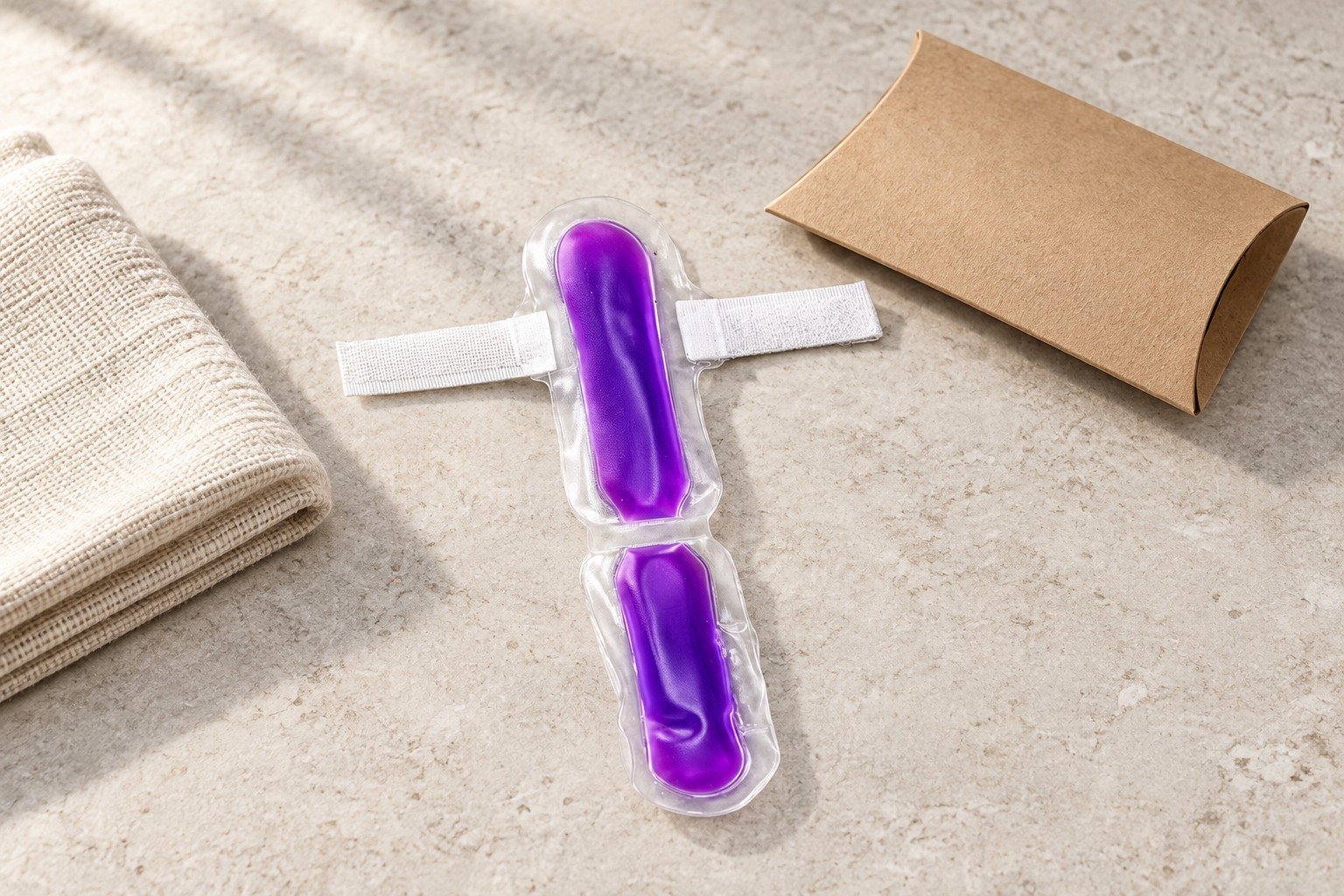
Cover image: AI-assisted editorial scene based on the catalog product. Packaging is illustrative; no fit or performance test is shown.
A finger ice pack can be a pull-on gel sleeve or a small sealed pouch held in place with a strap. Start with the area the product needs to cover and how it will be put on. Then compare the prepared sample, size range, fastening or stretch, and complete retail set. A product called a “finger pack” does not automatically fit every finger, thumb, or toe.
For brands and distributors, these differences affect which samples to request and what belongs in the quotation. A sleeve and a strapped pouch may look like alternatives, but their size systems, handling, and packaging can require different decisions.
On this page
Which finger ice pack format should you sample?
| Format | A useful starting point when… | What the buyer needs to establish |
|---|---|---|
| Pull-on gel sleeve | The brief calls for a product worn around an individual finger | Opening size, coverage, stretch, removal and the supported size range |
| Small pouch with a strap | The brief calls for a defined patch of coverage with an adjustable fastening | Filled footprint, strap reach, closure overlap and edge position |
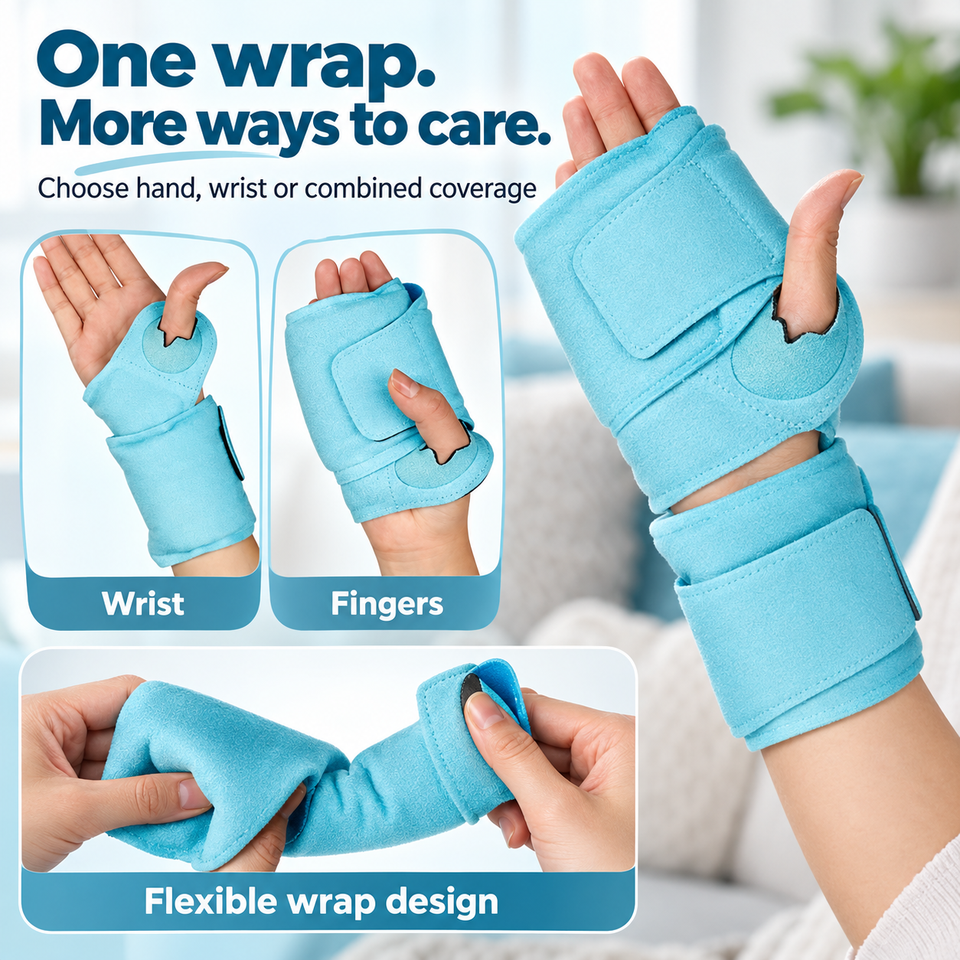
| Larger hand pack or mitten | The brief calls for coverage across a wider part of the hand | Hand position, coverage map and the complete retaining system |
These are construction choices, not a ranking of treatment effectiveness. If the brief specifies an individual finger, begin with individual-finger samples rather than assuming a wrist wrap can be scaled down unchanged. Compare the broader coverage of a segmented hand-and-wrist gel wrap only when the brief calls for a larger area.
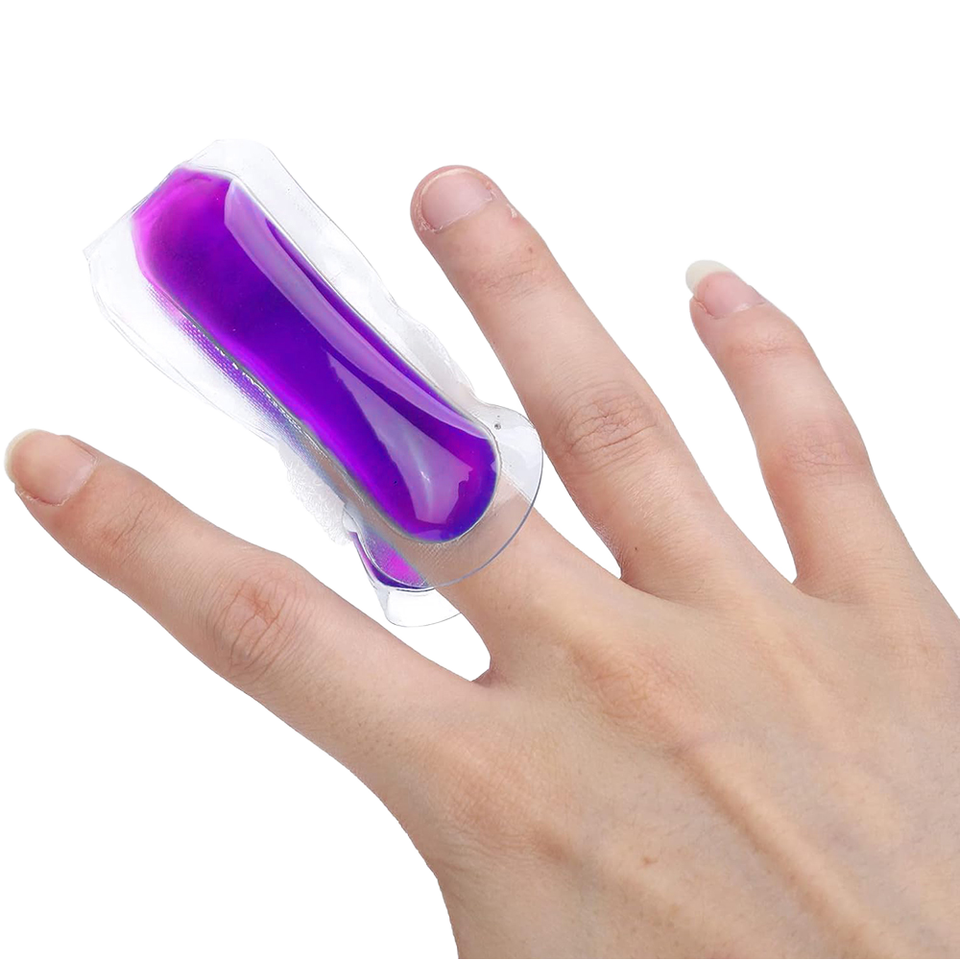
Examples on brand websites help clarify the distinction. Liontek’s thermal finger sleeves show a pull-on format sold as a multi-pack. Cryozin’s small finger gel pack with a fastening strap shows a narrow sealed pouch retained with a separate fastening feature. These examples establish formats; their claims, materials, and instructions are not interchangeable.
Define coverage before choosing a size
“Small” is not a usable size specification. Mark where the pack should sit and which areas should remain uncovered. Record the length of the intended contact area, the available width, and where a border, opening, or fastening would lie.
For a sleeve, distinguish overall length from the portion containing gel. Ask whether the ends are open and how the construction changes as it stretches. For a strapped pouch, distinguish the overall sealed dimensions from the filled area. The border takes up space even though it contains no gel.
Cryozin’s current strapped product page lists a 5 × 3 cm reference and asks buyers to confirm whether the measurement includes the sealed border. Use that as a question for the drawing and sample, not as proof of a universal fit.
For the drawing fields, use the custom ice pack size guide to distinguish overall dimensions, filled coverage, and related components. If a project includes several sizes, give each an identifier. A supplier should be able to connect the sample, drawing, label, and quotation to the same size. Do not rely on color alone to distinguish them.
Compare how the sample is put on and removed
A sleeve needs to pass over the finger before reaching its intended position. A strap-on pouch is placed first and then fastened. This gives the buyer two different handling sequences to evaluate.
For sleeves, record the opening dimensions and the method used to assess stretch and recovery. For strapped packs, record strap length, width, fastening location, and usable overlap. Ask whether the closure can be reached and released in the intended handling sequence.
Review both formats under the supplier’s proposed preparation conditions. Room-temperature softness does not establish flexibility after cooling. A sample with a different fill mass or pouch construction may also behave differently, so identify the complete configuration before comparing it.
The relevant question is whether the selected product can be positioned, retained, and removed as intended. A tight fit is not proof of a verified compression specification or a clinical benefit.
Approve preparation and care for the exact product
Settle whether the project is cold-only or intended for both hot and cold use. Do not copy a heating method from a competing sleeve onto a sealed pouch, strap, or retail kit. Ask for instructions and supporting evidence for the proposed combination of fill, outer material, fastening, and any contact barrier.
The same principle applies to cleaning. Establish which parts can be cleaned together, which parts separate, and how the user identifies damage. The final packaging should carry the approved instructions for that configuration.
The NHS guidance on sprains and strains describes a wrapped cold source in its general first-aid advice. For a product brief, this makes the contact layer a question to resolve: specify the proposed barrier, covering, and corresponding instructions. That general guidance does not validate a particular finger pack or supply its heating method.
For a U.S. launch, settle the intended use and proposed claims before approving retail copy. The FDA device-determination guide starts with intended use and indications, followed by a review of applicable classifications. Have the responsible reviewer assess the exact product and wording; a catalog title or a link to FDA does not establish clearance or approval.
For the approval process itself, use the existing ice pack sample approval checklist. The format comparison here determines which samples enter that process; it does not replace the product’s safety or suitability review.
Quote the retail set, not just one gel component
A “five-pack” might mean five complete sleeves, five pouches with five straps, or a different assortment. Those offers are not comparable until the component count is clear.
Write the set contents as a simple bill of materials. Include the number of filled units, straps or covers, instructions, and retail packages. State whether multiple sizes are mixed in one package or sold separately. Identify where size and lot information will appear.
Ask the supplier to distinguish the filled-unit count from the retail-set count in its quotation. This prevents a unit price or MOQ from being interpreted as the price or minimum quantity of a complete multi-pack.
A sample comparison card buyers can copy
Complete one card for each proposed configuration. This is an editorial procurement tool, not a standard test method.
| Field | Record before approval |
|---|---|
| Identity | Supplier, sample code, revision and format |
| Coverage | Intended placement, filled area, border or opening locations |
| Size system | Dimensions, tolerances and proposed size range |
| Retention | Sleeve opening/stretch criteria or strap dimensions/overlap |
| Preparation | Proposed instructions and sample condition during review |
| Handling | Positioning, retention and removal observations |
| Construction | Fill, outer material, edges and fastening details to confirm |
| Retail set | Complete component counts, size mix and packaging |
| Evidence | Instructions, relevant documents and unresolved questions |
| Decision | Resample, reject, or proceed to the defined approval process |
Keep observations separate from supplier statements. If a sample has not been reviewed after preparation, record that step as pending rather than marking the fit approved.
Questions to settle before ordering
Can one size fit every finger?
Only a defined size range and appropriate review can support that statement. Ask which positions and sizes were considered and how the range was established. A product photograph is not a size-range study.
Is a finger sleeve the same as a removable ice pack cover?
Not necessarily. Some sleeves incorporate the thermal section; other products use a separate pouch and retaining component. Confirm what is permanently joined and what can be removed before comparing construction, cleaning, or replacement costs.
What should a buyer send for an OEM discussion?
Send the intended placement, preferred format, size range, preparation requirements, target market, complete set contents, and expected order quantity. Add a drawing or reference sample where possible.
For private-label sampling, the OEM ice pack program provides the next project step. For a small strapped format, review the current finger gel pack and then send Cryozin your configuration and sample requirements. A clear coverage and set brief gives the supplier a useful starting point for feasibility and quotation.
Sources and scope
- NHS — Sprains and strains: general context for a wrapped cold source; not a product-specific treatment protocol.
- FDA — How to determine if your product is a medical device: intended-use and classification review, not evidence of Cryozin approval.
- Liontek and Cryozin product pages linked in the format comparison: visible constructions only.
No comparative clinical result, universal fit, heating instruction, or first-hand product test is asserted.
