
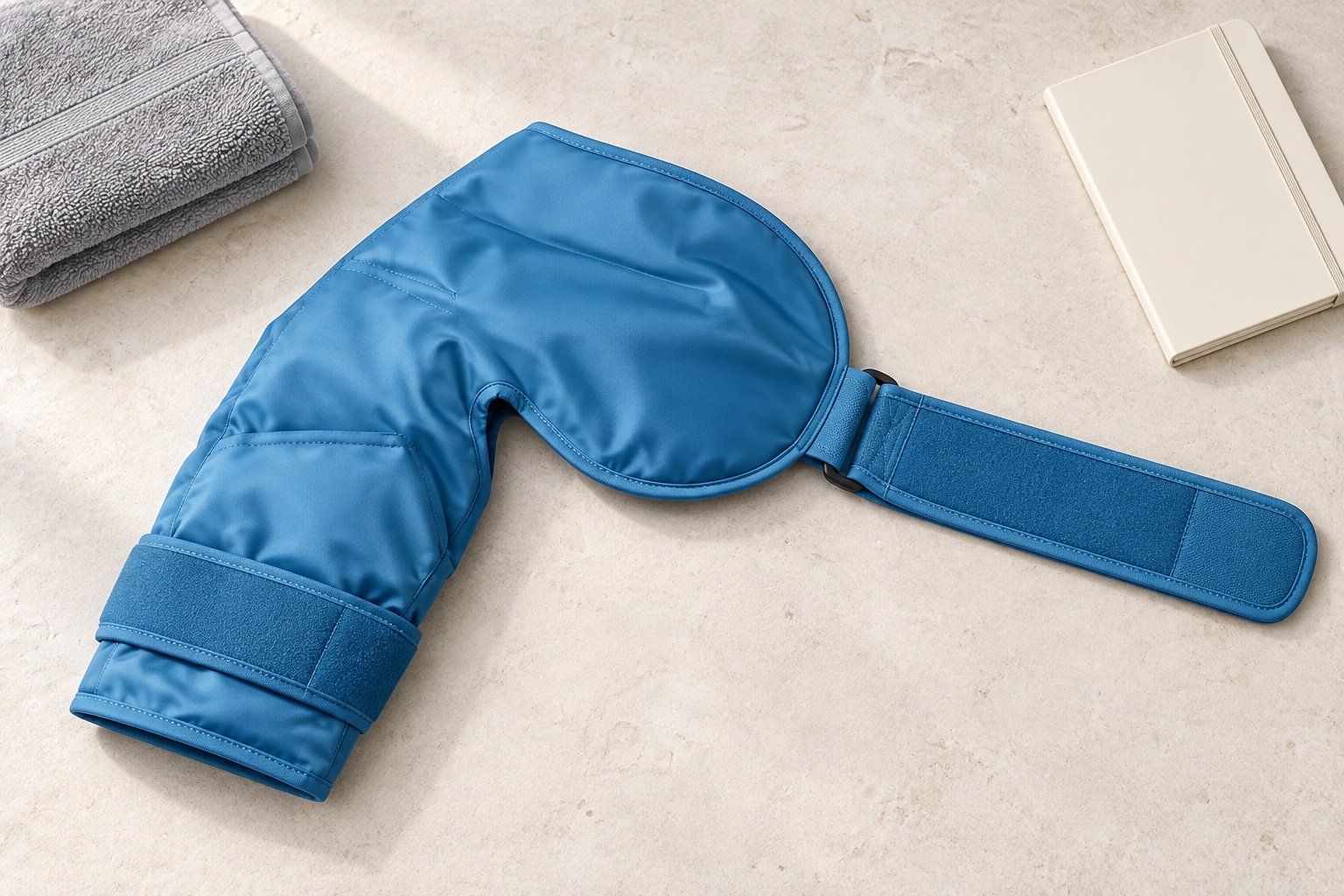
A shoulder wrap can look convincing in a catalog and still be awkward to fasten, slide when the wearer sits down, or leave the intended area uncovered. For a custom shoulder ice pack design, the buying decision is therefore not just a panel dimension. It is a fit system: the cold-pack shape, upper-arm band, torso strap, closures, and instructions must work together.
This guide helps brand and sourcing teams turn that system into a sample brief and an approval record. It covers product fit and procurement, not treatment instructions or a claim that a particular design improves recovery.
Cover image: a design illustration, not a production sample or a documented fit test.
On this page
Start with a coverage brief, not a universal size
Mark the intended coverage on front, side, and back outlines of the shoulder. Separate the area the pack should contact from areas where edges, seams, or closures should not press. Then identify the intended wearer population, whether the product is left-sided, right-sided, or reversible, and whether it is intended to sit over clothing or a specified barrier.
A single label such as “adult adjustable” leaves too much unresolved. Ask which body measurements control fit, which range the sample has actually been checked against, and how measurements were taken. ISO 7250-1 defines basic body measurements for technological design; it does not establish a universal shoulder-wrap size or prove that a product fits your customers.
- Coverage boundary: shoulder cap only, shoulder plus upper arm, or a wider surrounding area.
- Fit variables: upper-arm circumference, torso circumference, shoulder breadth, and the path the strap follows.
- Use context: seated or standing, intended clothing, and whether another person helps with fastening.
- Restrictions: movements and use situations outside the intended instructions.
Use the custom ice pack dimension guide for drawing conventions. For shoulder projects, add worn-fit views: a flat outline alone cannot show where a strap crosses the body.

Treat the arm band and torso strap as separate controls
An upper-arm band helps position the lower part of the wrap. A torso strap anchors the assembly around a different body path. Changing one to correct a poor fit can create a new problem elsewhere, so record their lengths, widths, attachment points, and adjustment limits separately.
During sample review, watch where each strap travels—not just whether the closure reaches. Check for a twisted strap, a buckle near the underarm, excess strap that cannot be secured, or a closure that only overlaps at the extreme edge of its fastening area. These are observations to resolve, not reasons to assume that tighter fastening is better.
For a format reference, view the contoured shoulder gel wrap with adjustable straps. The page is an example of a shoulder-specific configuration; the materials, fit range, and instructions for a custom project still need sample-level confirmation.
Check how the buyer will put it on
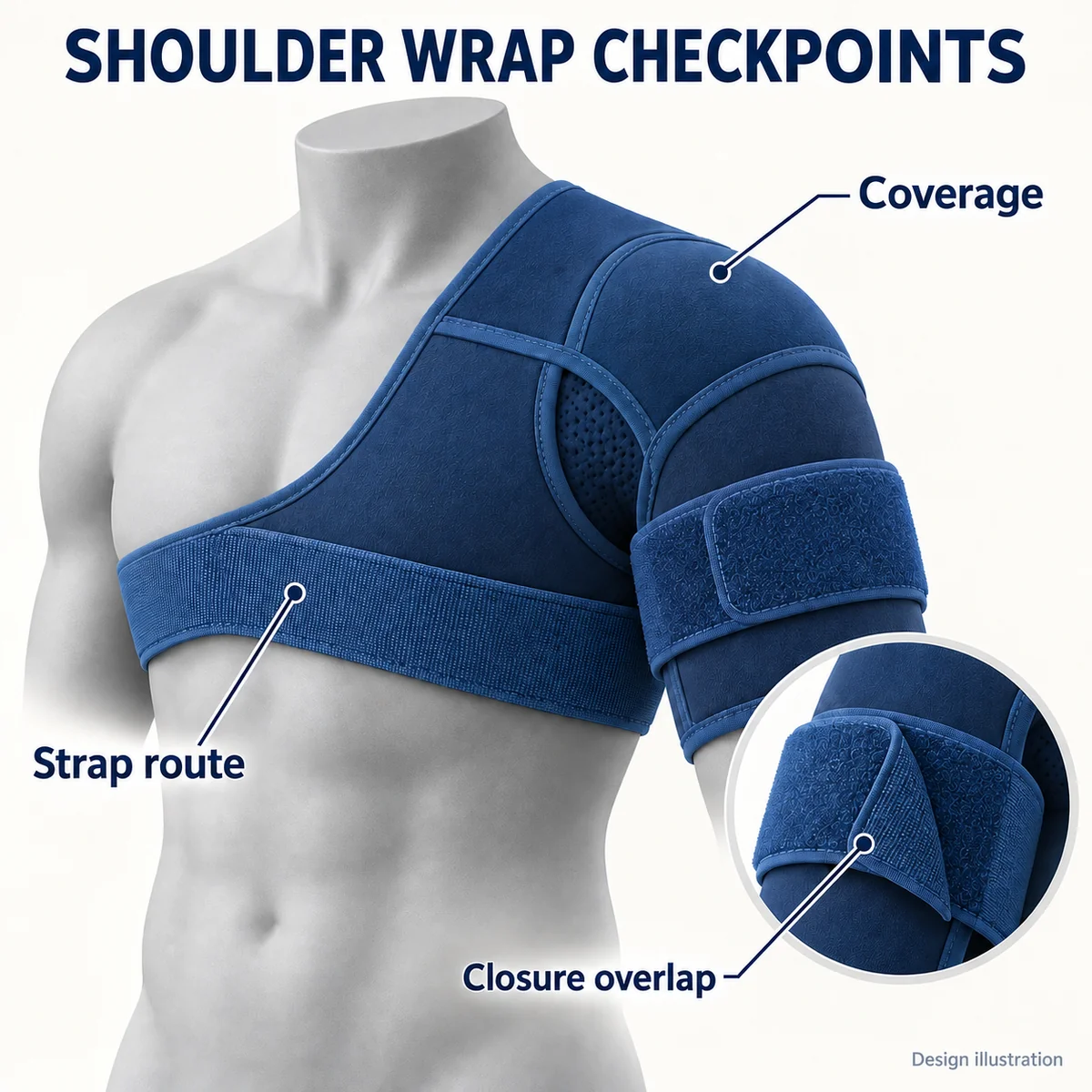
Define whether the intended wearer is expected to fasten the product independently. A strap that is easy to adjust on a table may be difficult to reach behind the body. A reversible design can also make the closure orientation confusing when switched from one side to the other.
Have representative intended users follow the proposed instructions without coaching, where appropriate and safe. Record missed steps, reversed panels, inaccessible tabs, and points where help is needed. If the product is intended to be a medical device, review the applicable process with a qualified specialist: FDA human-factors guidance addresses intended users, use environments, and interfaces. A procurement fit check is not a substitute for medical-device usability validation.
Review the conditioned sample, not only the room-temperature sample
Pack thickness, fill distribution, and flexibility can affect how a contoured panel sits. Check a sample in the preparation condition specified by its approved instructions as well as at room temperature. Do not invent a freezer temperature, preparation time, or wearing duration for an unverified sample.
Compare whether the panel follows the intended contour, whether the edges lift, and whether gel migration changes local thickness. If the design uses multiple chambers, evaluate whether chamber boundaries help articulation or create an uncomfortable ridge. The single-chamber and multi-chamber comparison explains that construction choice in more detail.

A practical shoulder-wrap sample review sequence
- Confirm the revision. Match the sample identifier to the drawing, bill of materials, fill specification, and draft instructions.
- Measure the unworn sample. Record panel outline, sealed edge, attachment positions, and usable strap adjustment—not just total strap length.
- Fit it in the intended configuration. Note side, clothing or barrier, wearer measurements, and whether assistance was used. Obtain consent and protect personal information in any photos or records.
- Follow the intended task. Check fastening, sitting or other permitted position changes, adjustment, and removal. Do not turn the check into an unsupervised treatment trial.
- Repeat after approved conditioning. Record preparation conditions and relevant changes in drape, bulk, or closure access.
- Resolve discrepancies. Tie each requested change to a marked photo or drawing and require a revised sample before final approval.
Build an approval record that survives a supplier handoff
The useful output is a short decision record, not “sample looks good.” Set project-specific acceptance criteria before approving production. The following fields are a starting point, not a test standard or a universal pass threshold.
- Coverage: approved boundary drawing and the sample views that demonstrate it.
- Adjustment: the measured fit range reviewed, remaining closure engagement, and management of loose strap ends.
- Usability: expected assistance, instruction steps, and unresolved handling errors.
- Construction: edge finish, attachment integrity, gel containment, and approved material identities.
- Conditioning: the exact approved preparation procedure and observations after it.
- Decision: accepted, revise and resubmit, or hold; named reviewer, sample revision, and date.
For a hypothetical example, suppose a sample covers the target area but its torso strap pulls the panel toward the underarm during the permitted seated task. The corrective question is whether to revise the attachment point, strap path, or panel shape—not simply add strap tension. Retest the changed configuration; a successful flat measurement does not close the worn-fit issue.
Keep fit approval separate from durability and safety evidence
Fit approval does not prove seam durability, thermal safety, or suitability for a medical indication. Specify the evidence required for each relevant risk, including attachment strength, closure retention, leakage, cleaning compatibility, and repeated preparation/use conditions where applicable.
For a suitable flexible barrier construction, a laboratory may consider ASTM F88/F88M seal-strength testing. The method is not a universal finished shoulder-wrap test, and it does not establish a safe contact temperature or treatment duration. Agree on method applicability, conditioning, sampling, and acceptance limits with the responsible technical reviewer.
Frequently asked sourcing questions
Can one shoulder wrap serve both sides?
Possibly, but confirm it on both sides with the actual strap route and closure orientation. Symmetry in a flat drawing does not demonstrate equivalent fastening or coverage when worn.
Should buyers start with one adjustable size?
Only if the intended range can be demonstrated without compromising coverage or usable closure engagement. If extremes need different geometry, separate sizes may be more appropriate than longer straps alone.
What should be sent with a request for a sample?
Send the coverage sketch, intended wearer measurements, sidedness, assistance expectations, target market, planned claims, and the sample checks you expect to review. Use the sample approval checklist to organize the broader sign-off.
Turn the design brief into a sourcing decision
A better shoulder-wrap brief links every dimension to a fit or handling question. Resolve coverage, strap routing, and instructions together, then keep the approved sample and revision record as the production reference.
Explore body-area cold therapy wrap formats or custom ice pack design options. To discuss a project, send Cryozin your shoulder-wrap drawing and sample requirements; configuration and evidence requirements should be confirmed for the proposed product and market.
Sources and further reading
- ISO 7250-1: Basic human body measurements for technological design — measurement definitions, not product sizing approval.
- FDA: Applying Human Factors and Usability Engineering to Medical Devices — medical-device user-interface considerations.
- ASTM F88/F88M-23 — seal strength of flexible barrier materials; applicability must be assessed.
Scene images are editorial concepts based on catalog references, not evidence of a factory, customer project, test or approved configuration. Catalog images illustrate visible product form only.
