
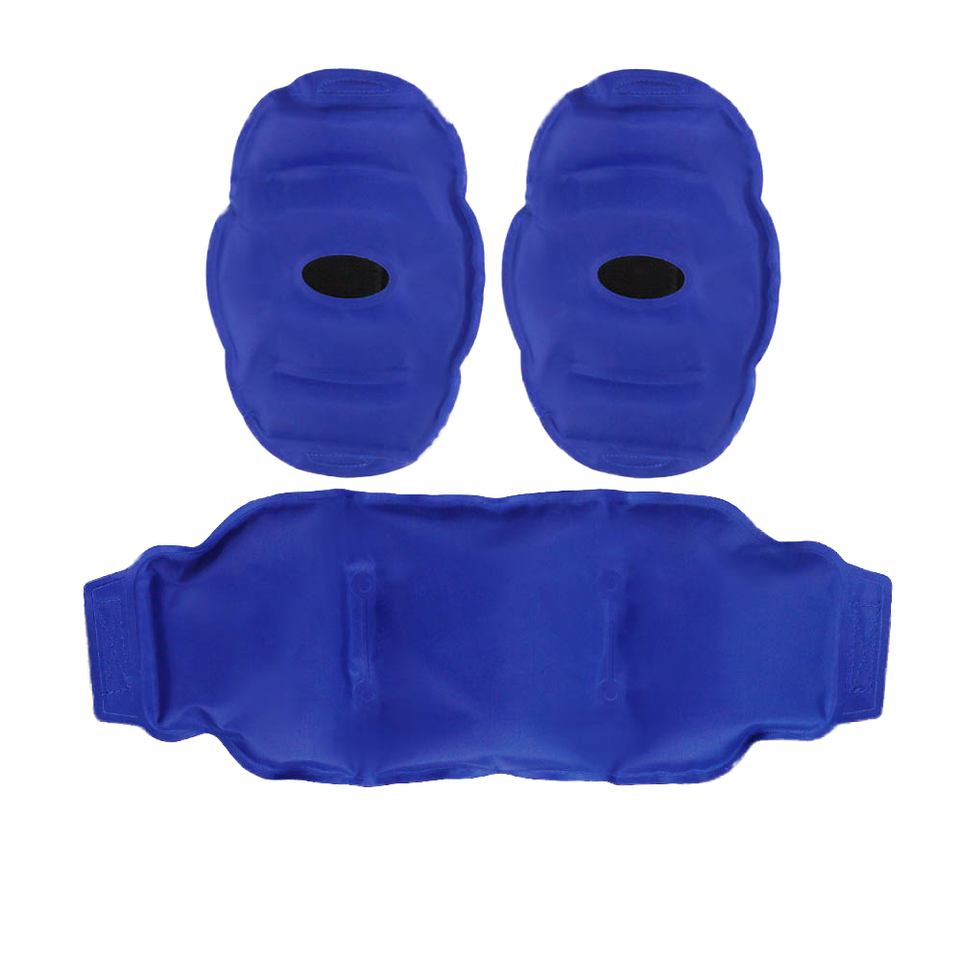
The best ice packs for physical therapy fit the intended body area, work with the clinic’s cleaning and freezer routine, and arrive as a clearly specified complete product. A large flat pack, a compact pouch, and a strapped wrap solve different buying problems. No filling name or “professional” label makes one format the best for every clinic.
This guide compares those formats for clinic buyers, distributors, and private-label brands. Start with the product selection below, then use the sample card to check fit, kit contents, and availability between appointments. Clinical staff should determine treatment suitability and application instructions.
On this page
Which cold-pack format belongs in your assortment?
| Format | When to shortlist it | What to approve |
|---|---|---|
| Large flat gel pack | When the specified contact area calls for a broad, relatively flat pouch. | Usable filled area, weight, bending after the intended conditioning, and the complete contact barrier. |
| Compact or narrow gel pack | When a large pouch would be awkward to position or store for the intended application. | Coverage after filling, edge bulk, handling with its cover, and identification among similar packs. |
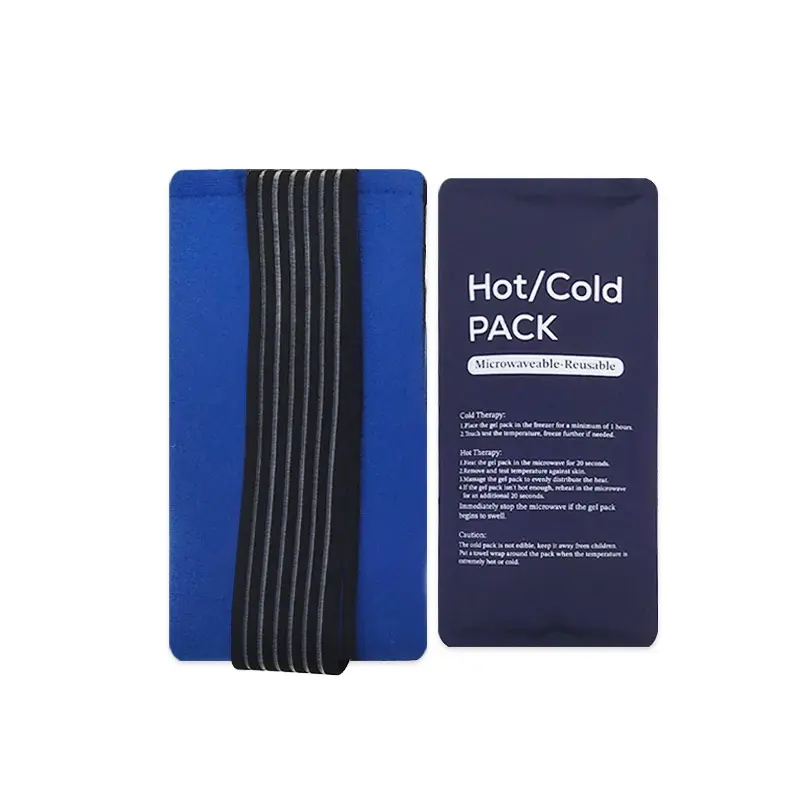
| Gel wrap with straps | When positioning and fastening are part of the product brief. | Fit range, strap routing, fastening overlap, attachment points, and removal with the specified barrier. |
| Removable pack-and-cover system | When the buyer wants the pack and textile components handled separately. | The exact number of inserts, compatible replacements, cover care, and the complete selling unit. |
These are selection routes, not a ranking of clinical effectiveness. A strapped product also does not automatically provide controlled compression. Powered cold-compression equipment is a different product category with its own operating requirements.
Compare usable coverage, not just the outside dimensions
A quoted width includes the sealed border. It does not necessarily describe the filled area that can contact a curved surface. Ask for both the overall dimensions and a drawing of the filled section. For a shaped wrap, check openings, cutouts, and the position of closures as well.
Evaluate a sample after the intended conditioning, with the proposed cover or barrier in place. Look for sections that lift away, excess material that folds over itself, and seams that sit at a pressure point. Freeze flexibility must be a specified formula requirement; it is not a property to assume for every gel pack.
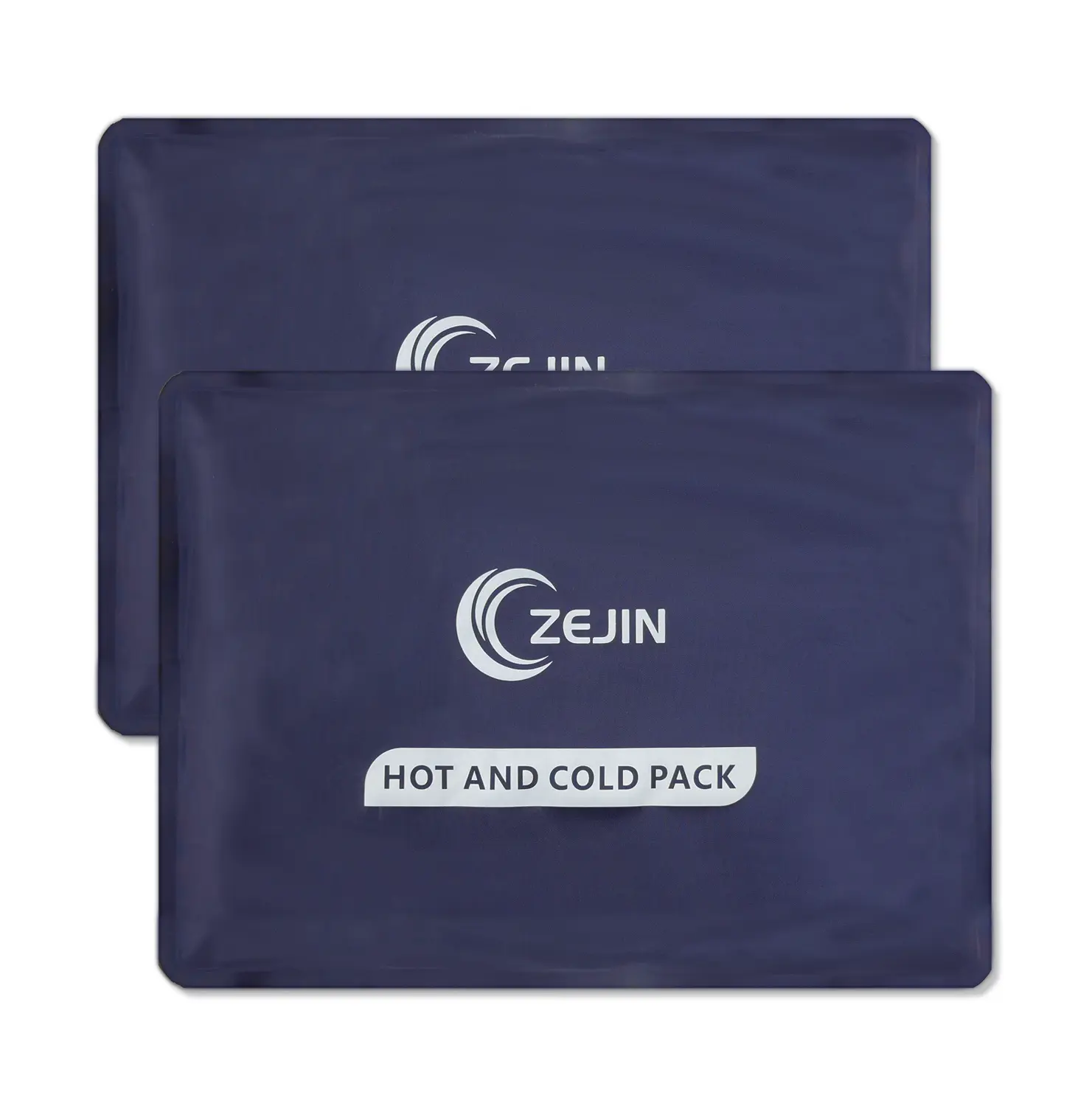
Cryozin’s large rectangular nylon gel pack is an example of the flat-pouch route. Its product page gives a format to discuss; the chosen dimensions, filling, and contact interface still need one approved specification.
Choose a wrap only when its fastening solves a real need
A wrap can simplify positioning, but it adds components to approve. Check how staff thread or close the straps, whether the fastening area remains usable across the requested size range, and whether the pack moves when the closure is adjusted. A wrap that looks secure in one catalog pose may not fit a different limb or barrier thickness.
Compare a center-opening knee wrap with a flat pack on the actual positioning task. Decide whether the opening helps placement, whether the required coverage remains available, and whether the same wrap is appropriate for all intended sizes. This is a fit evaluation, not evidence of a treatment outcome.
The American Academy of Physical Medicine and Rehabilitation’s thermal-modality reference describes a towel barrier for cold packs and identifies clinical precautions. For buyers, the practical implication is to approve the pouch, barrier, and application instructions together. A soft textile face alone does not establish that direct skin contact is appropriate.
Match the pack and cover to the cleaning workflow
Ask what is cleaned between uses, how it is cleaned, and where it waits afterward. Separate care instructions are needed when a product combines a sealed pouch, removable sleeve, straps, and hook-and-loop fasteners. Do not turn a removable cover’s washing instructions into permission to machine-wash the complete gel-filled assembly.
If the clinic requires a particular disinfectant or process, give that requirement to the supplier before sample approval. Request compatibility instructions for the selected surface, printing, seams, and accessories. A claim that a pouch is “wipeable” does not answer whether it tolerates the clinic’s chosen chemical, contact procedure, or repeated handling.
For products marketed as OTC medical devices in the United States, the FDA’s manufacturer considerations address labeling and cleaning instructions. Applicability depends on the finished product and intended use; selling a pack to a clinic does not establish a universal regulatory status.
Plan how many packs will actually be available
The number purchased is not the number ready to use at any moment. Some packs may be in use, being cleaned, awaiting inspection, or returning to the required starting condition. Larger packs and different freezer arrangements can also change how the inventory fits into the workflow.
A simple rotation planning card
Starting stock = maximum simultaneous positions + packs unavailable during turnaround + reserve.
For illustration, three simultaneous positions, four packs unavailable during turnaround, and one reserve give eight packs. These are hypothetical inventory counts, not a validated clinic requirement or a freezing-time claim. Replace them with observations from the intended routine before ordering.
Record the model, start condition, cleaning steps, storage position, and when each pack becomes available again. Include separate covers or replacement inserts if those parts have a different turnaround.
For a removable system, count ready assemblies separately from loose inserts. An insert in the freezer does not create another complete ready unit if its compatible cover is unavailable. Record the cover or holder reference with each replacement insert so a reorder cannot substitute a similar-looking part without a fit review.
Keep thermal comparisons consistent. Record conditioning method, starting condition, fill mass, cover, surroundings, and the endpoint being evaluated. A supplier’s “stays cold” phrase cannot substitute for a defined comparison, and longer cooling is not automatically a better clinical choice.
Use one sample card before comparing quotations
| Field | What to record | Decision it supports |
|---|---|---|
| Application and fit | Intended positioning task; overall and filled dimensions; required flexibility after conditioning. | Which format and size to shortlist. |
| Complete product | Pack count, cover, straps, spare inserts, instructions, and what is sold separately. State the contents of one complete selling unit, with spare components on separate quotation lines. Keep the pack-and-cover sample reference with those quantities; an insert count is not a count of complete wraps. | Whether quotations describe the same unit. |
| Preparation and care | Approved conditioning instructions; cleaning process; compatibility requirements; storage arrangement. | Whether the product fits the operating routine. |
| Sample observations | Fit, closure behavior, visible seal condition, handling, printing, and any agreed comparison results. Record the functional sample and print-proof revisions separately, and identify which revision each observation concerns. | What needs a revision before approval. |
| Quantity and documents | Quantity by SKU; rotation assumptions; target market; applicable labeling and inspection requirements. | A comparable bulk quote and approval record. |
For Cryozin projects, dimensions, materials, color, logo, and packaging are confirmed before production, with an approved sample retained as a reference. Pressure-leak checks cover every ice pack in the order. Checks that use sampling draw 10% of the total order across production batches; hot-and-cold checks take place at the sample stage. Additional inspection requirements should be agreed for the selected product and order. Cryozin does not currently hold recorded time–temperature performance data. A sample-stage check is not a published cooling-duration result or a product-specific certificate.
Choose the buying route after choosing the format
If an existing format fits, request a bulk quotation by product and quantity. Ask whether the offer covers a bare pack or a complete kit. For an original shape, artwork, cover, or retail package, review the custom ice pack options instead of comparing that project with a standard unprinted pouch.
Send the intended positioning task, dimensions, component list, care requirements, and quantity when you request a format and sample review. That gives the supplier a concrete starting point and makes the next decision more useful than asking for the “best professional pack.”
Questions clinic buyers ask
What ice packs do physical therapists use?
There is no single universal format. Compare flat reusable pouches, compact packs, and wraps against the clinic’s specified application, handling, and storage needs. Clinical staff should define appropriate use for each patient.
Does “professional-grade” identify a standard?
The phrase alone does not tell you the test method, construction, or regulatory status. Ask for the specific product specification and the evidence relevant to the intended use.
Are thicker packs always better?
No. More thickness can change weight, bending, fit, and storage space. Compare those trade-offs with the required coverage and agreed performance criteria rather than using thickness as a quality score.
Can a reusable cold pack also be heated?
Only when the selected product’s instructions permit it. Reusability, gel filling, and a similar appearance do not establish heating compatibility.
Should every department buy the same size?
Standardization may simplify handling, but first check whether one format actually covers the different positioning tasks. Keep the number of SKUs manageable without forcing a large pack into every application.
Sources and scope
Reviewed November 3, 2026. AAPM&R supports the clinical barrier/precaution boundary; FDA supports the conditional device-labeling and care discussion. Product links illustrate existing catalog structures. This is an editorial selection guide, not a hands-on ranking, clinical trial, or certification of the pictured products.
