
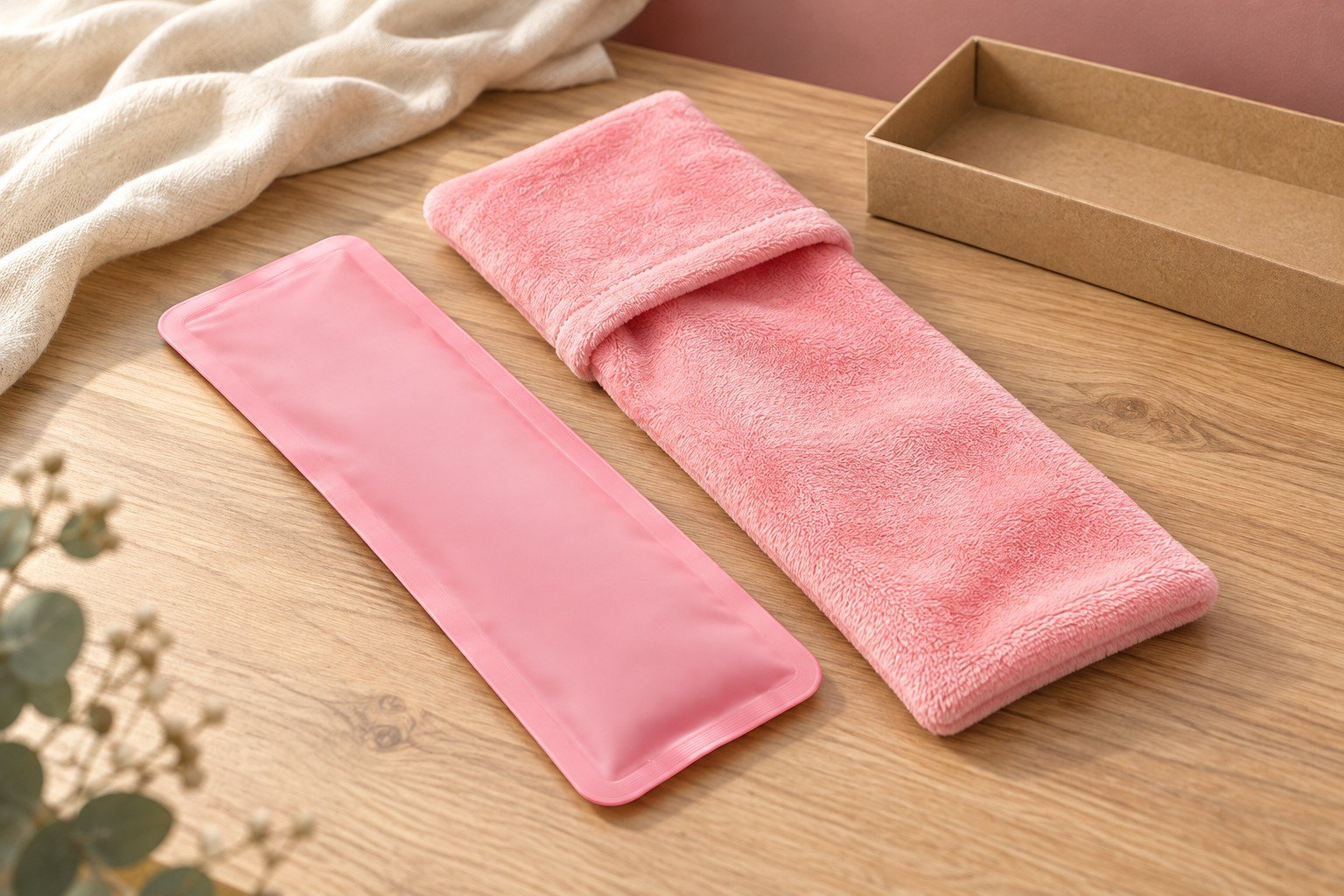
Cover image: AI-assisted editorial scene based on the catalog pad and sleeve. Props are illustrative; no use, hygiene, or cooling test is shown.
When comparing reusable vs disposable perineal ice packs, identify the cooling component and the contact layer separately. A reusable gel insert needs its specified preparation and care routine. A single-use activated cooling pad may combine cooling and absorbency in one item. A reusable insert can also be supplied with disposable sleeves, so one label for the whole kit can hide different component rules.
For a maternity-care brand, importer, or retail kit buyer, the decision is which complete configuration suits the intended setting and can be supported by clear instructions. This guide compares product formats and sourcing inputs. It does not recommend a postpartum treatment schedule or decide which product a particular patient should use.
Compare the whole format
| Selection point | Reusable gel-pack format | Single-use activated-pad format |
|---|---|---|
| Cooling component | A sealed insert prepared as its instructions specify | A pad activated and discarded according to its instructions |
| Preparation question | What cooling equipment and storage arrangements are needed? | How is the exact item activated, stored, and checked before use? |
| Contact layer | Integrated fabric, a removable sleeve, or another specified layer | The identified top sheet or supplied sleeve; construction varies |
| Absorbency | Must be established separately; a gel insert is not an absorbent pad | Some products combine absorbency and cooling; verify the exact model |
| Kit count | Count inserts, reusable covers, and disposable components separately | Count individual units, inner packs, and any extra layers |
| Buyer evidence | Preparation, care, reuse limits, and complete-set instructions | Activation, single-use labeling, storage, and complete-item instructions |
Neither route is automatically more hygienic, more comfortable, or longer lasting as a cooling product. Those are separate claims that need applicable evidence. A format choice should not become a clinical ranking.
The Frida Instant Ice Maxi Pads listing provides a named example of an activated cooling item combined with an absorbent pad. Lansinoh’s postpartum therapy packs provide a named reusable-pack example. Their product-specific contents and instructions illustrate why the assemblies need separate review; they are not instructions for a Cryozin product.
Start with preparation and handling conditions
A kit assembled for use where cooling equipment is available has different requirements from one expected to work without it. Record the actual setting rather than assuming that every hospital, household, or retailer has the same preparation arrangements.
For a reusable route, ask the supplier to identify the preparation method, storage condition, and handling sequence for the selected insert and cover. Determine which components are prepared together and which are added afterward. If a kit includes more than one insert, make the quantity explicit; do not infer a rotation routine or a clinical need from a two-pack photograph.
For a single-use route, review the activation steps and what indicates an unused, intact item. Confirm how the unit is individually packed and what happens to the complete item after use. Do not assume every disposable product has the same construction or activation system.
The buyer should also check whether the preparation instructions can be understood alongside the kit’s other items. A generic instruction sheet covering several unrelated products can leave the user uncertain about which sleeve, insert, or pad the directions describe.
Separate cooling, contact, and absorbency
These are three functions, even when a supplier combines them in one product. Identify which component provides each function and whether any required layer is supplied separately.
A removable soft sleeve is a cover. Its fabric appearance does not establish absorbency, a sterile barrier, suitability for contact with damaged skin, or protection from excessive cold. Ask for the intended contact arrangement and the supporting instructions. If the brief needs an absorbent layer, specify that requirement rather than assuming a fabric cover provides it.
Cryozin’s continuous-gel perineal pad with a removable sleeve shows the insert and cover as separate components. Confirm the ordered set contents, materials, dimensions, and care method against the approved sample.
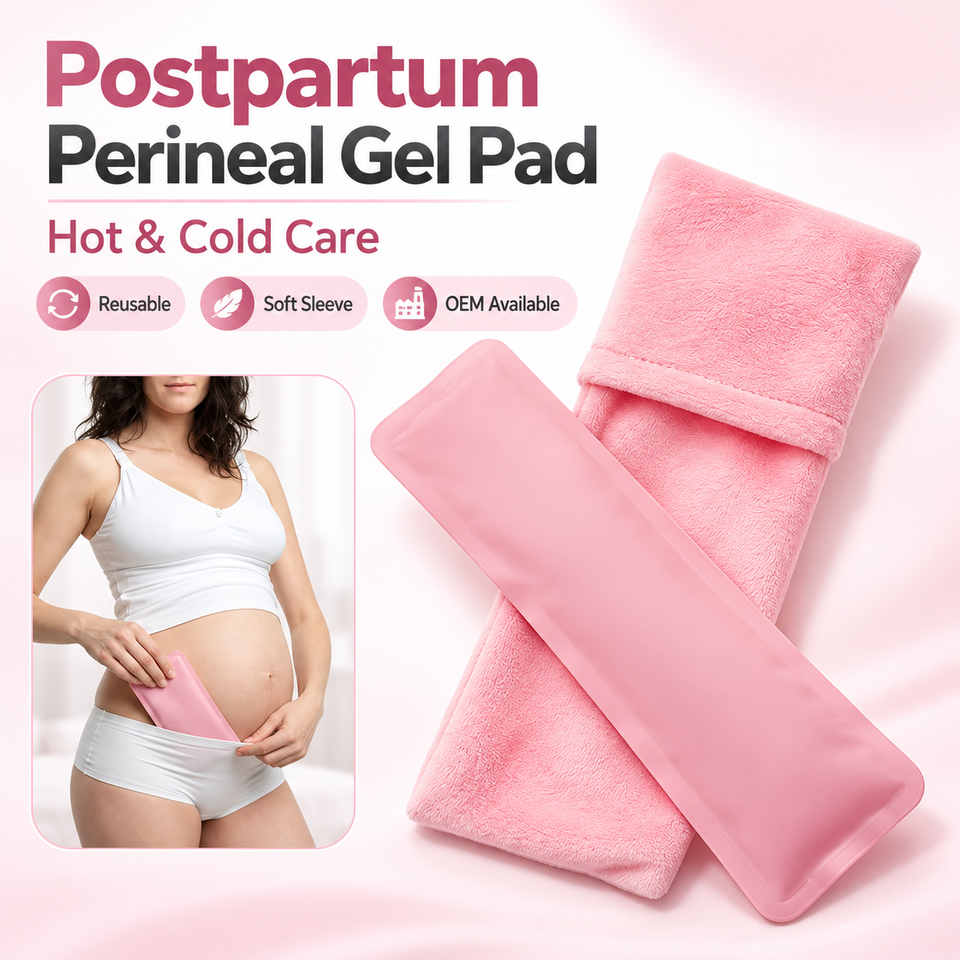
Make reuse instructions component-specific. A pack described as reusable does not make every layer in the box reusable. Equally, a disposable sleeve does not turn the sealed insert into a single-use product. The approved label should tell the user which part is being discussed.
Compare the finished pad, not just its length
For the reusable format, review width, filled thickness, edge profile, fill distribution, and the cover’s opening and seams. Include the covered assembly in the sample request. A longer insert is not necessarily a better match for the intended holder or garment.
Inspect how the cover fits around the pad and whether the closure or opening leaves part of the insert exposed. Check insertion and removal using the intended configuration. Avoid adding broad “fits all underwear” language because one catalog diagram shows a possible placement.
Cryozin’s slim gel-bead perineal pad is another visible construction. It has individual beads rather than the continuous-fill appearance of the pink insert above. That distinction belongs in the selected specification; it does not establish which one cools longer or provides a better clinical result.

For the single-use option, request the finished item’s dimensions and layer description. If the product includes an absorbent pad, review how that layer changes the complete item’s bulk and packing. Compare finished configurations rather than placing a bare gel insert beside a fully assembled disposable unit and calling the dimensions equivalent.
Build a component-by-component kit record
Use this editorial handoff card before asking suppliers to quote. It is a purchasing aid, not a clinical protocol or a hygiene validation.
| Component or decision | What the buyer records |
|---|---|
| Cooling item | Exact model and construction; reusable or single-use designation |
| Contact layer | Integrated or separate; material; intended placement and instructions |
| Absorbent layer | Included, separate, or not part of this product; evidence for any absorbency claim |
| Quantities | Cooling inserts, covers, disposable sleeves, and other kit items counted individually |
| Preparation | Model-specific instructions and required equipment |
| Care and disposal | Rules for each component, including when it must be replaced or discarded |
| Retail presentation | Front-of-pack description, contents list, illustrations, and instruction language |
| Approval | Sample reference, unresolved questions, and the person responsible for each answer |
This prevents a common quotation problem: “two-pack” can mean two inserts, two finished single-use items, or a kit containing an insert and a cover. Ask the supplier to price the same component list. For broader artwork and packaging decisions, use the private-label ice pack packaging guide.
Review the claims before approving the artwork
A maternity-care illustration can imply more than the literal words on the package. Review the title, imagery, instructions, and benefit statements together. The FTC’s Health Products Compliance Guidance explains why both express and implied health messages need relevant support.
For U.S. positioning, the FDA’s device-determination framework is a starting point for reviewing intended use and claims. A supplier document, material declaration, or similar-looking product does not by itself decide the regulatory status of the exact item and intended market.
Do not approve universal promises about recovery speed, infection prevention, pain reduction, safe contact time, or heating conditions from the format name. Ask for the exact evidence and qualified review needed for the proposed claim. General postpartum advice is not a substitute for the selected product’s instructions.
Questions buyers ask about the two routes
Is a reusable gel pad also a maternity pad?
Not simply because both use the word “pad.” Check whether the item provides cooling only, absorbency only, or both. Describe each function explicitly in the kit contents.
Is reusable always the lower-cost option?
The product price alone cannot answer that. Compare complete kit quantities, covers, any recurring disposable components, packing, and the supported replacement rules. Do not invent a number of uses to make one route appear cheaper.
Can Cryozin quote the disposable activated option?
Cryozin’s confirmed scope here is reusable gel-pack formats and related custom manufacturing. This article does not establish chemical instant-pack manufacturing capability. Use the perineal-pack catalog to identify the reusable construction to discuss.
Choose the route whose preparation, component handling, and evidence fit the product brief. For a reusable Cryozin project, send the insert format, cover requirement, kit quantities, target market, and intended claims through the OEM development program, then request a perineal-pack configuration review. Resolve those inputs before approving a sample or printing a medical message.
Sources and further reading
- Frida — Instant Ice Maxi Pads: a named combined cooling-and-absorbency product example.
- Lansinoh — Hot & Cold Postpartum Therapy Packs: a named reusable format; instructions are not transferred to another product.
- FDA — How to Determine if Your Product is a Medical Device: U.S. intended-use review framework.
- FTC — Health Products Compliance Guidance: support for health-related advertising claims.
