
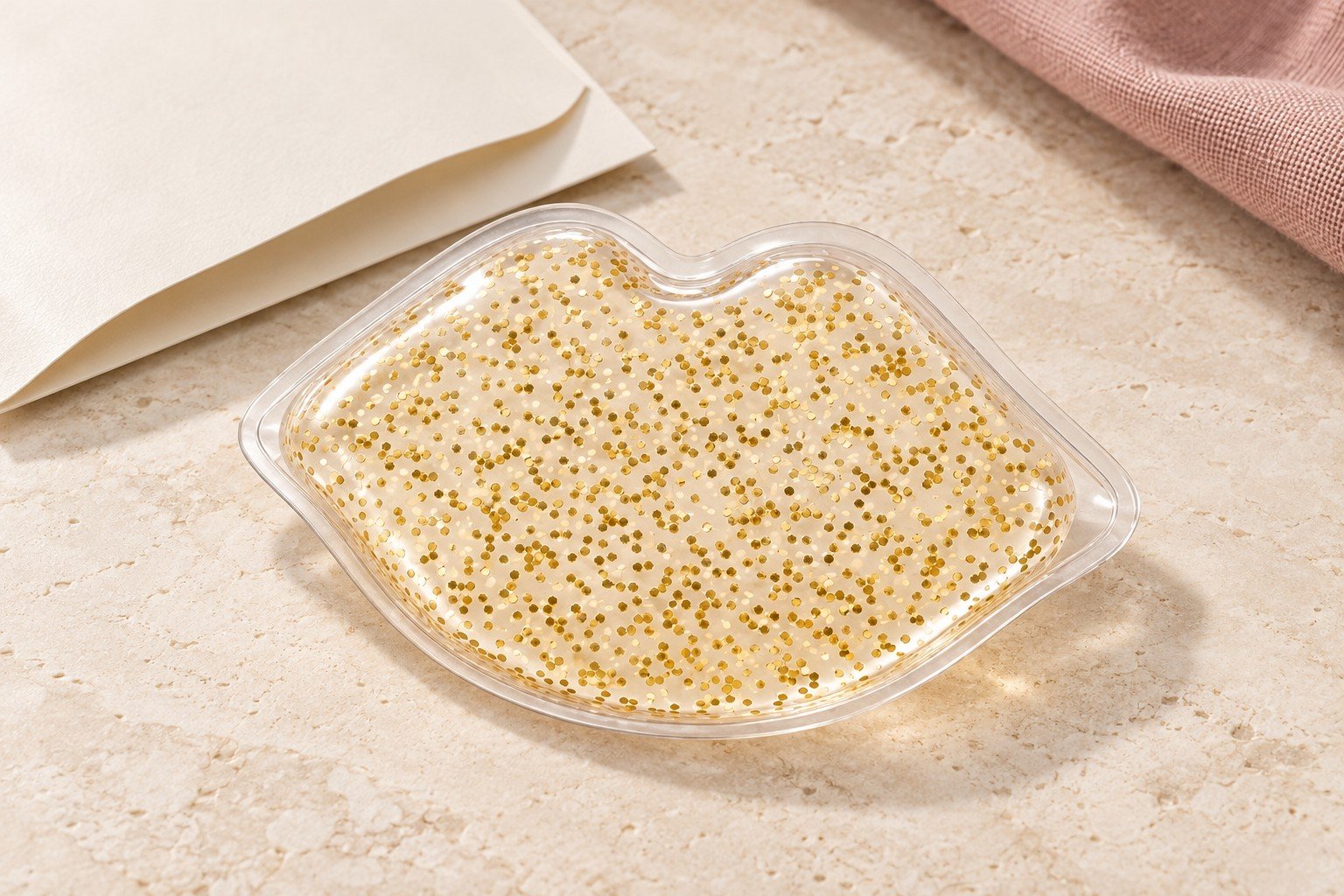
Cover image: AI-assisted editorial scene based on the catalog glitter lip pack. Props are illustrative; no body fit, treatment, or thermal performance is demonstrated.
When sourcing custom lip ice packs, approve the pouch outline, filled sample, printable area, and supplied components together. A lip silhouette does not define how much area is filled, where a logo will fit, or what one retail unit contains. Start with a specific model and intended channel, then make each customization decision against that sample.
For beauty brands, clinic groups, and distributors, this separates a recognizable branded accessory from a complete product specification. The guide below covers product and supplier decisions; it does not provide post-procedure treatment instructions.
On this page
Choose the starting product, not just a lip icon
Two packs described as lip-shaped may have different upper notches, pointed corners, lower curves, seal margins, and filled thicknesses. Ask for the proposed outline and dimensions before assuming that artwork for one model will transfer to another.
Record the overall envelope and the filled area separately. The outside width includes the sealed border; it is not automatically the usable area for contact or printing. On a curved outline, also identify the center and orientation so that the supplier and brand team review the same view.
A catalog picture is useful for identifying a candidate. It does not establish fit on every person or suitability for a particular procedure. If coverage is central to the brief, define the intended coverage and clearance with the appropriate professional input, then assess the actual sample.
Compare the visual construction before choosing a color
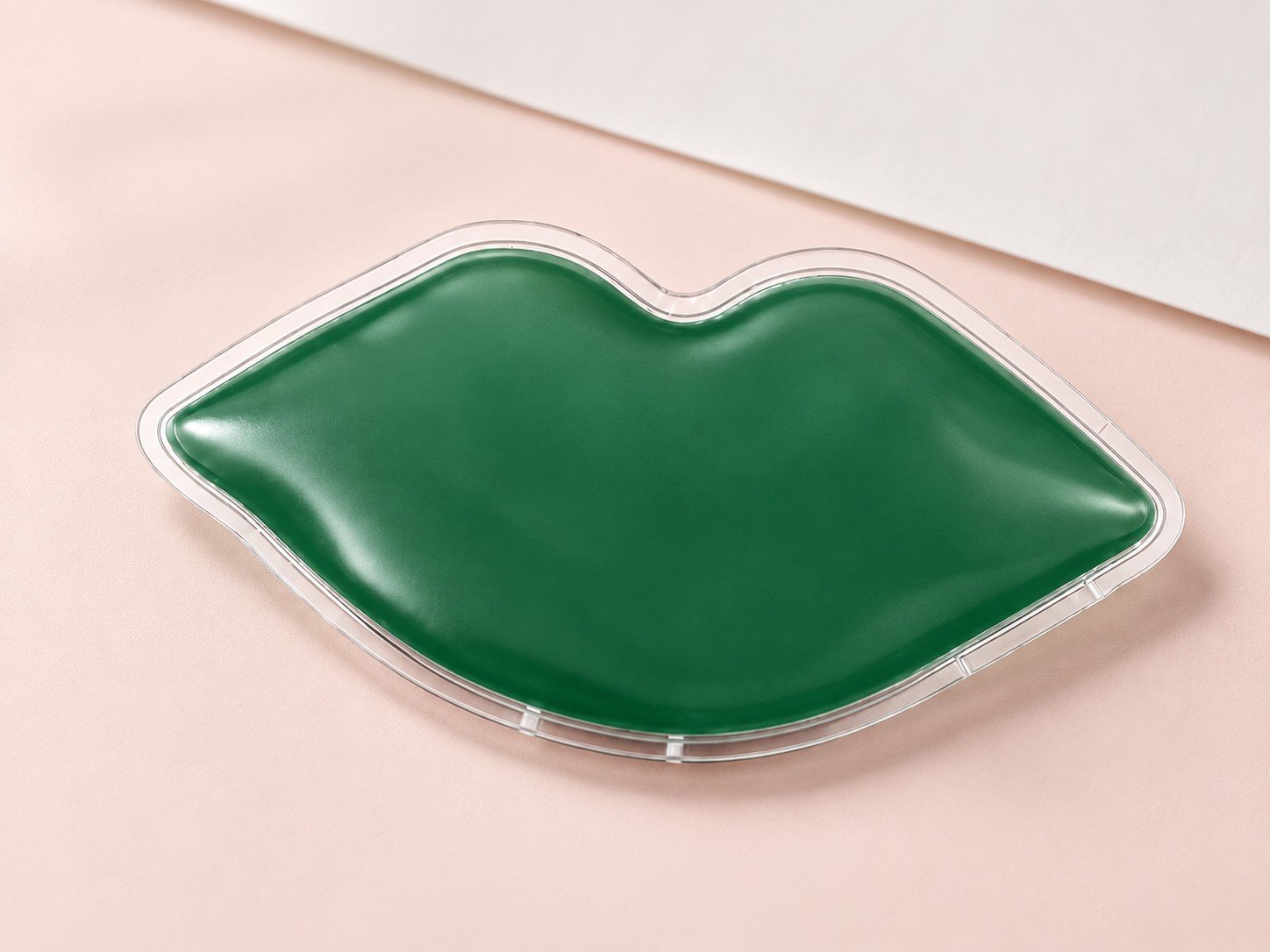
Cryozin’s catalog includes a clear glitter lip-shaped pack and a green lip-shaped gel pack. They provide different visual backgrounds for a brand mark. Their pictured appearance does not make them interchangeable configurations.
| Selection | What it changes in the brief | What to check on the chosen sample |
|---|---|---|
| Clear pouch with decorative particles | The filling becomes part of the visible design | Brand contrast, particle appearance, and the agreed filled sample |
| Colored gel background | The filling color sits behind the artwork | Actual color/print combination and legibility after the specified preparation |
| Separate cover or outer pouch, if requested | Another component changes handling and presentation | Fit, opening direction, supplied quantity, and its own care information |
Specify the selected fill and outer material independently from the appearance. Glitter, beads, and a continuous gel are not synonyms. Do not choose among them by assuming a fixed cooling duration from a photograph; request model-specific instructions and any relevant supporting evidence.

Define the printable zone inside the outline
Ask for a drawing that separates the outer edge, seal, filled body, and proposed imprint boundary. Then place the actual clinic or brand artwork within that boundary. Shrinking a logo until it fits an outer rectangle can leave important text crossing a curve or sitting too close to the seal.
Keep one clear priority: the brand name, a short website, or another essential identifier. If all three compete for a small panel, compare a simpler pack imprint with more information on the individual package. Review the finished layout at its actual size, with the selected filling behind it.
Promotional suppliers treat these as ordering details. AnyPromo’s named lip cold pack, for example, presents customization and sample options alongside quantity choices. That is a useful reminder to ask what the quoted configuration includes; its quantities, setup terms, and sample charges do not transfer to Cryozin.
Cryozin supports screen, offset, and digital printing subject to the project. Ask which method suits the selected material and artwork instead of choosing from a method name alone. The logo file guide covers file inputs; keep the lip-specific decision focused on the available panel and the filled sample.
Specify a single product and a finished kit separately
Write the component list in plain quantities: sealed packs, covers if included, individual outer packages, and instruction inserts. Then state how many complete retail units the order must produce. Do not use “one set” without defining its contents.
If the branded pack joins an existing beauty kit, give the supplier the available compartment or package dimensions. Review the filled product inside that actual space. A pack that fits when laid flat outside a box may require a different orientation once the other components are present.
Also separate individual packaging from hygiene claims. An outer bag is not evidence of sterility. For shared professional use, the relevant cleaning and handling instructions need to match the selected assembly; do not infer them from a sealed appearance. Use the private-label packaging guide for the broader packaging brief.
Keep intended use and brand copy aligned
Decide whether the project is a general beauty accessory, a promotional item, or a product marketed for a defined medical purpose. That decision affects the evidence and review the project needs. A supplier’s decorative options cannot settle it.
For the U.S., the FDA’s device-determination framework starts with whether the product meets the device definition and has an appropriate classification. Review the intended use and finished claims with qualified support where needed; a lip outline or clinic logo is not FDA approval.
The FTC’s health-products guidance also addresses implied messages. Before printing claims about swelling, bruising, pain, or recovery, establish support relevant to the specific product and message. Keep claims review separate from approval of color and logo placement.
Send a sample brief that can be compared
Use one record for each actual configuration. This is an editorial worksheet for purchasing, not a clinical protocol or an approved design.
| Sample brief | What to specify |
|---|---|
| Product identity | Existing SKU/reference or proposed new outline; drawing version |
| Geometry | Overall dimensions, seal border, filled area, and intended orientation |
| Construction | Selected outer material, fill, color, and any decorative particles |
| Branding | Exact artwork version, print side, usable zone, and essential readable text |
| Supplied unit | Number of packs, covers, outer packages, and inserts per unit |
| Instructions and claims | Target market, intended use, preparation/care information, and copy for review |
| Sample question | The specific difference to compare and who will approve it |
| Order basis | Quantity per product/configuration, destination, and minimum-order confirmation |
At Cryozin, an existing product sample is free, with freight paid by the customer. A newly developed product requires a tooling fee and can include two to three free samples; freight remains the customer’s responsibility. Confirm whether printed samples, revisions, or additional checks involve separate charges. A free sample is not a promise that every development activity is included.
For a new structure, a reference sample or clear material and construction information helps the initial assessment. Cryozin can discuss drawings, structure, and sampling from those inputs; manufacturing feasibility still depends on the actual design. The OEM development program explains the broader project route.
Questions before a bulk order
Can the existing lip outline carry our logo?
Submit the actual artwork and identify the selected model. Ask for a proposed print boundary and review the filled sample. The central area of one outline should not be assumed to match another supplier’s template.
What is the minimum order for a small lip pack?
Confirm it for the selected product, size, and configuration. Cryozin distinguishes regular small products from very small products, so a generic catalog minimum is not a final quotation for every lip-shaped pack. Clarify artwork versions and color quantities rather than assuming they can be pooled.
Can the same pack be sold individually and inside a kit?
That is a packaging proposal to review. Define the components, instructions, identification, and intended claims for each presentation; then confirm whether they use the same approved product configuration.
Begin with the lip ice pack catalog and shortlist the actual models. Prepare the outline reference, artwork, component count, quantity, and target market so the next discussion can resolve a specific product choice.
Send Cryozin your lip-pack sample brief
Sources and further reading
- FDA — How to Determine if Your Product is a Medical Device: U.S. intended-use and classification review.
- FTC — Health Products Compliance Guidance: support for express and implied health-related claims.
- AnyPromo — Kisses For You Lip Cold Pack: a named example of a configurable promotional SKU, not Cryozin commercial terms.
