

A useful pack-out trial does not ask only how many gel packs to place in a box. It tests one complete shipping system: the food, coolant, insulation, carton, packing pattern, starting temperatures, route exposure, transit time, sensors, and pass/fail limits. For B2B buyers sourcing gel packs for shipping food, that distinction matters. A pack that works in one payload or season may not work in another.
The goal is to define a repeatable configuration that keeps the product within the temperature limits established by the food business, its food-safety plan, and any applicable customer or regulatory requirements. This guide explains how to create that trial without turning a generic gel-pack specification into an unsupported shelf-life or temperature guarantee.
On this page
Gel packs for shipping food: the pack-out trial in one table
| Trial element | What to define | Why it changes the result |
|---|---|---|
| Food load | Product type, mass, geometry, packaging, initial temperature, and required range | The payload is part of the thermal mass and may have sensitive hot or cold spots |
| Coolant | Gel-pack model, dimensions, nominal fill mass, quantity, conditioning method, and placement | “One gel pack” is not a controlled unit unless its construction and starting state are known |
| Insulated shipper | Internal dimensions, wall construction, lid, joints, liners, and closure | Insulation, air gaps, and leakage paths affect heat transfer |
| Distribution lane | Origin, destination, service level, handoffs, dwell time, season, and delay allowance | Ambient exposure is rarely constant from pickup to delivery |
| Sensor plan | Logger model, calibration status, interval, locations, and identification | A single probe may miss the warmest or coldest product position |
| Acceptance rule | Permitted range, maximum excursion, duration, and disposition process | A graph cannot pass or fail a shipment until the decision rule is written |
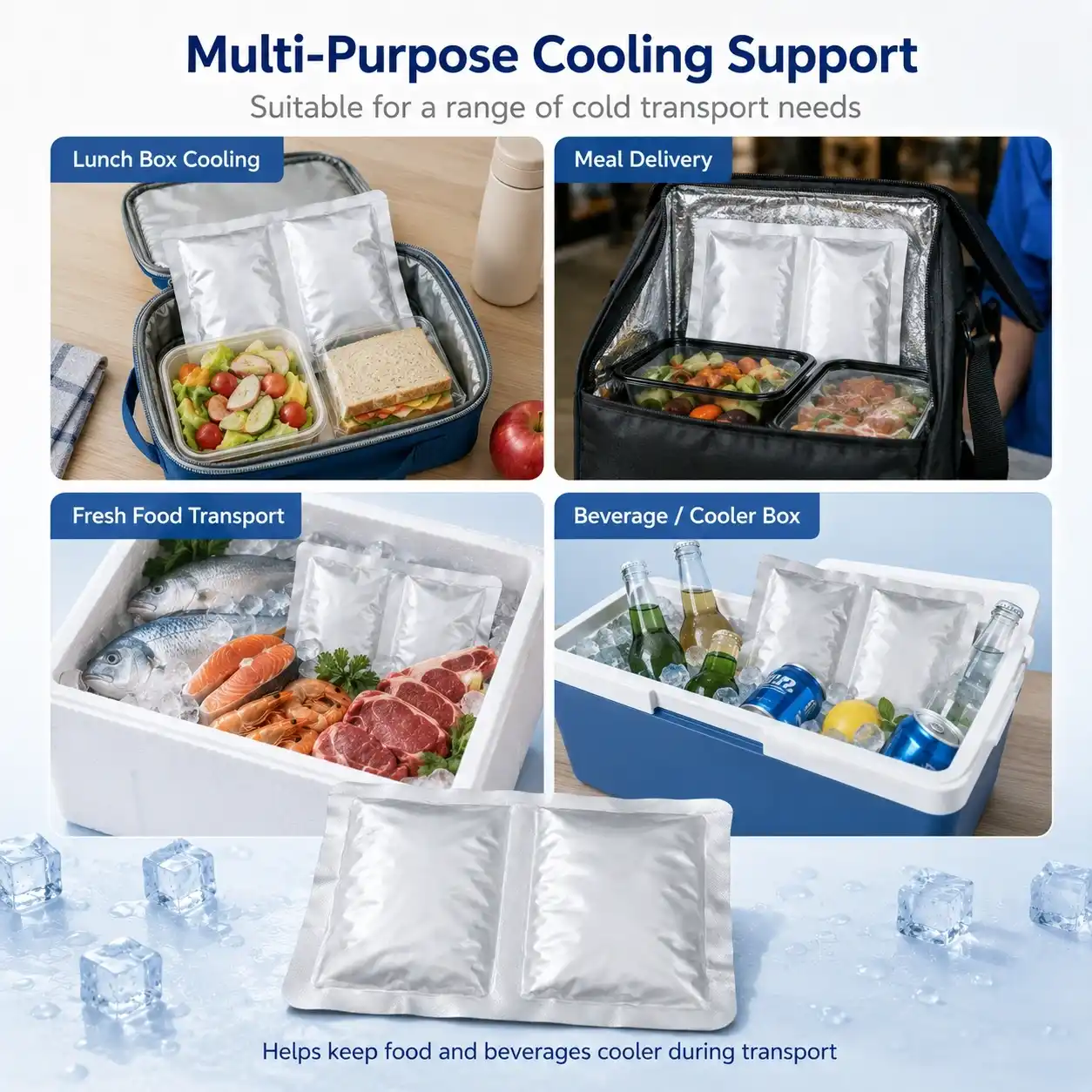
This article owns the trial method. Cryozin’s cold-packs-for-shipping solution page remains the commercial owner for pack-out requirements and quotation inputs. The food and foil cooling-pack category helps buyers compare available product formats, while the existing shipping and storage guide covers the logistics of finished ice-pack inventory.
1. Start with the product limit, not a gel-pack count
Write the acceptable condition for the shipped food before selecting coolant. “Keep cold” is not a test criterion. The product owner should define the required temperature range, the measurement basis, the allowed excursion—if any—and what happens when the limit is exceeded. Chilled, frozen, confectionery, meal-kit, seafood, produce, and diagnostic sample programs do not share one universal range.
In the United States, the FDA’s Sanitary Transportation rule assigns responsibilities among shippers, loaders, carriers, and receivers according to the operation and written agreements. FDA guidance explains that, where temperature control is needed for safety, equipment and practices must be adequate for the shipment and temperature conditions may need to be demonstrated with measurements or time-temperature data. The rule does not turn one generic gel-pack configuration into an approved solution for every food.
Capture these product inputs:
- Food name, formulation or SKU, and whether it ships chilled or frozen
- Primary package, secondary package, and case quantity
- Minimum, typical, and maximum payload mass
- Temperature at packing and the permitted range during distribution
- Any limit on direct contact between the coolant and product package
- Quality, safety, labeling, traceability, and delivery-acceptance requirements
USDA’s mail-order food guidance recommends a cold source such as frozen gel packs or dry ice for perishable foods, but commercial buyers still need a validated pack-out for their actual product and lane. Dry ice also has handling and carrier requirements that are outside the scope of a gel-pack trial.
2. Freeze the variables before freezing the packs
The coolant needs an identification system. Record the supplier, item number, dimensions, nominal fill mass, shell construction, chamber pattern, lot, and condition. If two candidate packs differ in mass and geometry, a performance difference cannot be attributed to material alone.
Then define conditioning:
- Freezer or cold-room equipment and set point
- Minimum conditioning time and the chosen end-point check
- Pack orientation, spacing, stack height, and maximum load per shelf
- Time allowed between removal from storage and final carton closure
- Starting temperature or physical-state check before packing
- Procedure for damaged, partly conditioned, or unidentified packs
Cryozin’s article on gel ice-pack freezing time explains why freezer conditions, geometry, stacking, and the selected end point should be recorded. The separate cooling-duration guide covers the variables that affect performance after the conditioned pack enters a shipment.
3. Build a representative food load and pack pattern
A useful test uses the intended shipper and a representative payload. If the product is unavailable during early development, a qualified thermal surrogate may help compare concepts, but it should be documented and justified. It should not silently become proof for the commercial food.
Photograph and diagram the pack-out from several views. Record:
- The orientation and count of every food unit.
- The location and orientation of every gel pack.
- Separators, absorbent material, void fill, liners, bags, and dividers.
- Clearances between the load and each wall, lid, and coolant surface.
- The sequence of loading and time from first placement to carton closure.
- Tape pattern, straps, labels, and any tamper-evident closure.
- Gross weight and external dimensions of the closed shipment.
Test minimum and maximum commercial payloads when both will be sold. A nearly empty box can contain more air and a different coolant-to-product ratio; a full box can restrict placement and create different thermal paths. Do not assume the “worst case” without evidence.
4. Use a sensor map, not one convenient probe
Place data loggers where the trial could reasonably fail: near the lid, corners, wall interfaces, center of the load, and positions farthest from or closest to coolant. The exact number depends on the shipper, payload geometry, risk, and study purpose. Give every sensor a unique ID and show its position in the pack-out record.
Document logger range, accuracy, resolution, calibration status, sampling interval, start time, time zone, and download procedure. The sampling interval should be short enough to detect meaningful excursions without exhausting memory. A logger resting against a frozen pack measures a different condition from one representing the food surface or product core.

Before the run, create a blank data sheet covering pack-out ID, materials and lots, preparation times, starting temperatures, logger IDs and positions, chamber or lane profile, observations, deviations, raw-file name, calculations, reviewer, and disposition.
5. Challenge the package with a relevant exposure profile
A constant room-temperature bench test can be useful for screening, but it does not reproduce pickup, terminal dwell, vehicle loading, doorstep exposure, or seasonal variation. Build the challenge from actual lane data when available: carrier history, logger records, facility dwell times, route duration, and realistic delay scenarios.
ISTA describes its 7E profiles as development tools based on measured parcel environments. ISTA also cautions that the profiles are general simulations, are not automatically the worst case for every lane, and do not by themselves evaluate shock, vibration, or compression. Buyers using an ISTA method should obtain the current procedure and apply it within the intended scope rather than quoting “ISTA tested” without the exact standard, version, configuration, and result.
A practical development matrix may compare:
| Variable | Example levels | Reason to test |
|---|---|---|
| Season or ambient profile | Hot, moderate, cold, or lane-specific | External heat flow and risk of overcooling can change |
| Transit duration | Planned service plus a justified delay | Late delivery is a common business risk |
| Payload | Minimum and maximum commercial loads | Thermal mass and void volume differ |
| Gel-pack configuration | Count, mass, geometry, and placement | Identifies a configuration with adequate margin |
| Shipper construction | Candidate box, liner, insulation, or closure | Compares the complete package system |
| Starting condition | Defined upper and lower packing limits | Shows sensitivity to packing-process variation |
Screening comparisons can reduce the number of final configurations. The final test should use the approved materials, food load or justified equivalent, pack-out, sensor plan, exposure, duration, and acceptance criteria.
6. Write the acceptance criteria before looking at the graph
A trial plan should state which measurements are decisive and how excursions are evaluated. Depending on the program, the decision may involve every sensor, defined product locations, time above or below a limit, arrival condition, physical integrity, condensation, label condition, or leakage. The rule should come from the product’s requirements and quality system—not from whichever curve looks most favorable after the test.
Also define invalid-run conditions: logger failure, incorrect sensor placement, unplanned chamber interruption, wrong payload, incomplete conditioning, damaged shipper, or undocumented deviation. Retesting a failed or invalid run is reasonable only when the cause and corrective action are recorded.
7. Diagnose a failure before adding more coolant
More gel is not always the right correction. It can increase freight weight, reduce payload space, create localized overcooling, or hide a weak insulation or process issue. Use the temperature curves, sensor map, photographs, and observations to identify the likely mechanism.
- Warm near the lid: review lid fit, closure, top insulation, and upper coolant placement.
- Warm at one corner: inspect joints, gaps, damage, and pack-out consistency.
- Warm everywhere too early: review total thermal mass, starting temperatures, exposure duration, and insulation.
- Cold damage near a pack: evaluate separation, coolant starting state, placement, and the product’s lower limit.
- Large repeat-to-repeat variation: tighten conditioning, loading time, pack orientation, material identification, and operator instructions.
Change one controlled variable at a time when possible. Otherwise, a successful rerun may not show which modification created the improvement.
8. Convert the successful trial into controlled documents
The output is more than a temperature chart. Release a pack-out instruction with revision control, component IDs, photographs or diagrams, gel-pack conditioning, food starting condition, loading order, sensor instructions for monitored shipments, carton closure, labels, and deviation handling. Connect the approved version to purchasing, packing, training, and change control.

Reassess the configuration when the food, payload, gel pack, supplier, insulation, carton, service level, lane, season, or acceptance limit changes. A supplier substitution that looks dimensionally similar can still alter fill mass, conditioning behavior, fit, or placement.
What to send a gel-pack supplier for a useful sample
- Food and market in scope, without disclosing unnecessary proprietary details
- Required temperature range and planned maximum transit duration
- Shipper internal dimensions, insulation construction, and closure
- Minimum and maximum payload, unit dimensions, and starting condition
- Preferred gel-pack size, shape, fill mass, chambering, and quantity—or permission to propose
- Expected conditioning equipment and packing workflow
- Target lane, season, service level, and delay allowance
- Required documents, lot identification, labels, and change-control expectations
- Trial protocol, sensor plan, acceptance criteria, and sample quantity
- Commercial quantity, packaging, delivery destination, and requested Incoterm
For most Cryozin product programs, the currently confirmed standard MOQ is 500 pieces. Current baseline timing is 1–3 business days for renderings, 3–7 business days for samples, and 18–25 business days for standard production. Custom production can take longer and is confirmed by project. These periods are not a shipment lead time, and their start event must be defined in the quotation or schedule.
Frequently asked questions
How many gel packs are needed to ship food?
There is no reliable universal count. The answer depends on the food load, required range, starting temperatures, gel-pack mass and geometry, insulation, pack pattern, ambient profile, duration, and acceptance rule. Use a controlled trial rather than a carton-size shortcut.
Should the gel packs touch the food?
That depends on the food package, lower temperature limit, gel-pack surface, condensation control, and approved pack-out. Direct contact can create cold spots. Define separators and placement in the trial instead of assuming contact is always helpful.
Does an ISTA profile certify the food shipment?
No. A named ISTA profile or procedure has a specific scope. The test configuration, laboratory process, version, results, certification status, and product requirements all matter. ISTA 7E is a thermal-development profile set and does not automatically represent every lane or every distribution hazard.
Can a bench test replace a live shipment?
A bench or chamber test can compare configurations under controlled conditions. A live-lane study can reveal operational variation. The appropriate evidence plan depends on risk; many programs use controlled development followed by monitored distribution confirmation.
Turn the trial into a supplier-ready pack-out brief
A strong inquiry gives the supplier enough information to propose a defined gel-pack configuration, while the buyer retains ownership of the food limit, lane, trial, and release decision. Use Cryozin’s custom ice-pack specification template to organize the product fields and the quality-control framework to connect approved samples with production records.
To discuss a food-shipping project, send Cryozin the shipper, payload, lane, target range, transit time, gel-pack concept, sample quantity, and trial plan. Final performance, materials, documents, and commercial terms remain subject to the approved configuration and written confirmation.
Sources and further reading
- U.S. Food and Drug Administration: FSMA Frequently Asked Questions, including Sanitary Transportation
- Electronic Code of Federal Regulations: 21 CFR 1.908, Sanitary Transportation Operations
- International Safe Transit Association: Test Procedures, including 7D and 7E thermal development tests
- International Safe Transit Association: Standard 7E Overview and Scope Notes
- USDA Food Safety and Inspection Service: Mail Order Food Safety
