

CE requirements for custom ice packs depend on the finished product, its intended purpose, its claims, and the European legislation that applies to that exact configuration. A reusable gel pack is not automatically a CE-marked product simply because it will be sold in Europe. CE marking is mandatory only for product categories covered by applicable EU harmonisation rules, and it is prohibited where no such rule requires it.
For a B2B buyer, the practical task is to decide the regulatory route before artwork and packaging are approved. This guide explains the questions a brand, importer, distributor, or procurement team should close with its regulatory adviser and manufacturing partner. It is general procurement information, not legal advice or a statement that every Cryozin product follows the same route.
On this page
Start with the short answer: not every ice pack needs CE marking
The European Commission’s CE-marking guidance states that CE marking is required only for products covered by specific EU rules and must not be placed on other products. It also explains that the mark is a manufacturer’s declaration of conformity, not an approval by the EU. That distinction prevents two common sourcing errors: asking for a “CE certificate” before defining the product, or adding the CE symbol to artwork because a similar-looking item carries one.
Begin with three questions:
- What is the finished product? Record the pouch, filling, cover, straps, heating or cooling method, packaging, and any accessory supplied with it.
- What does the manufacturer say it is for? The intended purpose is shaped by labels, instructions, promotional copy, and sales materials—not only by the internal design brief.
- Which EU legislation, if any, covers that intended purpose and configuration? A qualified reviewer should document the answer and the evidence behind it.
Use intended purpose to separate the main regulatory routes
Under the EU Medical Device Regulation (MDR), “intended purpose” is the use stated by the manufacturer in labeling, instructions, promotional or sales materials, and the clinical evaluation. Two physically similar cold packs can therefore have different regulatory obligations if their claims and intended users differ.
| Product positioning | Buyer’s first question | Evidence to request |
|---|---|---|
| General cooling or lifestyle product without a medical purpose | Which EU product-safety, chemical, labeling, packaging, or market-specific rules apply, and is CE marking actually required? | Written applicability review, material/chemical information, warnings, traceability plan, and market-language labeling |
| Product presented for a medical purpose | Does it meet the MDR definition of a medical device, and what classification and conformity route apply? | Intended-purpose statement, qualification/classification rationale, technical documentation plan, and applicable conformity records |
| Pack combined with another device, powered system, or regulated kit | Is the pack a device, accessory, component, or part of a system/procedure pack? | System architecture, responsibility map, compatibility evidence, and product-specific regulatory assessment |
This table is a scoping tool, not a classification decision. Borderline cases and national enforcement questions need professional review. The European Commission maintains a current Medical Device Coordination Group guidance index, including material on borderline and classification questions.
Do not treat “CE” as one document
A buyer should be able to connect each document to the exact product, model, intended purpose, and legal route. A generic test report, ISO certificate, factory audit, SDS, Declaration of Conformity, and notified-body certificate serve different purposes. One cannot be substituted for another.
For a product that legitimately requires CE marking, the evidence package may include a documented conformity assessment, applicable technical documentation, labeling and instructions, a Declaration of Conformity, and—when the route requires it—notified-body involvement. The precise package depends on the applicable legislation and classification. The CE symbol alone does not prove that those records exist or cover the buyer’s branded version.

Private-label artwork can change the evidence question
Private-label projects often change the trade name, responsible economic operator, claims, instructions, languages, package hierarchy, or sales channel. Buyers should not assume that an unbranded sample’s documents automatically cover the finished branded product. Before approving artwork, identify who is the legal manufacturer, who will import or distribute the product, which name and address appear on the label, and who controls post-market and complaint responsibilities.
Keep promotional claims inside the approved intended-purpose boundary. A design team should not add treatment, recovery, safety, duration, or performance claims simply because they appear on a competitor’s page. Under the MDR, the intended purpose is reflected in labeling and promotional materials; an unsupported marketing claim can therefore create more than an SEO or copywriting problem.
Use the custom ice pack artwork approval process to keep the regulatory copy, instructions, logo, and production proof under one revision. The private-label barcode and labeling guide covers identifier handoff, but identifiers do not replace a conformity assessment.
Build a buyer-ready CE and market-access review
1. Freeze the product configuration
List every supplied component: gel pouch, textile cover, strap, fastener, printed label, instruction leaflet, retail carton, and any heating or cooling accessory. Record the exact materials, dimensions, fill, preparation method, and target user. A statement about a bare gel pouch may not cover a finished wrap kit.
2. Write the intended purpose before the claims
Define what the product is intended to do, who uses it, where it is used, and whether it is marketed for a medical purpose. Align the brief, label, instructions, website copy, and distributor materials. If the claim set changes, ask the regulatory reviewer whether qualification, classification, testing, or documentation must change too.
3. Document the legal applicability decision
Ask the responsible party to identify the applicable EU legislation and explain whether CE marking is required. For an MDR route, retain the qualification and classification rationale. For a non-CE route, retain the basis for not applying the mark and the separate rules that still govern safety, chemicals, labeling, packaging, language, or traceability.
4. Map each claim to evidence
Create a claim table with the statement, product/version, test or source, acceptance criterion, owner, and artwork location. Remove or narrow claims that lack applicable evidence. A material declaration supports composition; it does not by itself prove clinical benefit, shelf life, cooling duration, or complete-product safety.
5. Release one controlled branded version
Link the approved specification, sample ID, artwork revision, instructions, document set, and responsible economic operators. Record which changes trigger a new review. This is especially important when different EU markets require different language versions or when one design is sold under several private labels.
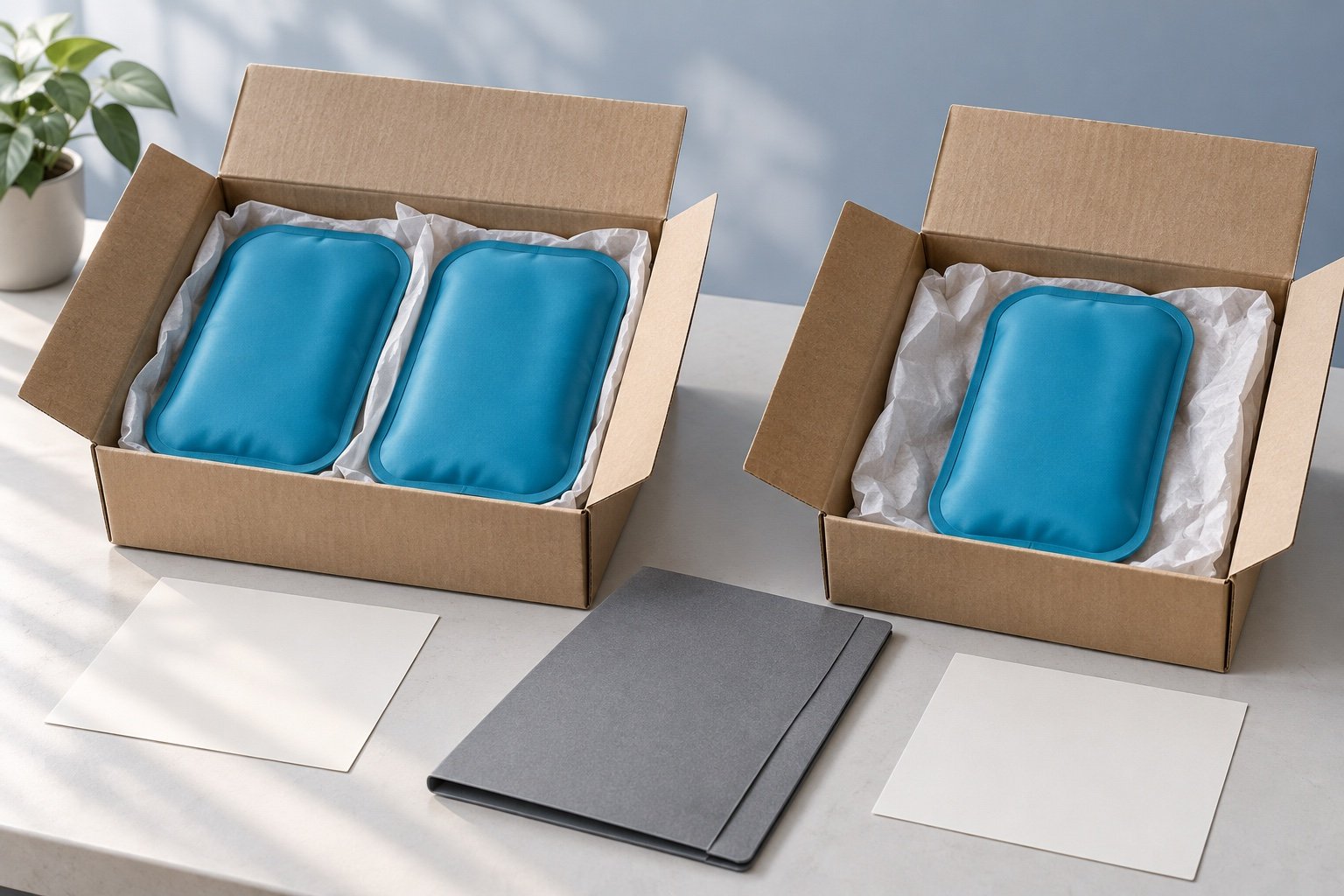
What should a buyer request from a supplier?
- Exact product name, model, configuration, intended purpose, and target markets.
- Material and fill specifications tied to the approved sample.
- Written qualification/classification or applicability rationale from the responsible regulatory party.
- Applicable test reports with product identity, method, date, laboratory, and limitations.
- Draft label, instructions, warnings, economic-operator details, and required language plan.
- Declaration of Conformity and notified-body evidence only when applicable to the final product and route.
- Revision control, complaint/traceability responsibilities, and change-notification rules.
Hold artwork approval when the product identity differs across documents, the intended purpose is inconsistent, a CE symbol appears without a documented legal basis, or the branded version is not covered by the cited evidence.
Frequently asked questions
Do all reusable gel ice packs sold in Europe need a CE mark?
No. CE marking applies only when specific EU legislation requires it for the product. The finished configuration and intended purpose must be assessed before the mark is used.
Is a CE mark the same as EU approval?
No. The European Commission describes it as the manufacturer’s declaration that the product meets applicable requirements. It does not indicate EU approval, origin, or a universal level of quality.
Can a supplier’s ISO 13485 certificate replace product CE documentation?
No. A quality-management-system certificate and product conformity evidence answer different questions. Verify scope, issuer, product applicability, and the exact conformity route.
Does changing the logo require a new regulatory review?
A logo-only change may be limited, but a private-label project can also change the responsible party, claims, instructions, identifiers, or languages. Review the complete branded artwork and responsibility map before deciding what must be updated.
Plan the regulatory route before requesting a quote
Give suppliers a stable configuration, intended purpose, claim boundary, target EU markets, and document list. Cryozin can review the manufacturing brief for custom ice packs and OEM/private-label programs, but regulatory status and evidence must be confirmed for the exact product and market. For a project review, send the intended use, configuration, artwork stage, target countries, and required documentation.
Sources and further reading
- European Commission — CE marking (when CE marking applies and what it does not mean).
- EUR-Lex — Regulation (EU) 2017/745 on medical devices (scope, intended purpose, conformity, labeling, and classification framework).
- European Commission — MDCG guidance and other medical-device guidance (current official guidance index).
Scene images are editorial concepts based on catalog references, not evidence of a factory, customer project, test or approved configuration. Catalog images illustrate visible product form only.
